
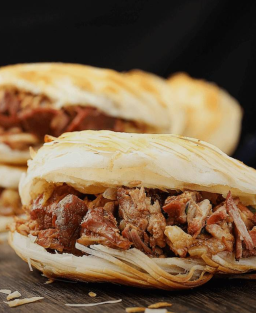
肉夹馍 – Iconic Sandwich of Shaanxi
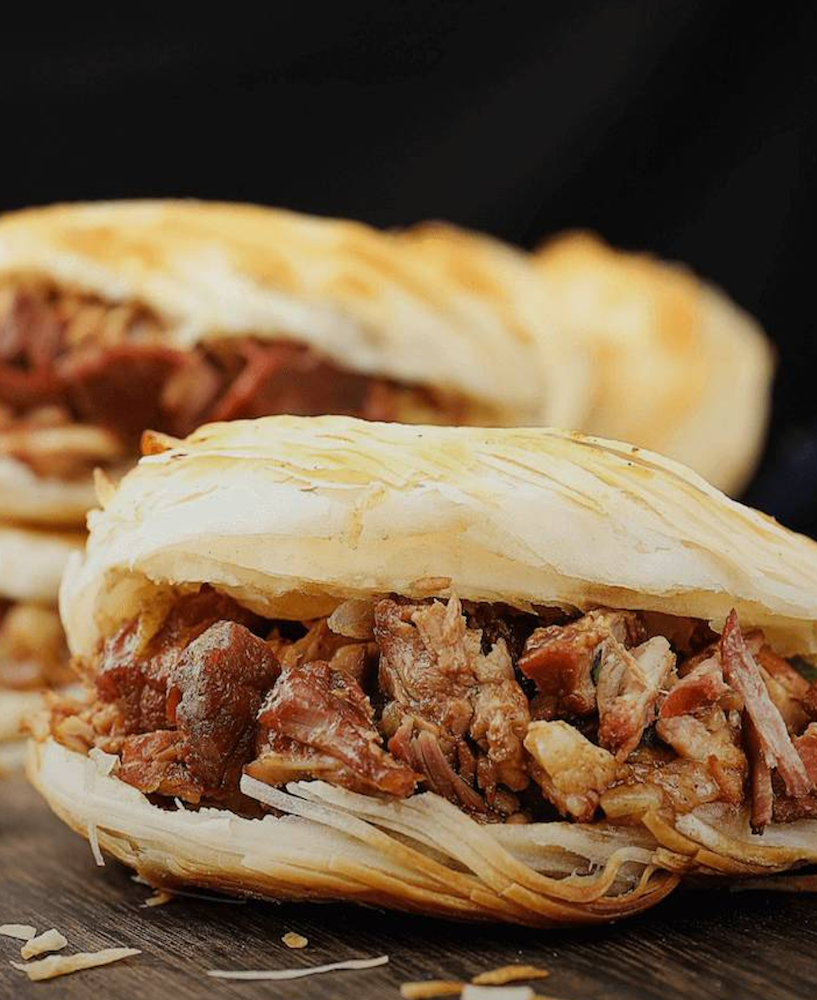
With its crispy mo flatbread, pork slowly braised in an aromatic lǔ sauce, and ancient spices, roujiamo is one of the most emblematic dishes of northwestern China. Often presented as one of the world’s oldest “sandwiches,” it embodies popular cuisine, imperial history, and Chinese street-food culture all at once.
Roujiamo is known by several names, reflecting its regional, cultural, and linguistic diversity.
Literally means “meat inserted into bread.” This is the modern, official name used throughout China. The reversed word order (meat + bread) is a linguistic feature characteristic of Shaanxi.
Refers to the canonical Xi’an version: pork slowly braised in a dark, richly spiced sauce (làzhī), then stuffed into mo bread.
Prepared with beef or lamb in Hui Muslim neighborhoods. Seasoning often emphasizes cumin, coriander, and chili.
Xi’an roujiamo (西安肉夹馍): finely chopped meat, dense bread
Tongguan roujiamo (潼关肉夹馍): very flaky and crispy bread, meat cut into chunks
In everyday Shaanxi speech, people often simply say jiāmó (夹馍) when the filling is obvious.
Roujiamo was born from the meeting of two very ancient traditions:
Braised meat, documented as early as the Zhou dynasty, well suited to soldiers and travelers due to its high energy value and keeping quality.
Mo flatbread, a wheat bread that appeared during the Qin dynasty, likely influenced by Central Asia.
Xi’an (ancient Chang’an), a major crossroads of the Silk Road, played a central role in spreading this combination. The modern form of roujiamo stabilized between the Ming and Qing dynasties, becoming an essential street food.
Chinese proverb: 民以食为天
“The people regard food as heaven.”
Xi’an: very finely shredded meat, melting texture, well-bound sauce
Tongguan: flaky, crispy bread, chunkier meat, rustic character
Yan’an: drier, thicker bread, hearty peasant cuisine
Beef or lamb, cumin, coriander, chili
Found in Xi’an, Lanzhou, Yinchuan
These versions use the name roujiamo without claiming Shaanxi authenticity, but they contribute to its nationwide spread.
Type: Street food / hot sandwich
Servings: 4–6
Level: Advanced
Total time: 20 min + 3–4 h cooking + 12 h resting
Pork shoulder or belly (with fat and skin): 900 g
Fresh ginger: 30 g
Garlic: 4 cloves
Fermented broad bean paste (fènsiǎnjiàng): 1 tbsp
Star anise: 2
Cassia cinnamon: 1 stick
Cloves: 3
Fennel seeds: 1 tsp
Sichuan peppercorns: 1 tsp
Bay leaves: 2–3
Light soy sauce: 2 tbsp
Dark soy sauce: 2 tbsp
Shaoxing wine: 3 tbsp
Brown sugar: 2 tbsp
Water: 800–1000 ml
Salt: to taste
Blanch the pork for 3 minutes, rinse under cold water, and pat dry thoroughly.
Melt the sugar dry until it reaches an amber caramel. Add ginger, garlic, spices, and fermented paste. Add the pork and coat well.
Deglaze with the wine and soy sauces. Cover with water, bring to a boil, then simmer gently for 3½–4 hours, until the meat shreds easily.
Xi’an: shred very finely and mix with a little sauce
Tongguan: cut into 1 cm chunks and lightly spoon over sauce
Let rest for 12 hours in the sauce in the refrigerator.
Split a warm mo bread without cutting through the bottom. Fill with 100–120 g of meat, drizzle with a little hot broth, and serve immediately.
Never remove the fat: it moistens the bread and carries the aromas
The lǔ sauce keeps well and improves with time
Roujiamo is eaten on its own, by hand, without side dishes
Approximately 450 kcal
Mo (馍): wheat flatbread
Lǔ zhī (卤汁): braising sauce
Wǔxiāng (五香): traditional five-spice blend
肉夹馍 – Iconic Sandwich of Shaanxi
With its crispy mo flatbread, pork slowly braised in an aromatic lǔ sauce, and ancient spices, roujiamo is one of the most emblematic dishes of northwestern China. Often presented as one of the world’s oldest “sandwiches,” it embodies popular cuisine, imperial history, and Chinese street-food culture all at once.
Roujiamo is known by several names, reflecting its regional, cultural, and linguistic diversity.
Literally means “meat inserted into bread.” This is the modern, official name used throughout China. The reversed word order (meat + bread) is a linguistic feature characteristic of Shaanxi.
Refers to the canonical Xi’an version: pork slowly braised in a dark, richly spiced sauce (làzhī), then stuffed into mo bread.
Prepared with beef or lamb in Hui Muslim neighborhoods. Seasoning often emphasizes cumin, coriander, and chili.
Xi’an roujiamo (西安肉夹馍): finely chopped meat, dense bread
Tongguan roujiamo (潼关肉夹馍): very flaky and crispy bread, meat cut into chunks
In everyday Shaanxi speech, people often simply say jiāmó (夹馍) when the filling is obvious.
Roujiamo was born from the meeting of two very ancient traditions:
Braised meat, documented as early as the Zhou dynasty, well suited to soldiers and travelers due to its high energy value and keeping quality.
Mo flatbread, a wheat bread that appeared during the Qin dynasty, likely influenced by Central Asia.
Xi’an (ancient Chang’an), a major crossroads of the Silk Road, played a central role in spreading this combination. The modern form of roujiamo stabilized between the Ming and Qing dynasties, becoming an essential street food.
Chinese proverb: 民以食为天
“The people regard food as heaven.”
Xi’an: very finely shredded meat, melting texture, well-bound sauce
Tongguan: flaky, crispy bread, chunkier meat, rustic character
Yan’an: drier, thicker bread, hearty peasant cuisine
Beef or lamb, cumin, coriander, chili
Found in Xi’an, Lanzhou, Yinchuan
These versions use the name roujiamo without claiming Shaanxi authenticity, but they contribute to its nationwide spread.
Type: Street food / hot sandwich
Servings: 4–6
Level: Advanced
Total time: 20 min + 3–4 h cooking + 12 h resting
Pork shoulder or belly (with fat and skin): 900 g
Fresh ginger: 30 g
Garlic: 4 cloves
Fermented broad bean paste (fènsiǎnjiàng): 1 tbsp
Star anise: 2
Cassia cinnamon: 1 stick
Cloves: 3
Fennel seeds: 1 tsp
Sichuan peppercorns: 1 tsp
Bay leaves: 2–3
Light soy sauce: 2 tbsp
Dark soy sauce: 2 tbsp
Shaoxing wine: 3 tbsp
Brown sugar: 2 tbsp
Water: 800–1000 ml
Salt: to taste
Blanch the pork for 3 minutes, rinse under cold water, and pat dry thoroughly.
Melt the sugar dry until it reaches an amber caramel. Add ginger, garlic, spices, and fermented paste. Add the pork and coat well.
Deglaze with the wine and soy sauces. Cover with water, bring to a boil, then simmer gently for 3½–4 hours, until the meat shreds easily.
Xi’an: shred very finely and mix with a little sauce
Tongguan: cut into 1 cm chunks and lightly spoon over sauce
Let rest for 12 hours in the sauce in the refrigerator.
Split a warm mo bread without cutting through the bottom. Fill with 100–120 g of meat, drizzle with a little hot broth, and serve immediately.
Never remove the fat: it moistens the bread and carries the aromas
The lǔ sauce keeps well and improves with time
Roujiamo is eaten on its own, by hand, without side dishes
Approximately 450 kcal
Mo (馍): wheat flatbread
Lǔ zhī (卤汁): braising sauce
Wǔxiāng (五香): traditional five-spice blend