
Traditional Recipe of Cul de Veau à l’Angevine
Other name: Braised Cul de Veau à l’Angevine
Discover the traditional recipe of Cul de Veau à l’Angevine – an iconic dish from the Anjou region, combining the nobility of veal, the finesse of Anjou white wine, and the slow braising process that produces tender, flavorful meat.
Rural wisdom
"Never rush the veal, nor the fire: the longer we take, the greater the taste."
"In Anjou, neither wine nor veal is hurried: patience brings the flavor."
These proverbs from the Anjou countryside reflect a lifestyle rooted in gentleness and moderation. The elders often reminded that patience is the key to allowing ingredients to express themselves fully.
In the farms of the Saumurois, veal was often slaughtered in spring and reserved for festive meals. It was slowly cooked “over low heat” in a cast-iron pot, while the white wine reduced gently, infusing the meat with subtle flavors.
In the 17th and 18th centuries in Anjou, the word “cul” could shock or seem too familiar, especially among bourgeois or aristocratic circles.
Cul de veau refers to the whole veal rump, a noble, tender, and flavorful cut. Yet the name often elicited smiles. In slightly prim families or bourgeois salons, people would never dare pronounce it aloud, instead politely asking their butcher for:
“a veal indecency”
or
“rear cut.”
This euphemism, both playful and prudent, reflected respect for social conventions while leaving a touch of gastronomic humor. Historical records abound with such expressions: an elegant way to refer to a cut that might otherwise provoke embarrassment or laughter.
The people of Anjou had sayings to emphasize the importance of gentle cooking:
"Low heat makes meat tender as an angel’s heart."
This careful, slow approach has become a symbol of Anjou gastronomy: no rush, no excess, just balance and subtlety of flavors.
Around 1738, under the reign of Louis XV, the court of Anjou enjoyed a quiet prosperity. Vineyards produced white wines renowned at Versailles, and the Anjou bourgeoisie cultivated a measured, refined way of life.
The Duke of Anjou stopped at the inn of the Cheval Blanc. Tired from travel and heavy meals, he requested a light, tender meat.
Guillaume Berthelot, a chef from Montreuil-Bellay, had the idea of braising a cul de veau with Anjou white wine, shallots, fresh butter, and garden herbs. The cooking lasted nearly three hours in a sealed pot.
The Duke exclaimed:
"By my faith, here is a dish that smells of the Loire and the patience of the Angevins!"
The recipe was recorded in his personal book under the name “Cul de Veau à l’Angevine” and appears in a culinary manuscript in Angers in 1772.
"Where the cul de veau simmers, happiness stays in the house."
Country: France
Region: Anjou (Maine-et-Loire, Pays de la Loire)
Transmission: Oral tradition, bourgeois recipe codified in the 19th century
Cul de Veau à l’Angevine belongs to the great bourgeois culinary tradition of the Loire Valley, where a mild climate and agricultural wealth favor elegant and generous cuisine.
18th century: Noble tables in Angers and Saumur, long-simmered white meat dishes with local wines
19th century: Recipe codified in bourgeois cookbooks
20th century: Tradition continued in Loire Valley inns, adapted for modern ovens
Today: Iconic dish for Sunday meals, banquets, and regional culinary demonstrations
Marc Guibert (Angers): Modernizes the sauce with sweet wine and glazed vegetables
Jean Bardet (Tours): Highlights slow braising and mushroom glazing
Jean-Pierre Coffe: Advocates a return to farm produce and authentic dry white wine
Pascal Favre d’Anne (Angers): Contemporary version with brown butter and reduced jus
Auberge Saint-Pierre (Saumur): Traditional version with mushrooms and lardons
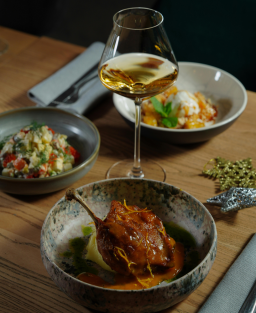
La Table de la Bergerie (Champ-sur-Layon): Gastronomic interpretation with Jerusalem artichoke purée
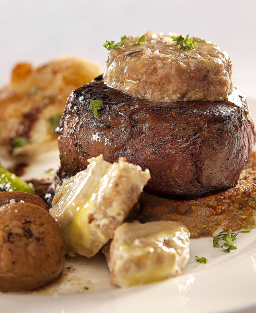
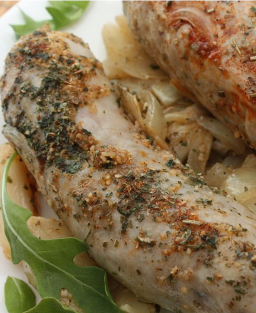
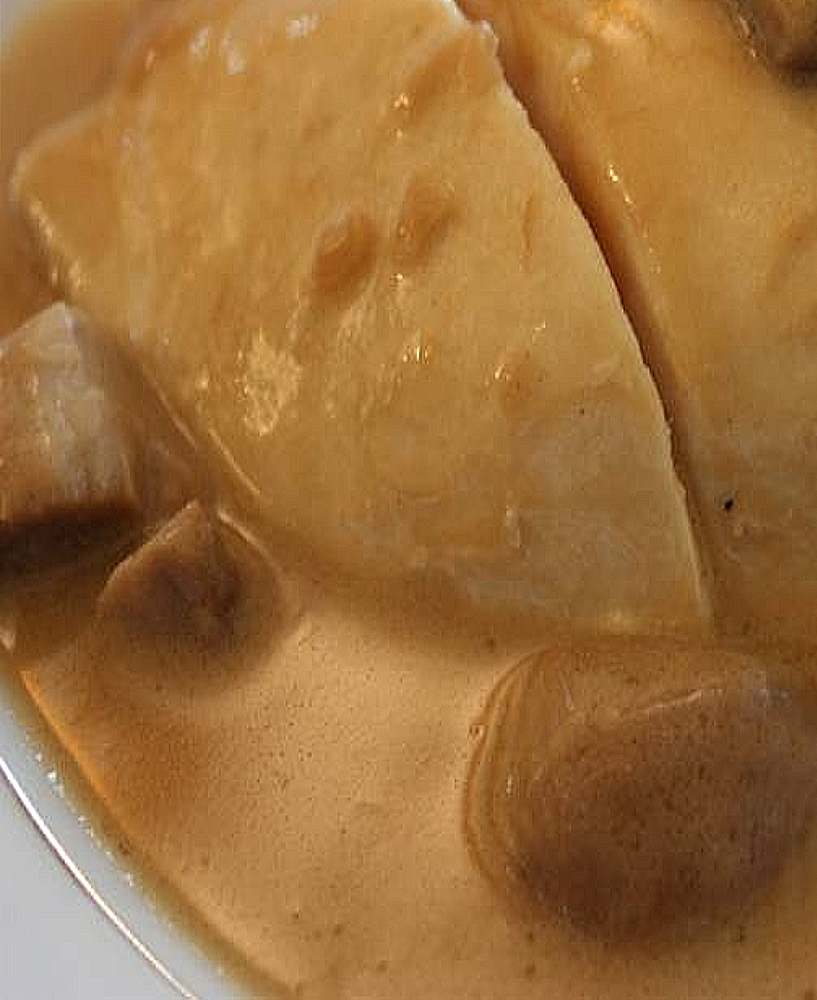
Appearance: Golden meat, coated with amber-blond sauce
Texture: Tender and melt-in-the-mouth
Dominant aromas: White wine, butter, shallot, reduced veal stock, mushrooms
Slow cooking in a closed pot
Thickening with flour (“singer”)
Deglazing with dry Anjou white wine
Final addition of sautéed mushrooms
Cast-iron pot
Fine-mesh strainer
Sauté pan
Skimmer
Paring knife
Cutting board
Ladle
Whisk
Saucepan
1.5 kg cul de veau (rump, tied)
100 g lardons
1 carrot
1 onion
2 grey shallots
1 garlic clove
250 g button mushrooms
30 g unsalted butter
1 tbsp flour
25 cl dry Anjou white wine
25 cl light veal stock
1 bouquet garni (thyme, bay leaf, parsley)
Salt, freshly ground pepper
Prep time: 30 min
Cooking time: 2 h 30 min – 3 h
Difficulty: Medium to advanced
Steps:
Prepare the meat
Trim, tie, and season.
Sear all sides in butter until golden.
Braising base
Add lardons and sliced aromatics, sweat 6–8 min without browning.
Deglaze with white wine if necessary.
Singer
Sprinkle with flour, cook 2–3 min until blond-brown.
Moisten
Pour in white wine, reduce by half, add hot veal stock.
Return the meat and bouquet garni, bring to a simmer.
Cooking
Cover and cook over low heat or in a 160 °C oven for 2 h 30 – 3 h.
Baste every 30 min and turn halfway through.
Finishing
Degrease and strain the jus, reduce 5–7 min.
Sauté mushrooms and add to the sauce.
Optional: mount sauce with butter for shine.
Serving
Slice 1.5 cm thick, coat with sauce, add mushrooms.
Serve with steamed potatoes, purée, glazed vegetables, pilaf rice, or gratin dauphinois.
Tender, juicy meat
Coating sauce, shiny, amber-blond color
Harmonious aromas: white wine, veal stock, butter, mushrooms
Core cooking temperature ≥ 68 °C
Respect cold chain
Clean work surfaces after handling raw meat
Classic Angevine: dry Anjou white wine, simple garnish
Saumur style: Saumur wine, caramelized shallots
Contemporary gourmet: reduction with sweet wine, root vegetable purée
Household version: oven-cooked, no lardons or mushrooms
Lightly flour for a smooth sauce without heaviness
Avoid too vigorous boiling
Mount the sauce with butter at the end for shine
White wines: dry Anjou blanc, Saumur blanc, Coteaux du Layon
Red wines: light, fruity Saumur-Champigny
Non-alcoholic alternatives: verbena infusion, lightly fermented white grape juice
Braise, Bouquet garni, Fine-mesh strainer, Cast-iron pot, Degrease, Deglaze, Skim, Tie, Veal stock, Thickening, Simmer, Mount with butter, Moisten, Coat, Trim, Reduction, Singer, Sweat
(Definitions as in the original text)
| Nutrient | Value |
|---|---|
| Energy | 520 kcal / 2175 kJ |
| Fat | 32 g |
| Carbohydrates | 8 g |
| Protein | 46 g |
| Fiber | 1.5 g |
| Allergens | Milk (butter), Gluten (flour) |
| Adaptations | Gluten-free (cornstarch), Lactose-free (neutral oil) |
Traditional Recipe of Cul de Veau à l’Angevine
Other name: Braised Cul de Veau à l’Angevine
Discover the traditional recipe of Cul de Veau à l’Angevine – an iconic dish from the Anjou region, combining the nobility of veal, the finesse of Anjou white wine, and the slow braising process that produces tender, flavorful meat.
Rural wisdom
"Never rush the veal, nor the fire: the longer we take, the greater the taste."
"In Anjou, neither wine nor veal is hurried: patience brings the flavor."
These proverbs from the Anjou countryside reflect a lifestyle rooted in gentleness and moderation. The elders often reminded that patience is the key to allowing ingredients to express themselves fully.
In the farms of the Saumurois, veal was often slaughtered in spring and reserved for festive meals. It was slowly cooked “over low heat” in a cast-iron pot, while the white wine reduced gently, infusing the meat with subtle flavors.
In the 17th and 18th centuries in Anjou, the word “cul” could shock or seem too familiar, especially among bourgeois or aristocratic circles.
Cul de veau refers to the whole veal rump, a noble, tender, and flavorful cut. Yet the name often elicited smiles. In slightly prim families or bourgeois salons, people would never dare pronounce it aloud, instead politely asking their butcher for:
“a veal indecency”
or
“rear cut.”
This euphemism, both playful and prudent, reflected respect for social conventions while leaving a touch of gastronomic humor. Historical records abound with such expressions: an elegant way to refer to a cut that might otherwise provoke embarrassment or laughter.
The people of Anjou had sayings to emphasize the importance of gentle cooking:
"Low heat makes meat tender as an angel’s heart."
This careful, slow approach has become a symbol of Anjou gastronomy: no rush, no excess, just balance and subtlety of flavors.
Around 1738, under the reign of Louis XV, the court of Anjou enjoyed a quiet prosperity. Vineyards produced white wines renowned at Versailles, and the Anjou bourgeoisie cultivated a measured, refined way of life.
The Duke of Anjou stopped at the inn of the Cheval Blanc. Tired from travel and heavy meals, he requested a light, tender meat.
Guillaume Berthelot, a chef from Montreuil-Bellay, had the idea of braising a cul de veau with Anjou white wine, shallots, fresh butter, and garden herbs. The cooking lasted nearly three hours in a sealed pot.
The Duke exclaimed:
"By my faith, here is a dish that smells of the Loire and the patience of the Angevins!"
The recipe was recorded in his personal book under the name “Cul de Veau à l’Angevine” and appears in a culinary manuscript in Angers in 1772.
"Where the cul de veau simmers, happiness stays in the house."
Country: France
Region: Anjou (Maine-et-Loire, Pays de la Loire)
Transmission: Oral tradition, bourgeois recipe codified in the 19th century
Cul de Veau à l’Angevine belongs to the great bourgeois culinary tradition of the Loire Valley, where a mild climate and agricultural wealth favor elegant and generous cuisine.
18th century: Noble tables in Angers and Saumur, long-simmered white meat dishes with local wines
19th century: Recipe codified in bourgeois cookbooks
20th century: Tradition continued in Loire Valley inns, adapted for modern ovens
Today: Iconic dish for Sunday meals, banquets, and regional culinary demonstrations
Marc Guibert (Angers): Modernizes the sauce with sweet wine and glazed vegetables
Jean Bardet (Tours): Highlights slow braising and mushroom glazing
Jean-Pierre Coffe: Advocates a return to farm produce and authentic dry white wine
Pascal Favre d’Anne (Angers): Contemporary version with brown butter and reduced jus
Auberge Saint-Pierre (Saumur): Traditional version with mushrooms and lardons
La Table de la Bergerie (Champ-sur-Layon): Gastronomic interpretation with Jerusalem artichoke purée
Appearance: Golden meat, coated with amber-blond sauce
Texture: Tender and melt-in-the-mouth
Dominant aromas: White wine, butter, shallot, reduced veal stock, mushrooms
Slow cooking in a closed pot
Thickening with flour (“singer”)
Deglazing with dry Anjou white wine
Final addition of sautéed mushrooms
Cast-iron pot
Fine-mesh strainer
Sauté pan
Skimmer
Paring knife
Cutting board
Ladle
Whisk
Saucepan
1.5 kg cul de veau (rump, tied)
100 g lardons
1 carrot
1 onion
2 grey shallots
1 garlic clove
250 g button mushrooms
30 g unsalted butter
1 tbsp flour
25 cl dry Anjou white wine
25 cl light veal stock
1 bouquet garni (thyme, bay leaf, parsley)
Salt, freshly ground pepper
Prep time: 30 min
Cooking time: 2 h 30 min – 3 h
Difficulty: Medium to advanced
Steps:
Prepare the meat
Trim, tie, and season.
Sear all sides in butter until golden.
Braising base
Add lardons and sliced aromatics, sweat 6–8 min without browning.
Deglaze with white wine if necessary.
Singer
Sprinkle with flour, cook 2–3 min until blond-brown.
Moisten
Pour in white wine, reduce by half, add hot veal stock.
Return the meat and bouquet garni, bring to a simmer.
Cooking
Cover and cook over low heat or in a 160 °C oven for 2 h 30 – 3 h.
Baste every 30 min and turn halfway through.
Finishing
Degrease and strain the jus, reduce 5–7 min.
Sauté mushrooms and add to the sauce.
Optional: mount sauce with butter for shine.
Serving
Slice 1.5 cm thick, coat with sauce, add mushrooms.
Serve with steamed potatoes, purée, glazed vegetables, pilaf rice, or gratin dauphinois.
Tender, juicy meat
Coating sauce, shiny, amber-blond color
Harmonious aromas: white wine, veal stock, butter, mushrooms
Core cooking temperature ≥ 68 °C
Respect cold chain
Clean work surfaces after handling raw meat
Classic Angevine: dry Anjou white wine, simple garnish
Saumur style: Saumur wine, caramelized shallots
Contemporary gourmet: reduction with sweet wine, root vegetable purée
Household version: oven-cooked, no lardons or mushrooms
Lightly flour for a smooth sauce without heaviness
Avoid too vigorous boiling
Mount the sauce with butter at the end for shine
White wines: dry Anjou blanc, Saumur blanc, Coteaux du Layon
Red wines: light, fruity Saumur-Champigny
Non-alcoholic alternatives: verbena infusion, lightly fermented white grape juice
Braise, Bouquet garni, Fine-mesh strainer, Cast-iron pot, Degrease, Deglaze, Skim, Tie, Veal stock, Thickening, Simmer, Mount with butter, Moisten, Coat, Trim, Reduction, Singer, Sweat
(Definitions as in the original text)
| Nutrient | Value |
|---|---|
| Energy | 520 kcal / 2175 kJ |
| Fat | 32 g |
| Carbohydrates | 8 g |
| Protein | 46 g |
| Fiber | 1.5 g |
| Allergens | Milk (butter), Gluten (flour) |
| Adaptations | Gluten-free (cornstarch), Lactose-free (neutral oil) |