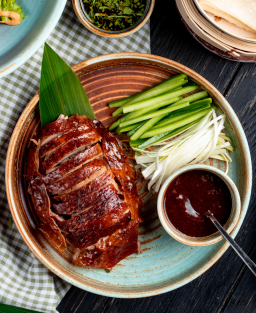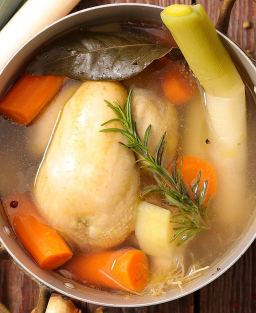

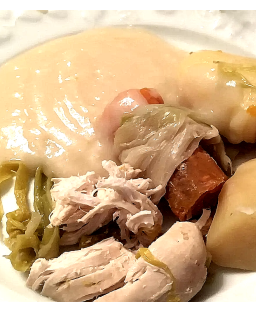
Traditional poule au blanc recipe, slowly simmered in its aromatic broth and served with a velvety sauce
Authentic poule au blanc recipe, with perfumed broth, melting vegetables, gentle cooking and white sauce bound with roux for a comforting French family dish.
Poule sauce blanche, poule à la crème (traditional French terms).
«Discover the traditional poule au blanc recipe, an emblematic dish of French peasant cuisine, appreciated for its authenticity, the tenderness of its meat and the softness of its velvety sauce.»
Use of other products (optional)
The poule can be replaced by:
– poularde,
– farm chicken,
– capon (festive version),
– turkey (in collective settings).
Categorization
Type of dish: Main dish
Service: Brasserie / Traditional restaurant / Collective
Number of portions: 8
Level: Intermediate
Traditional poule au blanc recipe, slowly simmered in its aromatic broth and served with a velvety sauce
Authentic poule au blanc recipe, with perfumed broth, melting vegetables, gentle cooking and white sauce bound with roux for a comforting French family dish.
Other names
Poule sauce blanche, poule à la crème.
«Discover the traditional poule au blanc recipe, an emblematic dish of French peasant cuisine, appreciated for its authenticity, the tenderness of its meat and the softness of its velvety sauce.»
Use of other products (optional)
The poule can be replaced by:
– poularde,
– farm chicken,
– capon (festive version),
– turkey (in collective settings).
Categorization
Type of dish: Main dish
Service: Brasserie / Traditional restaurant / Collective
Number of portions: 8
Level: Intermediate
Proverb
«À poule vieille, bon bouillon.» — French peasant proverb meaning that older poultry gives the best broths.
Fable
La Polle et li Caudron« Fol est li fer qui se tient plus proufitable que la bête. Car l’ome fait l’uevre del caudron, mes la polle donne vie, œf et potage. »
Country: France
Region: Center – Paris Basin – variations in Burgundy, Normandy and Brittany
Official status: None
Inventor: Oral transmission
Codified recipe: No
Official specification: Not applicable
Certification body: None
Poule au blanc fits into the French rural tradition since the Middle Ages. On farms, hens were raised mainly for eggs; older, less productive poultry were slaughtered and destined for broth. Their firm meat required long, gentle cooking, perfectly suited to what was then called «cuisson au pot». The principle of white sauce appears in many medieval culinary manuscripts.
In Normandy, this specialty developed particularly between the 18th and 19th centuries, inherited from peasant cuisine. The cull hen, aged and less productive, was simmered at length to tenderize its meat and feed the whole household during Sunday meals. The rich broth also served as a base for other preparations, making the dish economical and complete.
The dish fell into some oblivion after the 1960s-1970s, with the rise of fast cooking and industrial products. It was brought back to light from the 2000s thanks to the movement to valorize regional cuisines, carried by Norman chefs attached to heritage and culinary shows like Les Carnets de Julie. Today, poule au blanc is considered an emblem of Norman cuisine alongside marmite dieppoise or tripes à la mode de Caen.
Poule au blanc shares affinities with the popular poule au pot since Henry IV, but stands out with the systematic use of thick crème fraîche (crème d’Isigny AOP) and farm brut cider in the Norman version. The introduction of cream, abundant in Normandy, enriches the sauce and gives it its characteristic richness. Carrots and leeks, present in France since the Middle Ages, gradually became established thanks to agricultural progress in the 18th and 19th centuries.
Liaison techniques inherited from bourgeois cuisine, notably with egg yolk and cream, came from Italy via Catherine de Médicis and contributed to the sauce's evolution. Interregional trade and exchanges between Western regions (Brittany, Maine, Normandy) favored the standardization of certain vegetables and the appearance of variants, sometimes incorporating green cabbage or Paris mushrooms. The use of cider in partial or total replacement of wine testifies to local adaptation to agricultural resources and terroir.
Originally, poule au blanc was cooked in a large cast-iron pot suspended over the fireplace, for three to four hours. The technique involved gently cooking the poultry in an enriched broth, sometimes bound with bread or flour. With the arrival of wood then gas stoves, cooking times were better controlled. The blond roux gradually imposed itself, replacing rustic liaisons and allowing a more homogeneous and creamy sauce.
In the 19th century, poultry cutting was refined: trussing, trimming and separation of supremes and thighs for uniform cooking. Today, the recipe features several modern adaptations: use of whole farm chickens or pieces to shorten cooking, broth clarification for a more gastronomic result, plating, or sauce lightening by reducing cream and roux. Some chefs revisit the dish in bistronomic version: deboned poultry, turned vegetables, minute-mounted sauce and individual cocotte service.
Thanks to these evolutions, poule au blanc has spanned the centuries, moving from peasant cuisine to valued Norman gastronomy, while remaining true to its tradition of generous, family and refined dish.
Paul Bocuse – Lyon: very classic version, shiny white sauce and farm hen.
Alain Ducasse – Paris: sauce lightening, clarified broth, finer garnish.
Anne-Sophie Pic – Valence: floral interpretation, nuances of fine herbs.
Michel Troisgros – Ouches: work on acidity with reduced white wine.
Stéphane Jégo (L’Ami Jean) – Paris: bistronomic version, very slow cooking.
Maison Vérot – Paris: charcuterie declination in revisited poultry pot-au-feu.
Hugo Desnoyer – Paris: renowned butcher and traiteur, he popularized the recipe with the general public in Paris by offering an authentic version with Loué hen and organic vegetables, served at his gastronomic events.
Julie Andrieu (show "Les Carnets de Julie"): brought the recipe back to light in 2018 by valorizing Norman family transmission and adding strong mustard to the sauce to spice up the taste.
Arnaud (chef in "Météo à la Carte", France 3): offers a contemporary version with well-marked brut cider and vegetables cut into large pieces for a more rustic and visual result.
Auberge du Vieux Puits – Pont-Audemer (Eure): Sunday specialty, farm hen from Pays d'Auge, sauce enriched with calvados at the end of cooking.
Le Bouillon Normand – Caen (Calvados): brasserie version, family cocotte service, pilaf rice accompaniment, house brut cider.
Ferme-auberge La Bergerie – Bagnoles-de-l'Orne (Orne): hen raised on site, vegetable garden vegetables, rustic sauce without clarification, platter service with broth in tureen.noseychef
Presentation of the dish
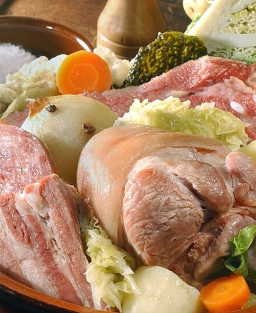
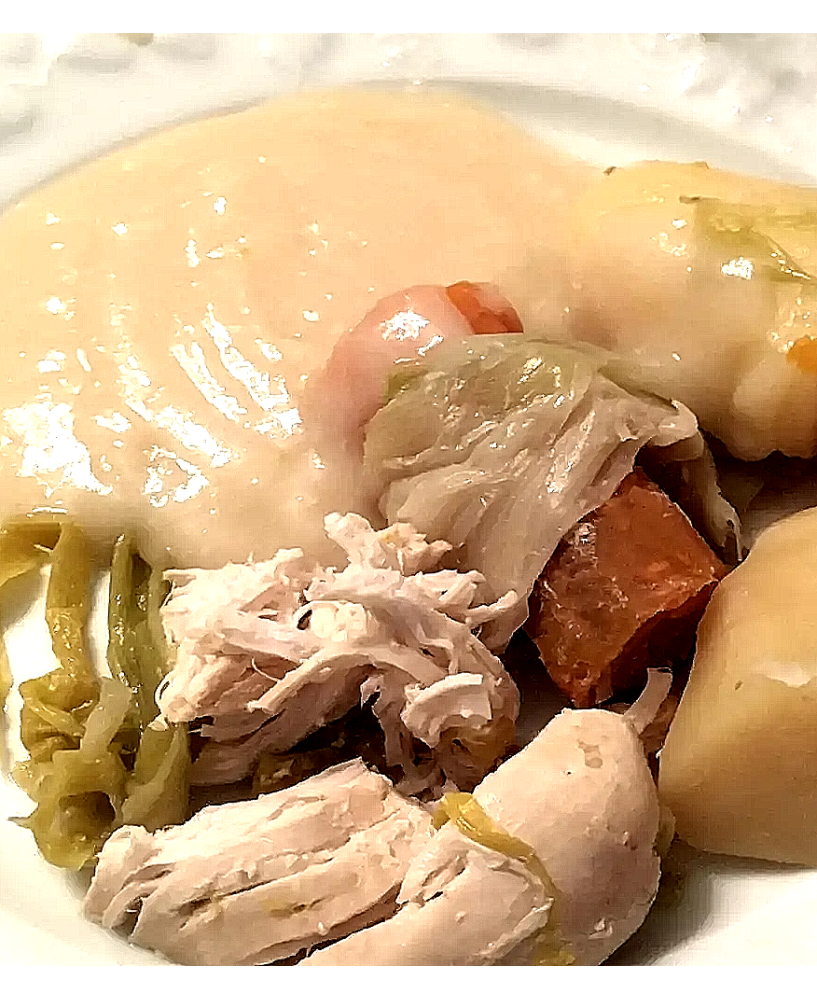
Aspect: poultry cut into pieces, slightly ivory nappante white sauce, melting vegetables.
Texture: melting meat, velvety sauce, tender vegetables.
Dominant aromas: lactic notes, herbaceous (leek), slightly musky.
Culinary particularities
Cookings: poaching, simmering, reduction.
Key techniques: blond roux, degreasing the broth, binding.
Typical ingredients: farm hen, bouquet garni, cream, flour, butter.
Necessary utensils
Cast iron cocotte, russe, sauteuse, skimmer, ladle, étamine chinois, whisk, immersion blender, paring knife, chef's knife, HACCP poultry board, maryse spatula, cooking probe, gastro bin.
Poultry and cooking
Farm hen: 1 piece of 2.5–3 kg
Water: 4 L
Coarse salt: 25 g
Peppercorns: 8 g
Carrots: 400 g
Leeks: 400 g
Turnips: 300 g
Onions: 2 pieces
Cloves: 2 pieces
Bouquet garni: 1
White sauce
Sweet butter: 80 g
T55 flour: 80 g
30% liquid cream: 20 cl
Filtered cooking broth: 1 L
Fine salt: q.s.
White pepper: q.s.
Lemon juice: 5 ml (optional)
Accepted variants
The sauce can be mounted with cream only, without roux.
Vegetables can include celery stalk or parsnip.
General information
Preparation: 30 min
Cooking: 2 h 30
Rest: 10 min
Professional method
Mise en place
Set up clean station, HACCP boards, recovery bin.
Take out the poultry, calibrate vegetables, check knife edges.
Cutting and preliminary preparations
Flame the poultry if necessary, trim, eviscerate if not prepared.
Stud the onions with cloves.
Cut vegetables into coarse mirepoix for the stock + regular cut for garnish.
Prepare bouquet garni.
Cooking
Place the hen in the cocotte, cover with cold water, salt.
Bring to boil, skim carefully.
Add stock vegetables and bouquet garni.
Cook at simmer 2 h at 85–90 °C.
Remove poultry, strain broth.
Prepare blond roux with butter and flour, cool.
Gradually pour 1 L hot broth over roux, whisk.
Reduce to nappante consistency, add cream and adjust.
Finishing and plating
Cut the hen: thighs, breasts, wings.
Gently reheat pieces in sauce.
Plate in deep dish or platter: vegetables at bottom, poultry nappé with sauce, fine herbs.
Sauces and condiments
White sauce: keeps 48 h at +3 °C in gastro bin.
Reheat gently, avoid excessive boiling to prevent splitting.
Safety and hygiene standards
Respect cold chain: +3 °C for poultry.
Core cooking regulatory: 75 °C minimum.
Rapid cooling if storage: +10 °C → +3 °C in <2 h.
Separate poultry board, hand washing, disinfection.
Recipe evolution
Gradual introduction of cream in the 19th century.
Modern light versions: plant milk, sauces mounted with broth only.
Variants
Norman version: addition of cider and thick cream.
Modern chef version: low-temperature cooked poultry, emulsified sauce.
Contemporary version: individual cocotte presentation, miniature turned vegetables.
Anticipate cooking the day before to degrease broth cold.
Always cook at simmer, never big bubbles.
Don't over-tighten roux to avoid pasty sauce.
Chef's tip: add a touch of lemon to wake up the sauce.
Plating
Rustic or bistro style; service in cocotte or family deep dish.
Traditional garnishes
Pilaf rice: 120 g / person
Steamed potatoes: 150 g / person
Glazed vegetables: 100 g / person
Wines
Whites: Vouvray sec, Pouilly-Fumé, Mâcon-Villages (8–20 €).
Service: 10–12 °C.
Non-alcoholic drinks
Thyme-lemon infusion, slightly heated cloudy apple juice.
Energy: 480 kcal
Lipids: 28 g
Carbohydrates: 12 g
Proteins: 40 g
Fibers: 3 g
Allergens
Gluten (roux), lactose (butter, cream), celery (depending on potential garnish).
Possible adaptations
Gluten-free: roux with starch or rice flour.
Lactose-free: neutral oil and plant milk or broth.
Low-sodium: reduce salt, unsalted broth.
Glossary:
Singer: sprinkle with flour to bind.
Mirepoix: mix of coarsely cut vegetables serving as aromatic base.
Roux: butter + flour mix intended to thicken.
Bouquet garni: bundle of aromatic herbs (thyme, bay leaf, parsley).
Skim: remove impurities floating on broth surface.
Blanch: briefly cook food to firm or clean it.
Nappante: sauce consistency uniformly coating spoon back.
Traditional poule au blanc recipe, slowly simmered in its aromatic broth and served with a velvety sauce
Authentic poule au blanc recipe, with perfumed broth, melting vegetables, gentle cooking and white sauce bound with roux for a comforting French family dish.
Poule sauce blanche, poule à la crème (traditional French terms).
«Discover the traditional poule au blanc recipe, an emblematic dish of French peasant cuisine, appreciated for its authenticity, the tenderness of its meat and the softness of its velvety sauce.»
Use of other products (optional)
The poule can be replaced by:
– poularde,
– farm chicken,
– capon (festive version),
– turkey (in collective settings).
Categorization
Type of dish: Main dish
Service: Brasserie / Traditional restaurant / Collective
Number of portions: 8
Level: Intermediate
Traditional poule au blanc recipe, slowly simmered in its aromatic broth and served with a velvety sauce
Authentic poule au blanc recipe, with perfumed broth, melting vegetables, gentle cooking and white sauce bound with roux for a comforting French family dish.
Other names
Poule sauce blanche, poule à la crème.
«Discover the traditional poule au blanc recipe, an emblematic dish of French peasant cuisine, appreciated for its authenticity, the tenderness of its meat and the softness of its velvety sauce.»
Use of other products (optional)
The poule can be replaced by:
– poularde,
– farm chicken,
– capon (festive version),
– turkey (in collective settings).
Categorization
Type of dish: Main dish
Service: Brasserie / Traditional restaurant / Collective
Number of portions: 8
Level: Intermediate
Proverb
«À poule vieille, bon bouillon.» — French peasant proverb meaning that older poultry gives the best broths.
Fable
La Polle et li Caudron« Fol est li fer qui se tient plus proufitable que la bête. Car l’ome fait l’uevre del caudron, mes la polle donne vie, œf et potage. »
Country: France
Region: Center – Paris Basin – variations in Burgundy, Normandy and Brittany
Official status: None
Inventor: Oral transmission
Codified recipe: No
Official specification: Not applicable
Certification body: None
Poule au blanc fits into the French rural tradition since the Middle Ages. On farms, hens were raised mainly for eggs; older, less productive poultry were slaughtered and destined for broth. Their firm meat required long, gentle cooking, perfectly suited to what was then called «cuisson au pot». The principle of white sauce appears in many medieval culinary manuscripts.
In Normandy, this specialty developed particularly between the 18th and 19th centuries, inherited from peasant cuisine. The cull hen, aged and less productive, was simmered at length to tenderize its meat and feed the whole household during Sunday meals. The rich broth also served as a base for other preparations, making the dish economical and complete.
The dish fell into some oblivion after the 1960s-1970s, with the rise of fast cooking and industrial products. It was brought back to light from the 2000s thanks to the movement to valorize regional cuisines, carried by Norman chefs attached to heritage and culinary shows like Les Carnets de Julie. Today, poule au blanc is considered an emblem of Norman cuisine alongside marmite dieppoise or tripes à la mode de Caen.
Poule au blanc shares affinities with the popular poule au pot since Henry IV, but stands out with the systematic use of thick crème fraîche (crème d’Isigny AOP) and farm brut cider in the Norman version. The introduction of cream, abundant in Normandy, enriches the sauce and gives it its characteristic richness. Carrots and leeks, present in France since the Middle Ages, gradually became established thanks to agricultural progress in the 18th and 19th centuries.
Liaison techniques inherited from bourgeois cuisine, notably with egg yolk and cream, came from Italy via Catherine de Médicis and contributed to the sauce's evolution. Interregional trade and exchanges between Western regions (Brittany, Maine, Normandy) favored the standardization of certain vegetables and the appearance of variants, sometimes incorporating green cabbage or Paris mushrooms. The use of cider in partial or total replacement of wine testifies to local adaptation to agricultural resources and terroir.
Originally, poule au blanc was cooked in a large cast-iron pot suspended over the fireplace, for three to four hours. The technique involved gently cooking the poultry in an enriched broth, sometimes bound with bread or flour. With the arrival of wood then gas stoves, cooking times were better controlled. The blond roux gradually imposed itself, replacing rustic liaisons and allowing a more homogeneous and creamy sauce.
In the 19th century, poultry cutting was refined: trussing, trimming and separation of supremes and thighs for uniform cooking. Today, the recipe features several modern adaptations: use of whole farm chickens or pieces to shorten cooking, broth clarification for a more gastronomic result, plating, or sauce lightening by reducing cream and roux. Some chefs revisit the dish in bistronomic version: deboned poultry, turned vegetables, minute-mounted sauce and individual cocotte service.
Thanks to these evolutions, poule au blanc has spanned the centuries, moving from peasant cuisine to valued Norman gastronomy, while remaining true to its tradition of generous, family and refined dish.
Paul Bocuse – Lyon: very classic version, shiny white sauce and farm hen.
Alain Ducasse – Paris: sauce lightening, clarified broth, finer garnish.
Anne-Sophie Pic – Valence: floral interpretation, nuances of fine herbs.
Michel Troisgros – Ouches: work on acidity with reduced white wine.
Stéphane Jégo (L’Ami Jean) – Paris: bistronomic version, very slow cooking.
Maison Vérot – Paris: charcuterie declination in revisited poultry pot-au-feu.
Hugo Desnoyer – Paris: renowned butcher and traiteur, he popularized the recipe with the general public in Paris by offering an authentic version with Loué hen and organic vegetables, served at his gastronomic events.
Julie Andrieu (show "Les Carnets de Julie"): brought the recipe back to light in 2018 by valorizing Norman family transmission and adding strong mustard to the sauce to spice up the taste.
Arnaud (chef in "Météo à la Carte", France 3): offers a contemporary version with well-marked brut cider and vegetables cut into large pieces for a more rustic and visual result.
Auberge du Vieux Puits – Pont-Audemer (Eure): Sunday specialty, farm hen from Pays d'Auge, sauce enriched with calvados at the end of cooking.
Le Bouillon Normand – Caen (Calvados): brasserie version, family cocotte service, pilaf rice accompaniment, house brut cider.
Ferme-auberge La Bergerie – Bagnoles-de-l'Orne (Orne): hen raised on site, vegetable garden vegetables, rustic sauce without clarification, platter service with broth in tureen.noseychef
Presentation of the dish
Aspect: poultry cut into pieces, slightly ivory nappante white sauce, melting vegetables.
Texture: melting meat, velvety sauce, tender vegetables.
Dominant aromas: lactic notes, herbaceous (leek), slightly musky.
Culinary particularities
Cookings: poaching, simmering, reduction.
Key techniques: blond roux, degreasing the broth, binding.
Typical ingredients: farm hen, bouquet garni, cream, flour, butter.
Necessary utensils
Cast iron cocotte, russe, sauteuse, skimmer, ladle, étamine chinois, whisk, immersion blender, paring knife, chef's knife, HACCP poultry board, maryse spatula, cooking probe, gastro bin.
Poultry and cooking
Farm hen: 1 piece of 2.5–3 kg
Water: 4 L
Coarse salt: 25 g
Peppercorns: 8 g
Carrots: 400 g
Leeks: 400 g
Turnips: 300 g
Onions: 2 pieces
Cloves: 2 pieces
Bouquet garni: 1
White sauce
Sweet butter: 80 g
T55 flour: 80 g
30% liquid cream: 20 cl
Filtered cooking broth: 1 L
Fine salt: q.s.
White pepper: q.s.
Lemon juice: 5 ml (optional)
Accepted variants
The sauce can be mounted with cream only, without roux.
Vegetables can include celery stalk or parsnip.
General information
Preparation: 30 min
Cooking: 2 h 30
Rest: 10 min
Professional method
Mise en place
Set up clean station, HACCP boards, recovery bin.
Take out the poultry, calibrate vegetables, check knife edges.
Cutting and preliminary preparations
Flame the poultry if necessary, trim, eviscerate if not prepared.
Stud the onions with cloves.
Cut vegetables into coarse mirepoix for the stock + regular cut for garnish.
Prepare bouquet garni.
Cooking
Place the hen in the cocotte, cover with cold water, salt.
Bring to boil, skim carefully.
Add stock vegetables and bouquet garni.
Cook at simmer 2 h at 85–90 °C.
Remove poultry, strain broth.
Prepare blond roux with butter and flour, cool.
Gradually pour 1 L hot broth over roux, whisk.
Reduce to nappante consistency, add cream and adjust.
Finishing and plating
Cut the hen: thighs, breasts, wings.
Gently reheat pieces in sauce.
Plate in deep dish or platter: vegetables at bottom, poultry nappé with sauce, fine herbs.
Sauces and condiments
White sauce: keeps 48 h at +3 °C in gastro bin.
Reheat gently, avoid excessive boiling to prevent splitting.
Safety and hygiene standards
Respect cold chain: +3 °C for poultry.
Core cooking regulatory: 75 °C minimum.
Rapid cooling if storage: +10 °C → +3 °C in <2 h.
Separate poultry board, hand washing, disinfection.
Recipe evolution
Gradual introduction of cream in the 19th century.
Modern light versions: plant milk, sauces mounted with broth only.
Variants
Norman version: addition of cider and thick cream.
Modern chef version: low-temperature cooked poultry, emulsified sauce.
Contemporary version: individual cocotte presentation, miniature turned vegetables.
Anticipate cooking the day before to degrease broth cold.
Always cook at simmer, never big bubbles.
Don't over-tighten roux to avoid pasty sauce.
Chef's tip: add a touch of lemon to wake up the sauce.
Plating
Rustic or bistro style; service in cocotte or family deep dish.
Traditional garnishes
Pilaf rice: 120 g / person
Steamed potatoes: 150 g / person
Glazed vegetables: 100 g / person
Wines
Whites: Vouvray sec, Pouilly-Fumé, Mâcon-Villages (8–20 €).
Service: 10–12 °C.
Non-alcoholic drinks
Thyme-lemon infusion, slightly heated cloudy apple juice.
Energy: 480 kcal
Lipids: 28 g
Carbohydrates: 12 g
Proteins: 40 g
Fibers: 3 g
Allergens
Gluten (roux), lactose (butter, cream), celery (depending on potential garnish).
Possible adaptations
Gluten-free: roux with starch or rice flour.
Lactose-free: neutral oil and plant milk or broth.
Low-sodium: reduce salt, unsalted broth.
Glossary:
Singer: sprinkle with flour to bind.
Mirepoix: mix of coarsely cut vegetables serving as aromatic base.
Roux: butter + flour mix intended to thicken.
Bouquet garni: bundle of aromatic herbs (thyme, bay leaf, parsley).
Skim: remove impurities floating on broth surface.
Blanch: briefly cook food to firm or clean it.
Nappante: sauce consistency uniformly coating spoon back.