
Complete Recipe for Turkish Baklava – The Traditional and Authentic Ottoman Dessert
Other Names: Baklawa, Baclava
Discover the traditional Baklava recipe – an iconic Turkish dessert that combines refinement, sweet flavor, and flaky texture, symbolizing the eternal love of Leyla and Kerem.
Anecdote or Saying:
“Tatlı aşıkların dileğidir, Baklava ile birleşir.”
(In Turkish: “The wish of sweet lovers comes true with Baklava.”)
In the heart of Istanbul, during the 16th century under the reign of Suleiman the Magnificent, palaces shimmered with gold and sparkling mosaics. In this city, where trade and poetry mingled with the aromas of spices, lived Leyla, the daughter of a wealthy silk merchant, known for her ethereal beauty and voice as soft as the murmur of the Bosphorus.
Kerem, a young poet and market musician, spent his days composing verses that he discreetly slipped into fruit baskets or among tree leaves, hoping that one day Leyla would read them. But their families, rivals in business, had already planned their futures: Leyla was to marry a noble chosen by her father, and Kerem had to follow the paths of commerce to support his family.
One summer evening, during a garden party at the palace, Kerem saw Leyla near the fountain where the water glittered under the lanterns. With a pounding heart, he offered her a small square of Baklava, made by his own hands: a pastry as thin as butterfly wings, crushed pistachios like jewels, and syrup flavored with rose and honey. Each bite was a poem, each layer a secret message of impossible love.
Leyla, moved by the gesture and the delicacy of the dessert, felt the intensity of their forbidden passion. They began to meet each night under the starry sky, exchanging sweet treats and passionate words, dreaming of a world where their love was no longer forbidden.
From that day on, Baklava became more than just a dessert: it was a symbol of their patience, secrecy, and pure love that survived despite obstacles. Later Ottoman poets would say that each pastry layer represents the challenges they overcame, and each pistachio, the sparkle of their passion.
Over the centuries, the legend of Leyla and Kerem became part of Istanbul’s heart, reminding everyone that Baklava is not just a delicacy but a messenger of eternal feelings and forbidden romances.
Country: Turkey
Region: Ottoman Empire / Anatolia
Baklava has its roots in the Ottoman Empire, with influences from Persian, Arab, and Byzantine cuisines. Its extremely thin layers and rose- or honey-flavored syrup reflect the culinary sophistication of the Ottoman court. Over time, the recipe spread to the Balkans and the Middle East, with each region adapting the types of nuts and flavors. Modern techniques have introduced new methods for layering and baking while retaining sugar and honey as essential ingredients. Today, Baklava symbolizes celebrations and family events, preserving the memory of Leyla and Kerem’s legendary love.
Hafiz Mustafa – Istanbul – Master of Traditional Baklava
Karaköy Güllüoğlu – Istanbul – Crispy pastry and premium pistachios
Saray Muhallebicisi – Istanbul – Rose-flavored syrup
Köşkeroğlu – Ankara – Royal Ottoman court version
Gaziantep Baklava Evi – Gaziantep – Local specialty with high-quality nuts
İmam Çağdaş – Gaziantep – Authentic family recipe
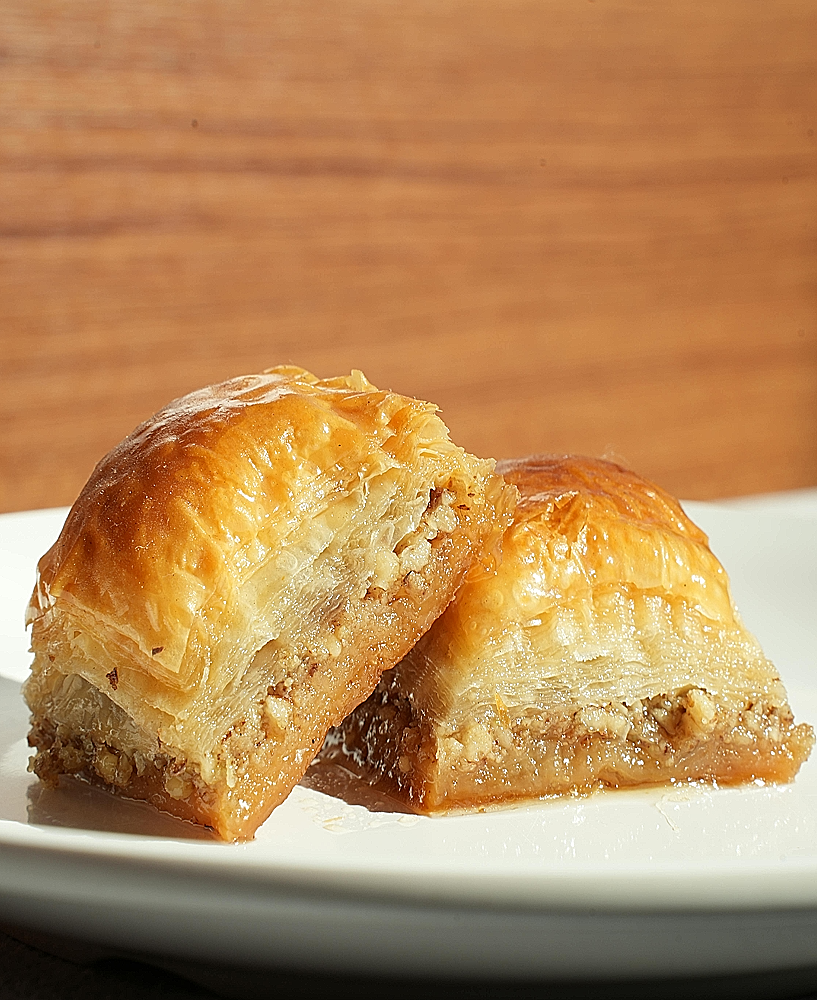
Appearance: Golden, shiny layers with nuts visible in the center
Texture: Crispy yet tender, soaked in sweet syrup
Dominant Flavors: Honey, pistachio, rose, or orange blossom
Culinary Particularities: Syrup bath after perfect browning
Required Utensils: Rolling pin, rectangular baking dish, brush, knife, saucepan for syrup
500 g phyllo pastry
300 g clarified butter, melted
250 g unsalted pistachios, roughly chopped
200 g walnuts (optional)
200 g granulated sugar
150 ml water
100 g honey
1 tablespoon rosewater or orange blossom water
Variants: almonds, cashews
Preparation time: 45 min
Cooking time: 35 min
Yield: 12–16 servings
Detailed Steps:
Preheat oven to 180°C (356°F). Place rack in the center.
Prepare the dish: Generously butter a 30x20 cm rectangular baking pan.
Layer the phyllo pastry:
Place the first sheet in the pan and brush with butter.
Repeat 5 times, covering unused sheets with a damp cloth.
Add the nuts:
Mix walnuts, pistachios, and almonds with sugar and a pinch of cinnamon.
Spread a third of the mixture over the first 5 layers.
Add 5 more layers, then another third of nuts.
Repeat and finish with 5 layers on top.
Cut before baking: Slice into diamonds or squares.
Bake: 30–35 min until golden and crisp. Check the center with a knife.
Prepare the syrup:
Boil 200 ml water with 150 g sugar.
Add 2 tablespoons honey and 1 tablespoon rosewater.
Pour over the hot Baklava and let absorb for at least 2 hours, ideally overnight.
Diamonds: Traditional and elegant, perfect for individual servings
Squares: Practical for buffet or modern presentation
Keep phyllo covered and cool
Handle nuts with clean hands and dry utensils
Check full baking in the center
Use a clean brush for butter
Add orange or lemon zest to the syrup
Replace some nuts with cashews for a softer texture
Serve warm or at room temperature for a perfect contrast of crisp and syrup
Gaziantep: Pistachios only, orange-flavored syrup
Istanbul: Pistachio/walnut mix, very thin pastry
Modern: Individual Baklava in a glass, lavender syrup infusion
Oriental: Arab version, sweeter and denser
Generously brush with butter
Cut before baking
Common mistakes: dry pastry, cold syrup added too early
Chef’s tip: let rest at least 2 hours before serving to allow syrup to fully soak
Presentation: Buffet or plated dessert
Accompaniments: Turkish tea or Turkish coffee
Decoration: Pistachios or edible gold leaf
Wines:
Sweet Muscat from Izmir: light, aromatic. Recommended vintages: 2018–2020
Alternative: Turkish Tokay wine, sweet and floral, 2017–2021
Non-alcoholic:
Turkish black tea with apple or cinnamon
Slightly fermented white grape juice or orange blossom infusion
Energy: 350 kcal / 1465 kJ
Fat: 22 g
Carbohydrates: 38 g
Protein: 5 g
Fiber: 2 g
Allergens: Nuts, gluten, butter
Possible adaptations: Gluten-free with gluten-free phyllo, vegan version with margarine
Complete Recipe for Turkish Baklava – The Traditional and Authentic Ottoman Dessert
Other Names: Baklawa, Baclava
Discover the traditional Baklava recipe – an iconic Turkish dessert that combines refinement, sweet flavor, and flaky texture, symbolizing the eternal love of Leyla and Kerem.
Anecdote or Saying:
“Tatlı aşıkların dileğidir, Baklava ile birleşir.”
(In Turkish: “The wish of sweet lovers comes true with Baklava.”)
In the heart of Istanbul, during the 16th century under the reign of Suleiman the Magnificent, palaces shimmered with gold and sparkling mosaics. In this city, where trade and poetry mingled with the aromas of spices, lived Leyla, the daughter of a wealthy silk merchant, known for her ethereal beauty and voice as soft as the murmur of the Bosphorus.
Kerem, a young poet and market musician, spent his days composing verses that he discreetly slipped into fruit baskets or among tree leaves, hoping that one day Leyla would read them. But their families, rivals in business, had already planned their futures: Leyla was to marry a noble chosen by her father, and Kerem had to follow the paths of commerce to support his family.
One summer evening, during a garden party at the palace, Kerem saw Leyla near the fountain where the water glittered under the lanterns. With a pounding heart, he offered her a small square of Baklava, made by his own hands: a pastry as thin as butterfly wings, crushed pistachios like jewels, and syrup flavored with rose and honey. Each bite was a poem, each layer a secret message of impossible love.
Leyla, moved by the gesture and the delicacy of the dessert, felt the intensity of their forbidden passion. They began to meet each night under the starry sky, exchanging sweet treats and passionate words, dreaming of a world where their love was no longer forbidden.
From that day on, Baklava became more than just a dessert: it was a symbol of their patience, secrecy, and pure love that survived despite obstacles. Later Ottoman poets would say that each pastry layer represents the challenges they overcame, and each pistachio, the sparkle of their passion.
Over the centuries, the legend of Leyla and Kerem became part of Istanbul’s heart, reminding everyone that Baklava is not just a delicacy but a messenger of eternal feelings and forbidden romances.
Country: Turkey
Region: Ottoman Empire / Anatolia
Baklava has its roots in the Ottoman Empire, with influences from Persian, Arab, and Byzantine cuisines. Its extremely thin layers and rose- or honey-flavored syrup reflect the culinary sophistication of the Ottoman court. Over time, the recipe spread to the Balkans and the Middle East, with each region adapting the types of nuts and flavors. Modern techniques have introduced new methods for layering and baking while retaining sugar and honey as essential ingredients. Today, Baklava symbolizes celebrations and family events, preserving the memory of Leyla and Kerem’s legendary love.
Hafiz Mustafa – Istanbul – Master of Traditional Baklava
Karaköy Güllüoğlu – Istanbul – Crispy pastry and premium pistachios
Saray Muhallebicisi – Istanbul – Rose-flavored syrup
Köşkeroğlu – Ankara – Royal Ottoman court version
Gaziantep Baklava Evi – Gaziantep – Local specialty with high-quality nuts
İmam Çağdaş – Gaziantep – Authentic family recipe
Appearance: Golden, shiny layers with nuts visible in the center
Texture: Crispy yet tender, soaked in sweet syrup
Dominant Flavors: Honey, pistachio, rose, or orange blossom
Culinary Particularities: Syrup bath after perfect browning
Required Utensils: Rolling pin, rectangular baking dish, brush, knife, saucepan for syrup
500 g phyllo pastry
300 g clarified butter, melted
250 g unsalted pistachios, roughly chopped
200 g walnuts (optional)
200 g granulated sugar
150 ml water
100 g honey
1 tablespoon rosewater or orange blossom water
Variants: almonds, cashews
Preparation time: 45 min
Cooking time: 35 min
Yield: 12–16 servings
Detailed Steps:
Preheat oven to 180°C (356°F). Place rack in the center.
Prepare the dish: Generously butter a 30x20 cm rectangular baking pan.
Layer the phyllo pastry:
Place the first sheet in the pan and brush with butter.
Repeat 5 times, covering unused sheets with a damp cloth.
Add the nuts:
Mix walnuts, pistachios, and almonds with sugar and a pinch of cinnamon.
Spread a third of the mixture over the first 5 layers.
Add 5 more layers, then another third of nuts.
Repeat and finish with 5 layers on top.
Cut before baking: Slice into diamonds or squares.
Bake: 30–35 min until golden and crisp. Check the center with a knife.
Prepare the syrup:
Boil 200 ml water with 150 g sugar.
Add 2 tablespoons honey and 1 tablespoon rosewater.
Pour over the hot Baklava and let absorb for at least 2 hours, ideally overnight.
Diamonds: Traditional and elegant, perfect for individual servings
Squares: Practical for buffet or modern presentation
Keep phyllo covered and cool
Handle nuts with clean hands and dry utensils
Check full baking in the center
Use a clean brush for butter
Add orange or lemon zest to the syrup
Replace some nuts with cashews for a softer texture
Serve warm or at room temperature for a perfect contrast of crisp and syrup
Gaziantep: Pistachios only, orange-flavored syrup
Istanbul: Pistachio/walnut mix, very thin pastry
Modern: Individual Baklava in a glass, lavender syrup infusion
Oriental: Arab version, sweeter and denser
Generously brush with butter
Cut before baking
Common mistakes: dry pastry, cold syrup added too early
Chef’s tip: let rest at least 2 hours before serving to allow syrup to fully soak
Presentation: Buffet or plated dessert
Accompaniments: Turkish tea or Turkish coffee
Decoration: Pistachios or edible gold leaf
Wines:
Sweet Muscat from Izmir: light, aromatic. Recommended vintages: 2018–2020
Alternative: Turkish Tokay wine, sweet and floral, 2017–2021
Non-alcoholic:
Turkish black tea with apple or cinnamon
Slightly fermented white grape juice or orange blossom infusion
Energy: 350 kcal / 1465 kJ
Fat: 22 g
Carbohydrates: 38 g
Protein: 5 g
Fiber: 2 g
Allergens: Nuts, gluten, butter
Possible adaptations: Gluten-free with gluten-free phyllo, vegan version with margarine