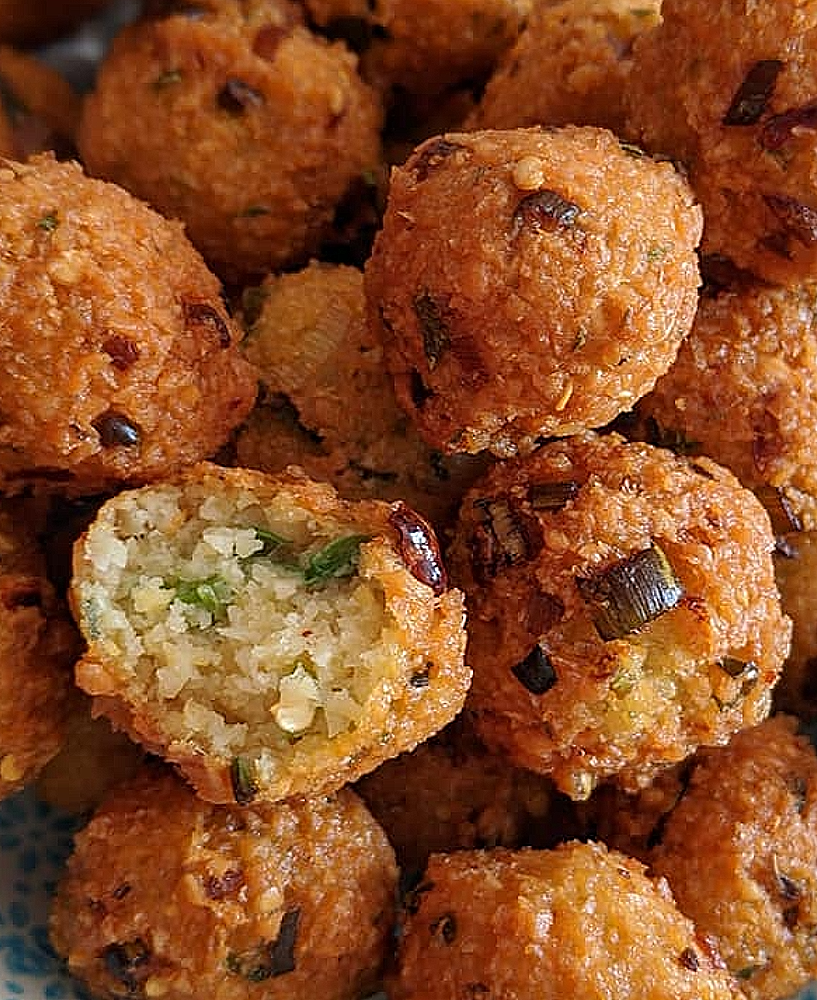

Gato pima (Mauritian Creole) Tamil name of origin: பருப்பு வடை (paruppu vadai)
Etymology: from Mauritian Creole — "gato" (corruption of "gâteau", generic term for any fried savoury or sweet fritter in Mauritius) + "pima" (corruption of "piment"). The term "bonbon piment" is the Réunionnaise and French designation of the same fritter.
Fried yellow split pea fritter with Indian spices, heritage of Indo-Mauritian indenture in the 19th century — essential gajdak of Mauritian street food.
"Discover the traditional recipe for bonbon piment, an emblematic speciality of Mauritius, recognised for its authenticity, its Indo-Creole heritage and its central role in Mauritian street culture since the 19th century."
Main name in Mauritian Creole: Gato pima Name in Mauritian French: Gâteau piment Tamil name of origin: பருப்பு வடை (paruppu vadai)
Attested dialectal variants:
⚠️ In Mauritius, the word "gato" does not exclusively refer to sweet confections — it encompasses all fried savoury and sweet fritters sold by marchands gato in the streets and bazaars.
Traditional Mauritian version (reference): yellow split peas (dholl), green chilli, coriander (cotomili), shallots, onion, ground cumin, salt. Slightly flattened patty shape, sometimes pierced in the centre. Frying at 150–160 °C.
Réunionnaise version (bonbon piment): base of Cape peas (large white beans), ginger, curry leaves (caloupilé), chives, turmeric. Slightly flattened ball shape. Slightly different, more herbaceous aromatic profile.
Enriched version: addition of curry leaves, grated ginger, turmeric for more pronounced golden colouring and earthier notes.
Diaspora family version: split peas replaced by chickpeas or red lentils if yellow split peas unavailable; dried coriander substituting fresh.
Contemporary gastronomic version: oven-baked fritter (less faithful to the original but lighter); mini bite-sized version for plated service; incorporated into a Mauritian burger with coriander chutney and buttered bread.
Festive version: preparation as curry (cari bari) during major celebrations such as Ganesh Chaturthi — gato pima form one of the dishes of the ritual meal.
Estimated period of appearance: second half of the 19th century, in the wake of the arrival of Indian indentured workers (1834–1907).
Ingredients added over time: curry leaves, turmeric, ginger — progressive enrichments through adaptation to locally available ingredients in Mauritius.
Modern adaptations: oven version for domestic use without deep frying; freezing raw dough in portions; sale in ready-to-fry dough packets in some Mauritian grocery stores.
« Enn gato pima ar dipin beré, sa li bon pou tou letan » — "A gato pima with buttered bread is good at any hour." (popular Mauritian Creole expression)
It is said that the first marchands gato of Port-Louis were Indian indentured women who, once freed from their contractual obligations in the sugarcane fields, set themselves up in the streets of the capital with their mortars and spices to sell the fritters of their homeland. This informal trade, tolerated and then integrated into Mauritian urban life, is said to have been for many the first form of economic emancipation accessible to women of the Indo-Mauritian community.
1. Origin of the dish
Gato pima has its roots in paruppu vadai (பருப்பு வடை) from southern India — a fried fritter made from split peas or lentils, seasoned with chilli, cumin and curry leaves, omnipresent in Tamil and Telugu cuisine. This fritter was prepared daily in households of Tamil Nadu and Andhra Pradesh, both as a street snack and as an offering during Hindu religious ceremonies.
Between 1835 and 1907, some 500,000 Indians, mainly from Bihar, Uttar Pradesh, Tamil Nadu and Andhra Pradesh, made the journey to Mauritius under the indenture system, to replace freed African slaves in the sugarcane plantations. They brought with them their legumes, spices and cooking techniques — among which the vadai, direct ancestor of gato pima.
2. Cultural influences and exchanges
Gato pima perfectly illustrates Mauritian culinary creolisation: a basic Tamil recipe, adapted to locally available ingredients (substitution of black lentils urad dal with more accessible yellow split peas in Mauritius), seasoned according to Creole tastes (addition of fresh coriander cotomili, progressive reduction of spiciness according to families), and integrated into distinctly Mauritian modes of consumption — served in buttered bread for breakfast, accompanied by milky tea (dité dilé), or as an aperitif (gajdak) during family gatherings and neighbourhood festivities.
More than 450,000 Indian workers marked the history of the island. Over time, their culinary traditions blended with local ingredients and Franco-Creole influences, giving birth to Indo-Mauritian cuisine: a vibrant fusion found in homes, street stalls and major celebrations alike.
3. Technical and culinary evolution
The original technique used a volcanic stone mortar (roche cari) to grind the soaked peas — an identical gesture to the Indian paruppu vadai. The electric blender, adopted in Mauritian households from the 1960s–70s, standardised texture and accelerated production, allowing marchands gato to prepare large quantities for morning bazaars. Freezing raw dough is a contemporary adaptation that allows Mauritian diaspora families to have this preparation available at any time.
Gato pima is part of Mauritian street food culture, what is called in Creole a gajdak — the local equivalent of aperitif or tapas — that can be eaten at any hour, as Mauritians enjoy snacking on all occasions.
[Sections on international star chefs and popular traditional establishments to be completed with locally available data]
The fundamental technical characteristic of gato pima is the complete absence of added binders (no flour, no egg): it is the ground split pea dough that ensures cohesion. Insufficient grinding or overly wet peas produce fritters that fall apart during frying. Mastering the dough texture — neither too dry nor too wet — is the critical control point of the recipe.
Yellow split peas (dholl), fresh green chilli, fresh coriander (cotomili), cumin — these four elements define the aromatic identity of the traditional Mauritian gato pima.
(Target yield: 25 to 30 pieces — 6 to 8 aperitif portions)
| Ingredient | Mauritian Creole name | Quantity | Approx. weight |
|---|---|---|---|
| Dry yellow split peas | Dholl | 250 g | 250 g |
| Fresh green chilli | Pima ver | 2 pieces | ~15 g |
| Fresh coriander | Cotomili | 2 tbsp chopped | ~10 g |
| Shallots | Zechalot | 2 tbsp chopped | ~20 g |
| Onion | Zonion | 1 small | ~60 g |
| Ground cumin | Cumin | 1 tsp | ~3 g |
| Salt | Dilo disel | To taste | ~4 g |
| Frying oil (sunflower) | Dilwil | Enough for frying | ~500 ml |
| Baking powder (optional) | — | ¼ tsp | ~1 g |
Accepted variants:
Variants not in keeping with Mauritian tradition:
1. Mise en place and soaking
The day before: wash the yellow split peas in cold water then soak in a large volume of cold water overnight (minimum 3 hours). Soaking is non-negotiable — insufficiently soaked peas will not grind correctly and will produce a grainy dough.
On the day: prepare and weigh all ingredients. Prepare a lightly oiled shaping surface. Heat frying oil to temperature.
2. Draining and skin removal
Drain the soaked peas. Remove the skin from each pea by gently pressing between the fingers — the skin detaches easily after soaking. This step is essential: residual skin weighs down the texture and produces a less fluffy result.
⚠️ Do not over-dry the peas after draining — a slight residual moisture is necessary to facilitate grinding and ensure dough cohesion.
3. Grinding / blending
By mortar (roche cari) — traditional method: pound the drained peas in small quantities until obtaining a slightly grainy paste — slightly fatty and sticky, not completely smooth.
By blender — contemporary method: blend the peas in successive pulses. Do not over-blend — a slight texture is desirable for the fritters' hold. Do not add water: use only the natural moisture of the soaked peas.
Transfer the obtained paste to a mixing bowl.
4. Seasoning and mixing
Incorporate into the pea paste: finely chopped green chilli, chopped coriander, sliced shallots, chopped onion, ground cumin and salt. Mix vigorously by hand or with a spatula until all aromatics are evenly distributed.
⚠️ Consistency check: the dough must be shapeable without falling apart. If too wet, sprinkle with a pinch of cornstarch or tapioca to absorb excess moisture — without adding wheat flour which alters the texture.
5. Shaping
Lightly oil the hands. Take approximately one tablespoon of dough. Form a ball then flatten it slightly between the palms to obtain a patty approximately 4 cm in diameter and 10 mm thick. Some traditional recipes provide for a small central hole — it allows more uniform cooking at the centre.
6. Frying
Heat oil to 150–160 °C in the sauté pan or deep fryer. Check temperature with thermometer — oil too hot (> 170 °C) burns the outside without cooking the centre; oil too cold (< 140 °C) soaks the fritters in oil.
Gently lower patties in batches of 5 to 6 pieces maximum. Fry 3 to 4 minutes on each side until uniformly golden. Turn halfway through cooking.
Drain on absorbent paper. Serve immediately, hot or warm.
7. Service
Serve hot, accompanied by a tomato or coriander chatini (chutney), or a homemade chilli sauce. Traditional use: in buttered bread (fresh half-baguette with butter) for breakfast or tea time.
| Observed defect | Probable cause | Correction |
|---|---|---|
| Fritters falling apart during frying | Dough too wet or insufficient grinding | Add a pinch of starch; blend longer |
| Heavy, greasy fritters | Oil not hot enough | Bring oil to 155–160 °C before each batch |
| Burnt exterior, raw centre | Oil too hot | Reduce to 150 °C; make thinner fritters |
| Dense texture without fluffiness | Poorly soaked peas or skin not removed | Sufficient soaking + careful skin removal |
| Bland taste | Insufficient seasoning or not-fresh ingredients | Adjust salt, cumin and chilli; use fresh coriander only |
Chatini tomate (tomato chutney): freshly chopped tomatoes, green chilli, coriander, onion, salt, lemon juice. Raw, fresh, tangy — counterbalances the heat of the fried fritter. Preparation: 5 minutes. Storage: 24 hours refrigerated.
Chatini cotomili (coriander chutney): fresh coriander, green chilli, garlic, lemon juice, salt, water. Blended or pounded. Herbaceous, spicy profile. Storage: 48 hours refrigerated.
Rougaille pima: cooked chilli sauce based on tomatoes, chilli, garlic, ginger. More elaborate version, served warm. Classic pairing with gato pima in cari bari version.
Service in buttered bread: most popular use in Mauritius — fresh buttered half-baguette, 2 to 3 gato pima inside, sometimes with cheese. Breakfast and tea time version.
Fried fritters:
Raw dough:
Frying
Cold chain
Cross-contamination prevention
Allergens
Applicable regulation
| Mistake | Consequence | Correction |
|---|---|---|
| Insufficient soaking of peas | Difficult grinding, grainy dough, fritters falling apart | Minimum 3-hour soak, ideally overnight |
| Not removing pea skins | Heavy texture, less smooth appearance | Remove skin pea by pea after soaking |
| Dough too wet | Fritters fall apart during frying | Add a pinch of cornstarch or tapioca |
| Oil not hot enough | Greasy, soft fritters without crust | Check temperature with thermometer before each batch |
| Oil too hot | Burnt exterior, raw centre | Regulate to 150–160 °C with thermometer |
| Too many pieces per batch | Temperature drop, greasy fritters | Maximum 5 to 6 pieces per batch |
| Powdered spices instead of fresh | Flat aromatic profile | Always use fresh coriander and chilli |
Texture: The key to cohesion is the dough texture — neither too smooth (loses its structure) nor too coarse (falls apart). With the blender, work in short pulses and check visually. With the mortar, a slight granularity is desirable and characteristic of artisanal gato pima.
Aromas: For even more fragrant fritters, lightly dry-toast whole cumin seeds in a hot pan before grinding — the essential oils released during toasting considerably intensify the aromatic profile.
Chef's tip: Prepare the dough the day before and refrigerate overnight — the aromas blend and the result is markedly superior. The dough freezes perfectly in 30 g portions: once portions are frozen on a tray, transfer to vacuum bags to have fritters available in 10 minutes at any time.
Equipment:
Traditional Mauritian service Served hot or warm, in newspaper or in a cone — the marchands gato street and bazaar selling method. As gajdak (aperitif), placed on a plate with chutney on the side. As breakfast: in a buttered half-baguette with or without cheese.
Traditional garnishes Raw tomato chatini, coriander chatini, rougaille pima, lime wedges.
Drink pairings
Regional and heritage pairings
Estimated values — to be refined according to the precise recipe and laboratory analysis
Note: fat values depend strongly on frying temperature and draining time. A fritter fried at the correct temperature (155–160 °C) absorbs significantly less oil than one fried too slowly.
Gato pima (Mauritian Creole) Tamil name of origin: பருப்பு வடை (paruppu vadai)
Etymology: from Mauritian Creole — "gato" (corruption of "gâteau", generic term for any fried savoury or sweet fritter in Mauritius) + "pima" (corruption of "piment"). The term "bonbon piment" is the Réunionnaise and French designation of the same fritter.
Fried yellow split pea fritter with Indian spices, heritage of Indo-Mauritian indenture in the 19th century — essential gajdak of Mauritian street food.
"Discover the traditional recipe for bonbon piment, an emblematic speciality of Mauritius, recognised for its authenticity, its Indo-Creole heritage and its central role in Mauritian street culture since the 19th century."
Main name in Mauritian Creole: Gato pima Name in Mauritian French: Gâteau piment Tamil name of origin: பருப்பு வடை (paruppu vadai)
Attested dialectal variants:
⚠️ In Mauritius, the word "gato" does not exclusively refer to sweet confections — it encompasses all fried savoury and sweet fritters sold by marchands gato in the streets and bazaars.
Traditional Mauritian version (reference): yellow split peas (dholl), green chilli, coriander (cotomili), shallots, onion, ground cumin, salt. Slightly flattened patty shape, sometimes pierced in the centre. Frying at 150–160 °C.
Réunionnaise version (bonbon piment): base of Cape peas (large white beans), ginger, curry leaves (caloupilé), chives, turmeric. Slightly flattened ball shape. Slightly different, more herbaceous aromatic profile.
Enriched version: addition of curry leaves, grated ginger, turmeric for more pronounced golden colouring and earthier notes.
Diaspora family version: split peas replaced by chickpeas or red lentils if yellow split peas unavailable; dried coriander substituting fresh.
Contemporary gastronomic version: oven-baked fritter (less faithful to the original but lighter); mini bite-sized version for plated service; incorporated into a Mauritian burger with coriander chutney and buttered bread.
Festive version: preparation as curry (cari bari) during major celebrations such as Ganesh Chaturthi — gato pima form one of the dishes of the ritual meal.
Estimated period of appearance: second half of the 19th century, in the wake of the arrival of Indian indentured workers (1834–1907).
Ingredients added over time: curry leaves, turmeric, ginger — progressive enrichments through adaptation to locally available ingredients in Mauritius.
Modern adaptations: oven version for domestic use without deep frying; freezing raw dough in portions; sale in ready-to-fry dough packets in some Mauritian grocery stores.
« Enn gato pima ar dipin beré, sa li bon pou tou letan » — "A gato pima with buttered bread is good at any hour." (popular Mauritian Creole expression)
It is said that the first marchands gato of Port-Louis were Indian indentured women who, once freed from their contractual obligations in the sugarcane fields, set themselves up in the streets of the capital with their mortars and spices to sell the fritters of their homeland. This informal trade, tolerated and then integrated into Mauritian urban life, is said to have been for many the first form of economic emancipation accessible to women of the Indo-Mauritian community.
1. Origin of the dish
Gato pima has its roots in paruppu vadai (பருப்பு வடை) from southern India — a fried fritter made from split peas or lentils, seasoned with chilli, cumin and curry leaves, omnipresent in Tamil and Telugu cuisine. This fritter was prepared daily in households of Tamil Nadu and Andhra Pradesh, both as a street snack and as an offering during Hindu religious ceremonies.
Between 1835 and 1907, some 500,000 Indians, mainly from Bihar, Uttar Pradesh, Tamil Nadu and Andhra Pradesh, made the journey to Mauritius under the indenture system, to replace freed African slaves in the sugarcane plantations. They brought with them their legumes, spices and cooking techniques — among which the vadai, direct ancestor of gato pima.
2. Cultural influences and exchanges
Gato pima perfectly illustrates Mauritian culinary creolisation: a basic Tamil recipe, adapted to locally available ingredients (substitution of black lentils urad dal with more accessible yellow split peas in Mauritius), seasoned according to Creole tastes (addition of fresh coriander cotomili, progressive reduction of spiciness according to families), and integrated into distinctly Mauritian modes of consumption — served in buttered bread for breakfast, accompanied by milky tea (dité dilé), or as an aperitif (gajdak) during family gatherings and neighbourhood festivities.
More than 450,000 Indian workers marked the history of the island. Over time, their culinary traditions blended with local ingredients and Franco-Creole influences, giving birth to Indo-Mauritian cuisine: a vibrant fusion found in homes, street stalls and major celebrations alike.
3. Technical and culinary evolution
The original technique used a volcanic stone mortar (roche cari) to grind the soaked peas — an identical gesture to the Indian paruppu vadai. The electric blender, adopted in Mauritian households from the 1960s–70s, standardised texture and accelerated production, allowing marchands gato to prepare large quantities for morning bazaars. Freezing raw dough is a contemporary adaptation that allows Mauritian diaspora families to have this preparation available at any time.
Gato pima is part of Mauritian street food culture, what is called in Creole a gajdak — the local equivalent of aperitif or tapas — that can be eaten at any hour, as Mauritians enjoy snacking on all occasions.
[Sections on international star chefs and popular traditional establishments to be completed with locally available data]
The fundamental technical characteristic of gato pima is the complete absence of added binders (no flour, no egg): it is the ground split pea dough that ensures cohesion. Insufficient grinding or overly wet peas produce fritters that fall apart during frying. Mastering the dough texture — neither too dry nor too wet — is the critical control point of the recipe.
Yellow split peas (dholl), fresh green chilli, fresh coriander (cotomili), cumin — these four elements define the aromatic identity of the traditional Mauritian gato pima.
(Target yield: 25 to 30 pieces — 6 to 8 aperitif portions)
| Ingredient | Mauritian Creole name | Quantity | Approx. weight |
|---|---|---|---|
| Dry yellow split peas | Dholl | 250 g | 250 g |
| Fresh green chilli | Pima ver | 2 pieces | ~15 g |
| Fresh coriander | Cotomili | 2 tbsp chopped | ~10 g |
| Shallots | Zechalot | 2 tbsp chopped | ~20 g |
| Onion | Zonion | 1 small | ~60 g |
| Ground cumin | Cumin | 1 tsp | ~3 g |
| Salt | Dilo disel | To taste | ~4 g |
| Frying oil (sunflower) | Dilwil | Enough for frying | ~500 ml |
| Baking powder (optional) | — | ¼ tsp | ~1 g |
Accepted variants:
Variants not in keeping with Mauritian tradition:
1. Mise en place and soaking
The day before: wash the yellow split peas in cold water then soak in a large volume of cold water overnight (minimum 3 hours). Soaking is non-negotiable — insufficiently soaked peas will not grind correctly and will produce a grainy dough.
On the day: prepare and weigh all ingredients. Prepare a lightly oiled shaping surface. Heat frying oil to temperature.
2. Draining and skin removal
Drain the soaked peas. Remove the skin from each pea by gently pressing between the fingers — the skin detaches easily after soaking. This step is essential: residual skin weighs down the texture and produces a less fluffy result.
⚠️ Do not over-dry the peas after draining — a slight residual moisture is necessary to facilitate grinding and ensure dough cohesion.
3. Grinding / blending
By mortar (roche cari) — traditional method: pound the drained peas in small quantities until obtaining a slightly grainy paste — slightly fatty and sticky, not completely smooth.
By blender — contemporary method: blend the peas in successive pulses. Do not over-blend — a slight texture is desirable for the fritters' hold. Do not add water: use only the natural moisture of the soaked peas.
Transfer the obtained paste to a mixing bowl.
4. Seasoning and mixing
Incorporate into the pea paste: finely chopped green chilli, chopped coriander, sliced shallots, chopped onion, ground cumin and salt. Mix vigorously by hand or with a spatula until all aromatics are evenly distributed.
⚠️ Consistency check: the dough must be shapeable without falling apart. If too wet, sprinkle with a pinch of cornstarch or tapioca to absorb excess moisture — without adding wheat flour which alters the texture.
5. Shaping
Lightly oil the hands. Take approximately one tablespoon of dough. Form a ball then flatten it slightly between the palms to obtain a patty approximately 4 cm in diameter and 10 mm thick. Some traditional recipes provide for a small central hole — it allows more uniform cooking at the centre.
6. Frying
Heat oil to 150–160 °C in the sauté pan or deep fryer. Check temperature with thermometer — oil too hot (> 170 °C) burns the outside without cooking the centre; oil too cold (< 140 °C) soaks the fritters in oil.
Gently lower patties in batches of 5 to 6 pieces maximum. Fry 3 to 4 minutes on each side until uniformly golden. Turn halfway through cooking.
Drain on absorbent paper. Serve immediately, hot or warm.
7. Service
Serve hot, accompanied by a tomato or coriander chatini (chutney), or a homemade chilli sauce. Traditional use: in buttered bread (fresh half-baguette with butter) for breakfast or tea time.
| Observed defect | Probable cause | Correction |
|---|---|---|
| Fritters falling apart during frying | Dough too wet or insufficient grinding | Add a pinch of starch; blend longer |
| Heavy, greasy fritters | Oil not hot enough | Bring oil to 155–160 °C before each batch |
| Burnt exterior, raw centre | Oil too hot | Reduce to 150 °C; make thinner fritters |
| Dense texture without fluffiness | Poorly soaked peas or skin not removed | Sufficient soaking + careful skin removal |
| Bland taste | Insufficient seasoning or not-fresh ingredients | Adjust salt, cumin and chilli; use fresh coriander only |
Chatini tomate (tomato chutney): freshly chopped tomatoes, green chilli, coriander, onion, salt, lemon juice. Raw, fresh, tangy — counterbalances the heat of the fried fritter. Preparation: 5 minutes. Storage: 24 hours refrigerated.
Chatini cotomili (coriander chutney): fresh coriander, green chilli, garlic, lemon juice, salt, water. Blended or pounded. Herbaceous, spicy profile. Storage: 48 hours refrigerated.
Rougaille pima: cooked chilli sauce based on tomatoes, chilli, garlic, ginger. More elaborate version, served warm. Classic pairing with gato pima in cari bari version.
Service in buttered bread: most popular use in Mauritius — fresh buttered half-baguette, 2 to 3 gato pima inside, sometimes with cheese. Breakfast and tea time version.
Fried fritters:
Raw dough:
Frying
Cold chain
Cross-contamination prevention
Allergens
Applicable regulation
| Mistake | Consequence | Correction |
|---|---|---|
| Insufficient soaking of peas | Difficult grinding, grainy dough, fritters falling apart | Minimum 3-hour soak, ideally overnight |
| Not removing pea skins | Heavy texture, less smooth appearance | Remove skin pea by pea after soaking |
| Dough too wet | Fritters fall apart during frying | Add a pinch of cornstarch or tapioca |
| Oil not hot enough | Greasy, soft fritters without crust | Check temperature with thermometer before each batch |
| Oil too hot | Burnt exterior, raw centre | Regulate to 150–160 °C with thermometer |
| Too many pieces per batch | Temperature drop, greasy fritters | Maximum 5 to 6 pieces per batch |
| Powdered spices instead of fresh | Flat aromatic profile | Always use fresh coriander and chilli |
Texture: The key to cohesion is the dough texture — neither too smooth (loses its structure) nor too coarse (falls apart). With the blender, work in short pulses and check visually. With the mortar, a slight granularity is desirable and characteristic of artisanal gato pima.
Aromas: For even more fragrant fritters, lightly dry-toast whole cumin seeds in a hot pan before grinding — the essential oils released during toasting considerably intensify the aromatic profile.
Chef's tip: Prepare the dough the day before and refrigerate overnight — the aromas blend and the result is markedly superior. The dough freezes perfectly in 30 g portions: once portions are frozen on a tray, transfer to vacuum bags to have fritters available in 10 minutes at any time.
Equipment:
Traditional Mauritian service Served hot or warm, in newspaper or in a cone — the marchands gato street and bazaar selling method. As gajdak (aperitif), placed on a plate with chutney on the side. As breakfast: in a buttered half-baguette with or without cheese.
Traditional garnishes Raw tomato chatini, coriander chatini, rougaille pima, lime wedges.
Drink pairings
Regional and heritage pairings
Estimated values — to be refined according to the precise recipe and laboratory analysis
Note: fat values depend strongly on frying temperature and draining time. A fritter fried at the correct temperature (155–160 °C) absorbs significantly less oil than one fried too slowly.