
Name in original language: Paella Valenciana (Valencian and Spanish)
Attested etymology: Paella is a word derived from the Latin patella, meaning «small dish» or «shallow vessel», a utensil introduced into the Iberian Peninsula by the Romans. This Latin term is also the origin of the Old French paële, ancient form of the modern French poêle, and of the Valencian paella, which designates both the utensil and, by extension, the dish cooked in it. While the Romans transmitted the name and the principle of the vessel, it was the Arabs, from the 8th century onwards and more intensively from the 10th century, who introduced and developed large-scale irrigated rice cultivation in the Valencian region, made possible by their sophisticated irrigation systems — the acequias — without which the rice fields of the Albufera would never have existed. The paella is therefore, from its very etymology, the fruit of two complementary civilisational heritages: Roman for the name and principle of the vessel, Arab for the content.
Other attested names:
⚠️ The term «paella» is a generic term, not legally protected at international level. It may therefore be used freely to designate different variants of the dish. However, the designation Paella Valenciana enjoys official protection in Spain, regulated by the Reglament de la Paella Valenciana and the Denominación de Origen Arroz de Valencia. Only recipes respecting the official specifications — ingredients, techniques, rice variety — may claim this protected designation. Other variants (seafood, mixed, vegetarian) must be designated by their own name and may not claim the codified Paella Valenciana designation.
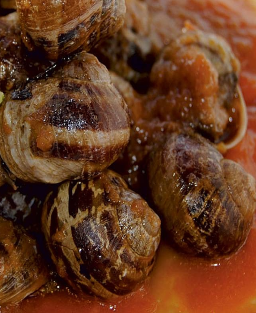
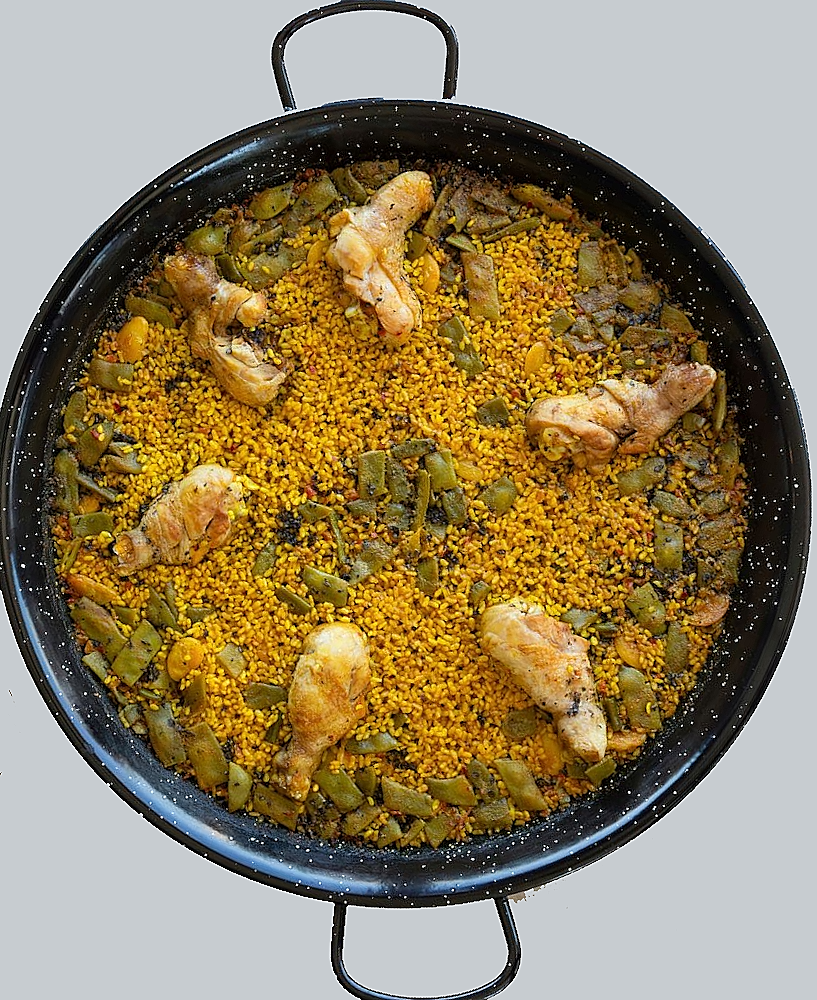
Valenciana version — codified reference version Chicken, rabbit, garrofones (large white beans), ferrura (flat green beans), artichoke, snails, tomato, saffron, rosemary, Bomba rice. No seafood whatsoever. The only mollusc in its composition is the land snail. Cooked over wood fire, without stirring, with mandatory formation of the socarrat.
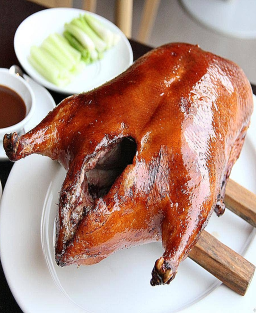
Albufera version — historical birthplace The essential ingredients that have always been used: chicken, rabbit, ferrura (green beans), broad beans, tomatoes, rice, olive oil, water, saffron and salt. By region, ingredients such as garlic, artichoke, duck, paprika, snails or rosemary are also accepted and permitted within the denomination. It is a dish of humble origin born in the Albufera of Valencia, precisely in the city of Sueca, according to the oral tradition of the region.
Alicante version — arroz a banda Coastal variant using seafood and fish — called arroz a banda or paella de marisco. Cannot claim the Paella Valenciana designation. Outside the codification.
Diaspora version (Spanish communities in Europe and the Americas) Substitution of Bomba rice with long-grain or ordinary rice. Addition of seafood, peppers, peas, chorizo — ingredients prohibited in the codified version. Use of yellow food colouring as a replacement for saffron. Result radically different from the authentic version.
Contemporary gastronomic version Quique Dacosta, three-Michelin-star chef, has developed a perfected socarrat technique: pour very hot stock, bring to the boil at maximum heat, cook ten minutes, reduce to low heat six minutes, then raise the heat again two minutes to caramelise the bottom. Use of Albufera rice smoked with orange wood. Stock cooked slowly for up to three hours, filtered to guarantee optimal absorption.
⚠️ Status: the Paella Valenciana enjoys official protection in Spain. In 2012, the Agriculture department of the Consell de la Generalitat Valenciana established that the list of paella ingredients would be protected by a Denominación de Origen. The Valencian Generalitat has also declared the paella a Cultural Asset of Interest (BIC), granting it a protection status under Spanish historical heritage, as a first step towards UNESCO recognition.
Period of appearance: The Valencian paella has its peasant roots in the 19th century, in the farms and rice fields of the Albufera of Valencia. The first documented versions are those of the agricultural workers of the rice fields, cooking over wood fire with the immediate resources of the terroir. It is in the 20th century, and more specifically from the 1950s–1960s, that the dish progressively standardised and spread at national and international level, particularly driven by mass tourism. This period marks its popularisation, not its appearance.
Disappeared or modified ingredients: duck, once common in peasant versions from the Albufera, has progressively given way to chicken and rabbit. Snails, present in the strict traditional version, have become optional in many contemporary versions.
Progressively added ingredients: saffron became widespread in the 20th century for its colour and aroma. Rosemary, present in some regional versions, has become an aromatic marker of the codified version.
Recent standardisation: in 2012, the Agriculture department of the Consell de la Generalitat Valenciana established the protection by Denominación de Origen of Valencia rice, fixing the list of mandatory ingredients. The declaration as Cultural Asset of Interest by the Generalitat specifies the recipe, the manufacturing techniques, the mode of cultivation and harvesting of the rice, and provides for protection and safeguard measures to guarantee its transmission to future generations.
Modern adaptations: development of authentic paella kits for home cooking, notably by Quique Dacosta with his A Fuego range. Vegetarian versions admitted under the designation paella de verduras — outside the strict Valenciana designation. No vegan or gluten-free version may claim the codified designation.
Type of dish: main course. Service: traditional (family Sunday lunch, popular festivals), gastronomic (starred chef interpretations), collective (large gatherings, Fallas de Valencia). Number of portions: 4 to 6 in standard family version. Technical level: intermediate to advanced — mastery of fire, stock/rice ratio, and socarrat formation indispensable.
Location and Terroir
Origin and Transmission
Official Status and Certifications
1. Mandatory Products (The 10 Base Ingredients)
2. Authorised Ingredients (Admissible Regional Variations)
3. Imposed Manufacturing Techniques
4. Strict Prohibitions (Designation Exclusion Clause)
Paella sense foc de llenya, no és paella valenciana. Translation: «Paella without wood fire is not a Valencian paella.» Popular saying from the Valencia region.
Founding legend The oral tradition of the villages of the Albufera crystallises the origin of the Paella in an immutable Sunday narrative. It is said that the dish was born from the pragmatism of peasants working in the heart of the rice fields. One Sunday morning, collective improvisation became the rule: each worker contributed to the common endeavour with the immediate resources of the terroir. One offered the chicken escaped from the farmyard, another the rabbit caught at dawn; fresh beans from the kitchen garden and snails (vaquetes) gathered at the rhythm of the rains were added. Gathered at the lakeside, they converged these ingredients in the steel of a single pan, sealing the alliance of rice and wood fire. This original sharing, where the rice was consumed from the vessel itself with a wooden spoon, transcends today the simple meal. It remains the foundation of the Valencian Sunday ritual, elevating the Paella to a symbol of family cohesion and respect for the agropastoral cycle.
History
Birth of a peasant dish (19th century) Rice from the region's rice fields was cooked over wood fire, with the basic foods of the Spanish diet drawn from the farmyard and kitchen garden added to it. Cooked in a single vessel that also served as a communal dish, the paella was eaten directly from the cooking pan. The dish was born on the margins of the Albufera of Valencia, a wetland and rice-growing area south of the Valencian capital, in a context of peasant frugality and subsistence economy.
Cultural influences and exchanges The main ingredient of the paella is rice. It was introduced into Spain during the Arab period, thanks to the establishment of highly developed irrigation systems. The Arabs introduced rice into the Iberian Peninsula from the 8th century onwards and, more intensively from the 10th century, developed large-scale irrigated cultivation in the Valencian region thanks to their sophisticated irrigation systems — the acequias — without which the rice fields of the Albufera would never have existed. Saffron, also a heritage of the Arab period in Spain, provides the characteristic golden colour.
Popularisation and national reach (20th century) It is truly in the 20th century that the paella becomes popular at national level. Several factors contribute to its reach: growing urbanisation, internal migrations from the Valencian region to the rest of Spain, and the rise of mass tourism on the Mediterranean coast in the 1960s–1980s. The anecdote according to which Franco officially promoted the paella as the national dish because its colours recall those of the Spanish flag is frequently cited, but is not supported by reliable historical sources — it belongs more to popular oral tradition than to verified historical documentation. The tourist boom of the 1960s–1980s spread a simplified and often distorted image of paella throughout the world — seafood, chorizo, peppers — which Valencian purists unanimously reject. This tourist distortion is precisely what leads, from the 2000s onwards, to the official codification and institutional protection of the dish.
Codification and contemporary protection In 2014, a group of eminent Valencians, local chefs and businesses from the Valencia region gathered and decided to found the Wikipaella Foundation, with the objective of clarifying what truly constitutes an authentic paella and promoting its recognition. The declaration as Cultural Asset of Interest by the Generalitat includes the main denomination of the Valencian paella, the description of its recipe with its regional variants, the mode of cultivation and harvesting of the rice, as well as the different manufacturing techniques.
Reference gastronomic chefs
Quique Dacosta — Quique Dacosta Restaurant — Dénia (Alicante) 3 Michelin stars. Leading figure of contemporary Valencian gastronomic cuisine. Chef passionate about authentic paella, he shares his five golden rules: cooking over fire, filtered and very hot stock, rice as a flavour conductor rather than an ingredient, meat added at the end of cooking, socarrat obtained by alternating strong and gentle heat. He published the reference book Arroces Contemporáneos in 2005. Website: www.quiquedacosta.es
El Poblet — Luis Valls — Valencia 2 Michelin star gastronomic restaurant. Luis Valls offers high cuisine te cocina València in the centre of Valencia. Part of the Quique Dacosta group. Website: www.elpobletrestaurante.com
Llisa Negra — Quique Dacosta — Valencia Since 2018, offers different rice dishes cooked over wood fire in a paella pan in full view of the restaurant in the centre of Valencia. Website: www.llisanegra.com
Dabiz Muñoz — DiverXo — Madrid Three Michelin star chef, has publicly declared that Casa Carmela in Valencia prepares the best paella in Spain. Website: www.diverxo.com
Traditional popular establishments
Casa Carmela — Valencia (Playa de la Malvarrosa) For nearly 100 years, fire has played an essential role and tradition, quality and local raw materials do the rest. The Valencian paella at Casa Carmela is prepared according to traditional methods over open fire fuelled with orange wood. Reservation mandatory 48 hours in advance for the Paella Valenciana. Website: www.casa-carmela.com
Restaurante Rioja — Benisanó (province of Valencia) Opened in 1924. Quique Dacosta has publicly declared that Restaurante Rioja serves the best Valencian paella in Valencia. Family restaurant specialising in paellas a la leña, prepared by Víctor Rioja, fourth generation of the family. The wood used is always orange wood dried for approximately two years. Website: www.hotelrioja.com
La Pepica — Valencia (Playa de la Malvarrosa) Mythical restaurant on the Malvarrosa beach where Hemingway himself was a regular. Historic institution of the Valencian seafront since 1898. Website: www.lapepica.com
Concurso Internacional de Paella de Sueca — Sueca (province of Valencia) International Valencian paella competition organised every year in Sueca, a city considered the historical birthplace of the dish. Website: www.paellasueca.com
Presentation Large flat pan (paellera) served in the centre of the table — diameter 40 to 55 cm for 4 to 6 people. Thin and regular layer of rice, golden to amber in colour from the saffron. Pieces of meat and vegetables visible on the surface. Slightly blackened and crispy bottom: the socarrat, the most sought-after part of the dish. No contemporary plating elements in the traditional version — the pan is the plate.
Texture Rice: separated grains, non-sticky, slightly al dente on the surface, tender at the core, with a fine caramelised crust at the bottom. Bomba rice has great resistance to expansion during cooking, with a higher amylose content than average making it less sticky. These characteristics enable the realisation of the socarrat.
Dominant aromas Saffron dominant in colour and aroma. Toasted and slightly smoky base of the socarrat. Woody and resinous notes if cooked with orange wood. Rosemary at the end of cooking providing a Mediterranean herbal touch.
Culinary particularities Cooking in a single flat pan, over high heat, without a lid and without stirring the rice. Mandatory formation of the socarrat for authenticity. Stock added hot in a single go, never in several instalments. The rice is not considered an ingredient but the plate on which the dish is served, a conductor of the stock's flavour.
Cereal base and meat proteins
Identity vegetable garnish
Fat, liquid and aromatics
General information
Step 1 — Mise en place Prepare and filter the poultry stock — it must be clear and hot (≥ 80°C) at the moment of pouring. Infuse the saffron in a small quantity of hot stock for a minimum of 10 minutes. Cut the vegetables, prepare the meat pieces. Measure the rice precisely.
Step 2 — Browning the meats Heat the olive oil over high heat in the paellera. Brown the chicken and rabbit pieces on all sides until deep and uniform coloration. Push the meat to the edges of the pan to free the centre.
Step 3 — Sofrito and vegetables In the centre of the pan, sauté the green beans and artichokes until lightly coloured. Add the grated tomatoes and reduce over high heat for 8 to 10 minutes until obtaining a dense and caramelised sofrito. Incorporate the sweet paprika one minute before pouring the stock — take care not to burn it. Mix everything together in the pan.
Step 4 — Adding the stock and rice
The stock: two methods according to approach
Method 1 — The original peasant version In the traditional recipe, there was no separately prepared stock. It was built directly in the pan, in several steps:
This is the Valencian peasant's method: everything is built in a single vessel, from beginning to end.
Method 2 — The gastronomic version In this more controlled approach, the stock is prepared in advance and separately, then incorporated at the precise moment of cooking the rice:
The stock, carefully prepared separately, brings controlled depth of flavour and allows better control of the rice cooking.
Step 5 — Rice cooking and socarrat Cook over high heat for 10 minutes, then reduce to low heat for 8 to 10 minutes until complete absorption of the stock. For the socarrat: in the last two minutes, raise the heat to maximum to caramelise the bottom. Monitor by ear — a slight crackling signals the formation of the socarrat. Stop immediately if a burning smell appears.
Step 6 — Resting and service Remove from heat. Leave to rest 5 minutes covered with a clean cloth — never with a lid, which would trap steam and soften the rice. Serve the paellera in the centre of the table. Eat directly from the pan with a wooden spoon, according to Valencian tradition.
Tolerances and corrections
The authentic Valencian paella does not include a separate sauce. The sauce is the stock itself, absorbed entirely by the rice during cooking — no residual sauce in the pan at the end.
Traditional regional condiment Alioli (Valencian alioli) — emulsion of raw garlic and olive oil, without egg yolk in the strictly Valencian version. Served separately, it is used exclusively with fish and seafood paellas. Alioli does not accompany the chicken and rabbit Paella Valenciana in the orthodox version.
Service
Cold chain
Core cooking temperatures
Prevention of cross-contamination
Frequent errors
Texture tips
Aroma and flavour tips
Chef's advice The secret of an authentic paella lies in the heat. Traditionally, paella was cooked outdoors over open fire. If cooking on a gas stove, position the pan in the centre and light all burners simultaneously for stable and uniform heat across the entire surface. Paella is a Sunday and celebration dish — it demands time, attention and a good pan.
Vessel — the paellera itself, placed on a trivet support in the centre of the table. The paella is traditionally never transferred to another dish.
Service temperature — immediate, ideally ≥ 70°C.
Traditional garnishes
Wines and pairings
⚠️ Indicative values to be confirmed by analysis in an accredited laboratory.
Paella — Valencian and Spanish term designating both the dish and the pan in which it is cooked. Etymology: Latin patella.
Socarrat — The thin crispy layer of rice at the bottom of the pan that constitutes the very essence of a true paella. The most sought-after part of the dish by Valencians.
Bomba rice — Short-grain rice with great resistance to expansion during cooking, capable of reaching up to two or three times the initial grain volume, with a higher amylose content than average making it less sticky. Mandatory variety in the codified version.
Garrofó — Valencian Lima bean (Phaseolus lunatus), a local variety with a large slightly floury white grain, mandatory ingredient of the codified Paella Valenciana. Non-substitutable in the strict version.
Ferrura — Flat wide-podded green bean (bajoqueta), local Valencian variety, mandatory ingredient of the codified Paella Valenciana.
Sofrito — Aromatic base of the paella consisting of grated tomato, possibly garlic and vegetables, reduced over high heat until caramelisation. Aromatic backbone of the dish.
Denominación de Origen Arroz de Valencia — Spanish protected designation of origin regulating the production of Valencian rice. The most prized varieties are Bahía, Senia and Bomba.
Albufera — Wetland and natural lake located south of Valencia, historical heart of Valencian rice growing and birthplace of the paella. Protected natural park of 1,600 hectares.
Wikipaella — Valencian foundation created in 2014 to define, document and promote the authentic recipe of Valencian paella. Website: www.wikipaella.org
BIC (Cultural Asset of Interest) — Spanish historical heritage protection status, granted to the Valencian paella by the Valencian Generalitat.
File established according to the Professional Framework Heritage Recipe File — Optimised version March 2026.
Name in original language: Paella Valenciana (Valencian and Spanish)
Attested etymology: Paella is a word derived from the Latin patella, meaning «small dish» or «shallow vessel», a utensil introduced into the Iberian Peninsula by the Romans. This Latin term is also the origin of the Old French paële, ancient form of the modern French poêle, and of the Valencian paella, which designates both the utensil and, by extension, the dish cooked in it. While the Romans transmitted the name and the principle of the vessel, it was the Arabs, from the 8th century onwards and more intensively from the 10th century, who introduced and developed large-scale irrigated rice cultivation in the Valencian region, made possible by their sophisticated irrigation systems — the acequias — without which the rice fields of the Albufera would never have existed. The paella is therefore, from its very etymology, the fruit of two complementary civilisational heritages: Roman for the name and principle of the vessel, Arab for the content.
Other attested names:
⚠️ The term «paella» is a generic term, not legally protected at international level. It may therefore be used freely to designate different variants of the dish. However, the designation Paella Valenciana enjoys official protection in Spain, regulated by the Reglament de la Paella Valenciana and the Denominación de Origen Arroz de Valencia. Only recipes respecting the official specifications — ingredients, techniques, rice variety — may claim this protected designation. Other variants (seafood, mixed, vegetarian) must be designated by their own name and may not claim the codified Paella Valenciana designation.
Valenciana version — codified reference version Chicken, rabbit, garrofones (large white beans), ferrura (flat green beans), artichoke, snails, tomato, saffron, rosemary, Bomba rice. No seafood whatsoever. The only mollusc in its composition is the land snail. Cooked over wood fire, without stirring, with mandatory formation of the socarrat.
Albufera version — historical birthplace The essential ingredients that have always been used: chicken, rabbit, ferrura (green beans), broad beans, tomatoes, rice, olive oil, water, saffron and salt. By region, ingredients such as garlic, artichoke, duck, paprika, snails or rosemary are also accepted and permitted within the denomination. It is a dish of humble origin born in the Albufera of Valencia, precisely in the city of Sueca, according to the oral tradition of the region.
Alicante version — arroz a banda Coastal variant using seafood and fish — called arroz a banda or paella de marisco. Cannot claim the Paella Valenciana designation. Outside the codification.
Diaspora version (Spanish communities in Europe and the Americas) Substitution of Bomba rice with long-grain or ordinary rice. Addition of seafood, peppers, peas, chorizo — ingredients prohibited in the codified version. Use of yellow food colouring as a replacement for saffron. Result radically different from the authentic version.
Contemporary gastronomic version Quique Dacosta, three-Michelin-star chef, has developed a perfected socarrat technique: pour very hot stock, bring to the boil at maximum heat, cook ten minutes, reduce to low heat six minutes, then raise the heat again two minutes to caramelise the bottom. Use of Albufera rice smoked with orange wood. Stock cooked slowly for up to three hours, filtered to guarantee optimal absorption.
⚠️ Status: the Paella Valenciana enjoys official protection in Spain. In 2012, the Agriculture department of the Consell de la Generalitat Valenciana established that the list of paella ingredients would be protected by a Denominación de Origen. The Valencian Generalitat has also declared the paella a Cultural Asset of Interest (BIC), granting it a protection status under Spanish historical heritage, as a first step towards UNESCO recognition.
Period of appearance: The Valencian paella has its peasant roots in the 19th century, in the farms and rice fields of the Albufera of Valencia. The first documented versions are those of the agricultural workers of the rice fields, cooking over wood fire with the immediate resources of the terroir. It is in the 20th century, and more specifically from the 1950s–1960s, that the dish progressively standardised and spread at national and international level, particularly driven by mass tourism. This period marks its popularisation, not its appearance.
Disappeared or modified ingredients: duck, once common in peasant versions from the Albufera, has progressively given way to chicken and rabbit. Snails, present in the strict traditional version, have become optional in many contemporary versions.
Progressively added ingredients: saffron became widespread in the 20th century for its colour and aroma. Rosemary, present in some regional versions, has become an aromatic marker of the codified version.
Recent standardisation: in 2012, the Agriculture department of the Consell de la Generalitat Valenciana established the protection by Denominación de Origen of Valencia rice, fixing the list of mandatory ingredients. The declaration as Cultural Asset of Interest by the Generalitat specifies the recipe, the manufacturing techniques, the mode of cultivation and harvesting of the rice, and provides for protection and safeguard measures to guarantee its transmission to future generations.
Modern adaptations: development of authentic paella kits for home cooking, notably by Quique Dacosta with his A Fuego range. Vegetarian versions admitted under the designation paella de verduras — outside the strict Valenciana designation. No vegan or gluten-free version may claim the codified designation.
Type of dish: main course. Service: traditional (family Sunday lunch, popular festivals), gastronomic (starred chef interpretations), collective (large gatherings, Fallas de Valencia). Number of portions: 4 to 6 in standard family version. Technical level: intermediate to advanced — mastery of fire, stock/rice ratio, and socarrat formation indispensable.
Location and Terroir
Origin and Transmission
Official Status and Certifications
1. Mandatory Products (The 10 Base Ingredients)
2. Authorised Ingredients (Admissible Regional Variations)
3. Imposed Manufacturing Techniques
4. Strict Prohibitions (Designation Exclusion Clause)
Paella sense foc de llenya, no és paella valenciana. Translation: «Paella without wood fire is not a Valencian paella.» Popular saying from the Valencia region.
Founding legend The oral tradition of the villages of the Albufera crystallises the origin of the Paella in an immutable Sunday narrative. It is said that the dish was born from the pragmatism of peasants working in the heart of the rice fields. One Sunday morning, collective improvisation became the rule: each worker contributed to the common endeavour with the immediate resources of the terroir. One offered the chicken escaped from the farmyard, another the rabbit caught at dawn; fresh beans from the kitchen garden and snails (vaquetes) gathered at the rhythm of the rains were added. Gathered at the lakeside, they converged these ingredients in the steel of a single pan, sealing the alliance of rice and wood fire. This original sharing, where the rice was consumed from the vessel itself with a wooden spoon, transcends today the simple meal. It remains the foundation of the Valencian Sunday ritual, elevating the Paella to a symbol of family cohesion and respect for the agropastoral cycle.
History
Birth of a peasant dish (19th century) Rice from the region's rice fields was cooked over wood fire, with the basic foods of the Spanish diet drawn from the farmyard and kitchen garden added to it. Cooked in a single vessel that also served as a communal dish, the paella was eaten directly from the cooking pan. The dish was born on the margins of the Albufera of Valencia, a wetland and rice-growing area south of the Valencian capital, in a context of peasant frugality and subsistence economy.
Cultural influences and exchanges The main ingredient of the paella is rice. It was introduced into Spain during the Arab period, thanks to the establishment of highly developed irrigation systems. The Arabs introduced rice into the Iberian Peninsula from the 8th century onwards and, more intensively from the 10th century, developed large-scale irrigated cultivation in the Valencian region thanks to their sophisticated irrigation systems — the acequias — without which the rice fields of the Albufera would never have existed. Saffron, also a heritage of the Arab period in Spain, provides the characteristic golden colour.
Popularisation and national reach (20th century) It is truly in the 20th century that the paella becomes popular at national level. Several factors contribute to its reach: growing urbanisation, internal migrations from the Valencian region to the rest of Spain, and the rise of mass tourism on the Mediterranean coast in the 1960s–1980s. The anecdote according to which Franco officially promoted the paella as the national dish because its colours recall those of the Spanish flag is frequently cited, but is not supported by reliable historical sources — it belongs more to popular oral tradition than to verified historical documentation. The tourist boom of the 1960s–1980s spread a simplified and often distorted image of paella throughout the world — seafood, chorizo, peppers — which Valencian purists unanimously reject. This tourist distortion is precisely what leads, from the 2000s onwards, to the official codification and institutional protection of the dish.
Codification and contemporary protection In 2014, a group of eminent Valencians, local chefs and businesses from the Valencia region gathered and decided to found the Wikipaella Foundation, with the objective of clarifying what truly constitutes an authentic paella and promoting its recognition. The declaration as Cultural Asset of Interest by the Generalitat includes the main denomination of the Valencian paella, the description of its recipe with its regional variants, the mode of cultivation and harvesting of the rice, as well as the different manufacturing techniques.
Reference gastronomic chefs
Quique Dacosta — Quique Dacosta Restaurant — Dénia (Alicante) 3 Michelin stars. Leading figure of contemporary Valencian gastronomic cuisine. Chef passionate about authentic paella, he shares his five golden rules: cooking over fire, filtered and very hot stock, rice as a flavour conductor rather than an ingredient, meat added at the end of cooking, socarrat obtained by alternating strong and gentle heat. He published the reference book Arroces Contemporáneos in 2005. Website: www.quiquedacosta.es
El Poblet — Luis Valls — Valencia 2 Michelin star gastronomic restaurant. Luis Valls offers high cuisine te cocina València in the centre of Valencia. Part of the Quique Dacosta group. Website: www.elpobletrestaurante.com
Llisa Negra — Quique Dacosta — Valencia Since 2018, offers different rice dishes cooked over wood fire in a paella pan in full view of the restaurant in the centre of Valencia. Website: www.llisanegra.com
Dabiz Muñoz — DiverXo — Madrid Three Michelin star chef, has publicly declared that Casa Carmela in Valencia prepares the best paella in Spain. Website: www.diverxo.com
Traditional popular establishments
Casa Carmela — Valencia (Playa de la Malvarrosa) For nearly 100 years, fire has played an essential role and tradition, quality and local raw materials do the rest. The Valencian paella at Casa Carmela is prepared according to traditional methods over open fire fuelled with orange wood. Reservation mandatory 48 hours in advance for the Paella Valenciana. Website: www.casa-carmela.com
Restaurante Rioja — Benisanó (province of Valencia) Opened in 1924. Quique Dacosta has publicly declared that Restaurante Rioja serves the best Valencian paella in Valencia. Family restaurant specialising in paellas a la leña, prepared by Víctor Rioja, fourth generation of the family. The wood used is always orange wood dried for approximately two years. Website: www.hotelrioja.com
La Pepica — Valencia (Playa de la Malvarrosa) Mythical restaurant on the Malvarrosa beach where Hemingway himself was a regular. Historic institution of the Valencian seafront since 1898. Website: www.lapepica.com
Concurso Internacional de Paella de Sueca — Sueca (province of Valencia) International Valencian paella competition organised every year in Sueca, a city considered the historical birthplace of the dish. Website: www.paellasueca.com
Presentation Large flat pan (paellera) served in the centre of the table — diameter 40 to 55 cm for 4 to 6 people. Thin and regular layer of rice, golden to amber in colour from the saffron. Pieces of meat and vegetables visible on the surface. Slightly blackened and crispy bottom: the socarrat, the most sought-after part of the dish. No contemporary plating elements in the traditional version — the pan is the plate.
Texture Rice: separated grains, non-sticky, slightly al dente on the surface, tender at the core, with a fine caramelised crust at the bottom. Bomba rice has great resistance to expansion during cooking, with a higher amylose content than average making it less sticky. These characteristics enable the realisation of the socarrat.
Dominant aromas Saffron dominant in colour and aroma. Toasted and slightly smoky base of the socarrat. Woody and resinous notes if cooked with orange wood. Rosemary at the end of cooking providing a Mediterranean herbal touch.
Culinary particularities Cooking in a single flat pan, over high heat, without a lid and without stirring the rice. Mandatory formation of the socarrat for authenticity. Stock added hot in a single go, never in several instalments. The rice is not considered an ingredient but the plate on which the dish is served, a conductor of the stock's flavour.
Cereal base and meat proteins
Identity vegetable garnish
Fat, liquid and aromatics
General information
Step 1 — Mise en place Prepare and filter the poultry stock — it must be clear and hot (≥ 80°C) at the moment of pouring. Infuse the saffron in a small quantity of hot stock for a minimum of 10 minutes. Cut the vegetables, prepare the meat pieces. Measure the rice precisely.
Step 2 — Browning the meats Heat the olive oil over high heat in the paellera. Brown the chicken and rabbit pieces on all sides until deep and uniform coloration. Push the meat to the edges of the pan to free the centre.
Step 3 — Sofrito and vegetables In the centre of the pan, sauté the green beans and artichokes until lightly coloured. Add the grated tomatoes and reduce over high heat for 8 to 10 minutes until obtaining a dense and caramelised sofrito. Incorporate the sweet paprika one minute before pouring the stock — take care not to burn it. Mix everything together in the pan.
Step 4 — Adding the stock and rice
The stock: two methods according to approach
Method 1 — The original peasant version In the traditional recipe, there was no separately prepared stock. It was built directly in the pan, in several steps:
This is the Valencian peasant's method: everything is built in a single vessel, from beginning to end.
Method 2 — The gastronomic version In this more controlled approach, the stock is prepared in advance and separately, then incorporated at the precise moment of cooking the rice:
The stock, carefully prepared separately, brings controlled depth of flavour and allows better control of the rice cooking.
Step 5 — Rice cooking and socarrat Cook over high heat for 10 minutes, then reduce to low heat for 8 to 10 minutes until complete absorption of the stock. For the socarrat: in the last two minutes, raise the heat to maximum to caramelise the bottom. Monitor by ear — a slight crackling signals the formation of the socarrat. Stop immediately if a burning smell appears.
Step 6 — Resting and service Remove from heat. Leave to rest 5 minutes covered with a clean cloth — never with a lid, which would trap steam and soften the rice. Serve the paellera in the centre of the table. Eat directly from the pan with a wooden spoon, according to Valencian tradition.
Tolerances and corrections
The authentic Valencian paella does not include a separate sauce. The sauce is the stock itself, absorbed entirely by the rice during cooking — no residual sauce in the pan at the end.
Traditional regional condiment Alioli (Valencian alioli) — emulsion of raw garlic and olive oil, without egg yolk in the strictly Valencian version. Served separately, it is used exclusively with fish and seafood paellas. Alioli does not accompany the chicken and rabbit Paella Valenciana in the orthodox version.
Service
Cold chain
Core cooking temperatures
Prevention of cross-contamination
Frequent errors
Texture tips
Aroma and flavour tips
Chef's advice The secret of an authentic paella lies in the heat. Traditionally, paella was cooked outdoors over open fire. If cooking on a gas stove, position the pan in the centre and light all burners simultaneously for stable and uniform heat across the entire surface. Paella is a Sunday and celebration dish — it demands time, attention and a good pan.
Vessel — the paellera itself, placed on a trivet support in the centre of the table. The paella is traditionally never transferred to another dish.
Service temperature — immediate, ideally ≥ 70°C.
Traditional garnishes
Wines and pairings
⚠️ Indicative values to be confirmed by analysis in an accredited laboratory.
Paella — Valencian and Spanish term designating both the dish and the pan in which it is cooked. Etymology: Latin patella.
Socarrat — The thin crispy layer of rice at the bottom of the pan that constitutes the very essence of a true paella. The most sought-after part of the dish by Valencians.
Bomba rice — Short-grain rice with great resistance to expansion during cooking, capable of reaching up to two or three times the initial grain volume, with a higher amylose content than average making it less sticky. Mandatory variety in the codified version.
Garrofó — Valencian Lima bean (Phaseolus lunatus), a local variety with a large slightly floury white grain, mandatory ingredient of the codified Paella Valenciana. Non-substitutable in the strict version.
Ferrura — Flat wide-podded green bean (bajoqueta), local Valencian variety, mandatory ingredient of the codified Paella Valenciana.
Sofrito — Aromatic base of the paella consisting of grated tomato, possibly garlic and vegetables, reduced over high heat until caramelisation. Aromatic backbone of the dish.
Denominación de Origen Arroz de Valencia — Spanish protected designation of origin regulating the production of Valencian rice. The most prized varieties are Bahía, Senia and Bomba.
Albufera — Wetland and natural lake located south of Valencia, historical heart of Valencian rice growing and birthplace of the paella. Protected natural park of 1,600 hectares.
Wikipaella — Valencian foundation created in 2014 to define, document and promote the authentic recipe of Valencian paella. Website: www.wikipaella.org
BIC (Cultural Asset of Interest) — Spanish historical heritage protection status, granted to the Valencian paella by the Valencian Generalitat.
File established according to the Professional Framework Heritage Recipe File — Optimised version March 2026.