
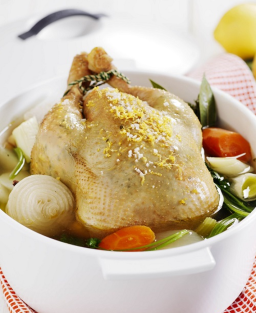
Occitan: Recèpta tradicionau de la Pola al Poishon d’Enric Quate
An emblematic recipe of French cuisine, symbol of prosperity and conviviality, Henri IV’s Poule au Pot embodies the spirit of local gastronomy: simplicity, sharing, and the excellence of farm products.
Other names:
Occitan (Gascon/Béarnais): Pola al poishon, Pola farcida al poishon, La pola deu Henric Quart
French: Poule au bouillon, Poule farcie au bouillon, Poule farcie d’Henri IV
"I want every farmer in my kingdom to be able to put a chicken in the pot on Sundays." — Henri IV
In Old French: “Chascun laboureur doibt avoir sa poule en la pote.”
This phrase became a symbol of prosperity and the good life that King Henri IV wanted for his subjects. The “poule au pot” was not just a dish but an ideal: peace and well-being in the French countryside.
It is said that Henri IV, passing through a Béarn village, saw peasant tables lacking meat. Touched, he promised his minister Sully that he would ensure every household could enjoy a poule au pot on a festive day. This promise made the dish a symbol of well-being and social justice, celebrating peace and rural prosperity.
In the hills of Monein, there once lived a young winemaker named Baptiste and a spinner named Maridòu. They had loved each other since childhood, but their families were feuding over a small plot of land and opposed their union.
Every evening, Baptiste went to the washhouse where Maridòu washed wool. He brought her eggs from a white hen he raised behind the barn. It was said to be a “heaven-blessed” hen, born on an Easter Sunday, that always laid eggs before dawn.
When winter scarcity arrived, his hungry family begged Baptiste to give them his hen to eat. Out of love—and so that no one went hungry—he agreed, provided the broth was shared equally among everyone. Maridòu, in tears, blessed the poultry before it was put in the pot.
It was said that those who tasted the broth saw their love last a lifetime.
Since that day, in Monein, when a young girl shares her poule au pot meal with her fiancé, it is said she “puts her heart in the pot.”
Country: France
Region: Béarn / Southwest
Inventor: Passed down orally, popularized at Henri IV’s court
Codified recipe: Yes
Unofficial specifications: Farm chicken, stuffing made of pork or veal, clear root vegetable broth, served with soup or white sauce
16th–17th century: The chicken became a symbol of nobility and prosperity in France.
François Pierre La Varenne (1615–1678) describes recipes for poule au pot, fricassee chicken, and stuffed chicken in Le Cuisinier François.
Henri IV popularized “poule au pot” for all his subjects.
The Poule au Pot originates from medieval rural traditions, where poultry was a festive dish reserved for special occasions. Under Henri IV (1589–1610), the dish became a political symbol of prosperity and peace after the Wars of Religion.
17th century: The recipe spread among noble and peasant households, codified by La Varenne with slow, gentle cooking in aromatic broth.
19th century: Mentioned in most domestic and bourgeois cookbooks, with regional variations:
Gers: foie gras stuffing
Béarn: broth with cloves
North: assorted vegetables
Today, it remains a classic in culinary competitions and inns, symbolizing a generous France rooted in local tradition.
La Varenne (17th c.) – Cooking method in aromatic broth
Antonin Carême (19th c.) – Presentation with supreme sauce and pilaf rice
Auguste Escoffier (early 20th c.) – Codified bourgeois garnishes in Le Guide Culinaire
Paul Bocuse (20th c.) – Emphasis on Bresse poultry and simplicity of broth
Joël Robuchon (20th c.) – Mousse-like stuffing for airy texture
Hélène Darroze (21st c.) – Landes poultry and heirloom vegetables, contemporary gourmet version
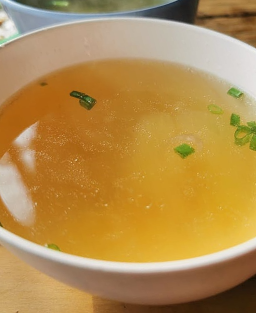
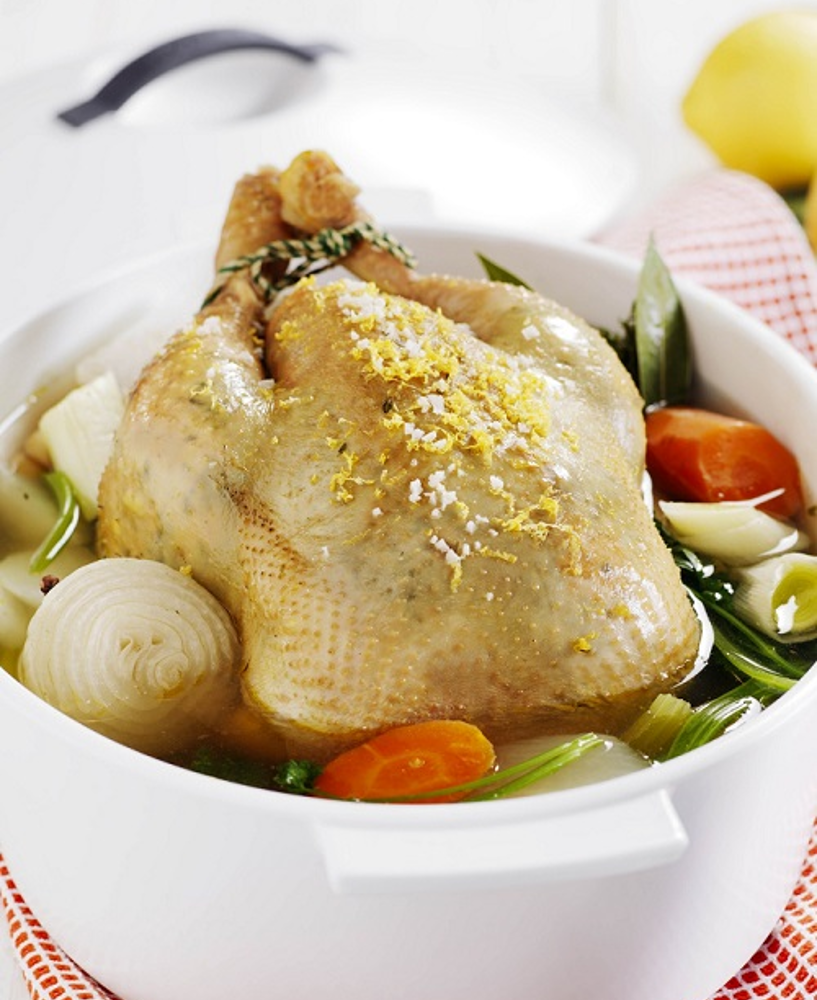
Appearance: Whole poached chicken, tender meat, clear golden broth
Texture: Tender meat, melting stuffing, slightly crisp vegetables
Aromas: Poultry, pot-au-feu herbs, clove, celery
Particularities: Gentle cooking, aromatic broth skimmed regularly, stuffing combining pork, bread, and herbs
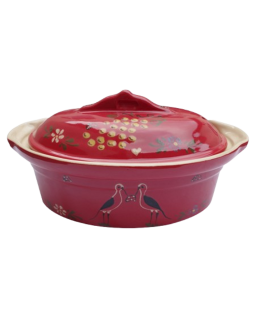
Necessary utensils: Pot or Dutch oven, skimmer, string, knife, cutting board, fine sieve, ladle, thermometer, chinois
1 farm-raised pullet (1.5–2 kg)
2 garlic cloves, chopped
2 carrots
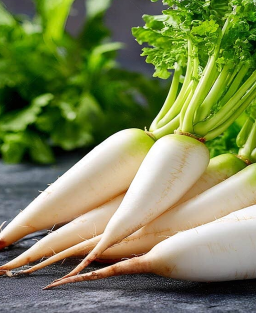
2 turnips
2 leeks
1 onion studded with 2 cloves
1 bouquet garni (thyme, bay leaf, parsley, celery)
2.5 liters chicken broth
1 marrow bone
Salt, pepper
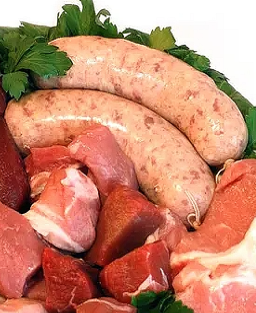
200 g veal mince
3 slices brioche
200 ml semi-skimmed milk
2 shallots
150 g mushrooms (button or porcini)
½ bunch chervil
1 small truffle
50 g candied chestnut pieces
300 g raw duck foie gras
Grapeseed oil (or neutral oil)
10 g butter
50 ml Armagnac
2 egg yolks
Salt, freshly ground pepper
Prep time: 45 min
Cooking time: 2 h 30 min – 3 h
Remove crusts from brioche slices, cut into pieces, soak in milk
Peel and finely chop shallots
Clean and thinly slice mushrooms
Rinse, dry, pluck, and chop chervil
Peel truffle and dice finely
Cut raw foie gras into 1 cm cubes
Heat a drizzle of oil in a pan, sweat shallots for 5–6 min without browning until soft → transfer to a bowl
In the same pan, sweat mushrooms over high heat. Drain immediately, reduce liquid, add butter, return mushrooms and cook 5 min → add to bowl
Add veal mince, soaked brioche, Armagnac, and egg yolks → mix well
Incorporate chervil, candied chestnuts, foie gras, truffle
Season generously, mix gently to avoid crushing foie gras
Cover and refrigerate until use
Pro tip: Stuffing must hold together in the bird without dissolving during cooking
Clean and season cavity, optionally debone
Stuff cavity with prepared filling
Truss and close carefully with needle and string
Chef’s tip: Proper closure ensures uniform cooking and neat presentation
Place stuffed chicken in pot, cover with chicken broth
Add vegetables, clove-studded onion, marrow bone, bouquet garni
Bring to gentle boil, skimming repeatedly
Technical tip: Keep liquid just below boiling to keep poultry firm
Simmer gently 2 h 30 min – 3 h, monitor broth and vegetables
Core temperature ~82 °C
Turn gently at halfway for even cooking
Tip: Slow cooking preserves flavor, texture, and juices
Rest poultry 10–15 min under foil for juice redistribution
Remove vegetables, aromatics, marrow, strain broth through fine sieve or chinois
For clear consommé, clarify with egg white
Adjust seasoning, optionally add cream or beurre monté
Keep broth at 65–70 °C for service, or cool to ≤4 °C for storage
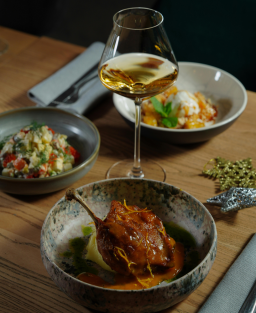
Serving tip: Serve whole or sliced with vegetables and some broth, or serve broth separately for refined presentation
Carving poultry – follow natural joints, use sharp knife, stable board
Vegetables – cut into uniform portions, glaze with hot broth or butter
Cocotte presentation – arrange chicken and vegetables, add some broth
Plate presentation – meat center, vegetables around, drizzle broth
Broth on the side – serve separately
Final tips – start cooking in cold water, never boil, glaze vegetables, alternate colors for visual impact, keep poultry and broth at 65–70 °C
White wines: Meursault 2020/21 (buttery, nutty), Pouilly-Fuissé 2021/22 (subtle minerality), Sancerre 2022 (freshness, liveliness)
Light reds: Beaujolais-Villages 2021/22 (fruity, light), Pinot Noir Burgundy 2020 (elegant)
Rosé: Tavel 2021, Côtes-de-Provence 2022 (floral, peach notes)
Cider: Brut or semi-dry 2022 vintage
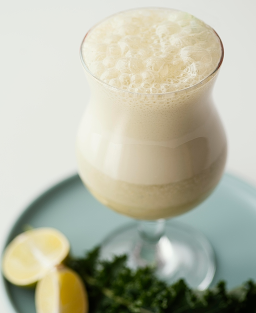
Non-alcoholic: Fresh apple juice, thyme-lemon infusion, sparkling lemon water
Écroûter: Remove crusts from brioche for softer stuffing
Ciseler: Finely chop herbs or shallots without crushing
Émincer: Thinly slice mushrooms for uniform cooking
Brunoise: Dice ingredients into 1–2 mm cubes for flavor
Faire suer: Gently cook without coloring to concentrate flavor
Débarrasser: Transfer cooked ingredients to stop cooking
Cul-de-poule: Rounded stainless bowl for mixing or cooling
Homogénéiser: Mix thoroughly for uniform texture
Brider: Truss poultry for even cooking and neat presentation
Bouquet garni: Aromatic bundle of herbs for broth
Écumer: Skim impurities from broth surface
Frémissement: Gentle simmer just below boiling
Température à cœur: Core temperature (~82 °C)
Clarifier: Make broth clear by straining or egg white
Réserver: Set aside ingredients properly
Rectifier l’assaisonnement: Adjust seasoning at end
Repos de la viande: Rest cooked poultry under foil
Consommé: Clarified broth served as starter or side
Glacer les légumes: Glaze vegetables with broth or butter
Pochage: Slow gentle poaching in hot liquid
Farce: Stuffing made with meat, bread, eggs, herbs, garnishes
Désosser: Remove bones optionally
Bouillon de volaille: Broth made with carcasses, bones, vegetables, aromatics
Beurre monté: Cold butter added to hot broth for shine and richness
Brillance du service: Visual appeal: glazed vegetables, clear broth, neat cuts
Dressage: Harmonious arrangement on dish with broth
Hygiène et sécurité: Maintain cold chain, clean utensils, cook poultry ≥82 °C
Occitan: Recèpta tradicionau de la Pola al Poishon d’Enric Quate
An emblematic recipe of French cuisine, symbol of prosperity and conviviality, Henri IV’s Poule au Pot embodies the spirit of local gastronomy: simplicity, sharing, and the excellence of farm products.
Other names:
Occitan (Gascon/Béarnais): Pola al poishon, Pola farcida al poishon, La pola deu Henric Quart
French: Poule au bouillon, Poule farcie au bouillon, Poule farcie d’Henri IV
"I want every farmer in my kingdom to be able to put a chicken in the pot on Sundays." — Henri IV
In Old French: “Chascun laboureur doibt avoir sa poule en la pote.”
This phrase became a symbol of prosperity and the good life that King Henri IV wanted for his subjects. The “poule au pot” was not just a dish but an ideal: peace and well-being in the French countryside.
It is said that Henri IV, passing through a Béarn village, saw peasant tables lacking meat. Touched, he promised his minister Sully that he would ensure every household could enjoy a poule au pot on a festive day. This promise made the dish a symbol of well-being and social justice, celebrating peace and rural prosperity.
In the hills of Monein, there once lived a young winemaker named Baptiste and a spinner named Maridòu. They had loved each other since childhood, but their families were feuding over a small plot of land and opposed their union.
Every evening, Baptiste went to the washhouse where Maridòu washed wool. He brought her eggs from a white hen he raised behind the barn. It was said to be a “heaven-blessed” hen, born on an Easter Sunday, that always laid eggs before dawn.
When winter scarcity arrived, his hungry family begged Baptiste to give them his hen to eat. Out of love—and so that no one went hungry—he agreed, provided the broth was shared equally among everyone. Maridòu, in tears, blessed the poultry before it was put in the pot.
It was said that those who tasted the broth saw their love last a lifetime.
Since that day, in Monein, when a young girl shares her poule au pot meal with her fiancé, it is said she “puts her heart in the pot.”
Country: France
Region: Béarn / Southwest
Inventor: Passed down orally, popularized at Henri IV’s court
Codified recipe: Yes
Unofficial specifications: Farm chicken, stuffing made of pork or veal, clear root vegetable broth, served with soup or white sauce
16th–17th century: The chicken became a symbol of nobility and prosperity in France.
François Pierre La Varenne (1615–1678) describes recipes for poule au pot, fricassee chicken, and stuffed chicken in Le Cuisinier François.
Henri IV popularized “poule au pot” for all his subjects.
The Poule au Pot originates from medieval rural traditions, where poultry was a festive dish reserved for special occasions. Under Henri IV (1589–1610), the dish became a political symbol of prosperity and peace after the Wars of Religion.
17th century: The recipe spread among noble and peasant households, codified by La Varenne with slow, gentle cooking in aromatic broth.
19th century: Mentioned in most domestic and bourgeois cookbooks, with regional variations:
Gers: foie gras stuffing
Béarn: broth with cloves
North: assorted vegetables
Today, it remains a classic in culinary competitions and inns, symbolizing a generous France rooted in local tradition.
La Varenne (17th c.) – Cooking method in aromatic broth
Antonin Carême (19th c.) – Presentation with supreme sauce and pilaf rice
Auguste Escoffier (early 20th c.) – Codified bourgeois garnishes in Le Guide Culinaire
Paul Bocuse (20th c.) – Emphasis on Bresse poultry and simplicity of broth
Joël Robuchon (20th c.) – Mousse-like stuffing for airy texture
Hélène Darroze (21st c.) – Landes poultry and heirloom vegetables, contemporary gourmet version
Appearance: Whole poached chicken, tender meat, clear golden broth
Texture: Tender meat, melting stuffing, slightly crisp vegetables
Aromas: Poultry, pot-au-feu herbs, clove, celery
Particularities: Gentle cooking, aromatic broth skimmed regularly, stuffing combining pork, bread, and herbs
Necessary utensils: Pot or Dutch oven, skimmer, string, knife, cutting board, fine sieve, ladle, thermometer, chinois
1 farm-raised pullet (1.5–2 kg)
2 garlic cloves, chopped
2 carrots
2 turnips
2 leeks
1 onion studded with 2 cloves
1 bouquet garni (thyme, bay leaf, parsley, celery)
2.5 liters chicken broth
1 marrow bone
Salt, pepper
200 g veal mince
3 slices brioche
200 ml semi-skimmed milk
2 shallots
150 g mushrooms (button or porcini)
½ bunch chervil
1 small truffle
50 g candied chestnut pieces
300 g raw duck foie gras
Grapeseed oil (or neutral oil)
10 g butter
50 ml Armagnac
2 egg yolks
Salt, freshly ground pepper
Prep time: 45 min
Cooking time: 2 h 30 min – 3 h
Remove crusts from brioche slices, cut into pieces, soak in milk
Peel and finely chop shallots
Clean and thinly slice mushrooms
Rinse, dry, pluck, and chop chervil
Peel truffle and dice finely
Cut raw foie gras into 1 cm cubes
Heat a drizzle of oil in a pan, sweat shallots for 5–6 min without browning until soft → transfer to a bowl
In the same pan, sweat mushrooms over high heat. Drain immediately, reduce liquid, add butter, return mushrooms and cook 5 min → add to bowl
Add veal mince, soaked brioche, Armagnac, and egg yolks → mix well
Incorporate chervil, candied chestnuts, foie gras, truffle
Season generously, mix gently to avoid crushing foie gras
Cover and refrigerate until use
Pro tip: Stuffing must hold together in the bird without dissolving during cooking
Clean and season cavity, optionally debone
Stuff cavity with prepared filling
Truss and close carefully with needle and string
Chef’s tip: Proper closure ensures uniform cooking and neat presentation
Place stuffed chicken in pot, cover with chicken broth
Add vegetables, clove-studded onion, marrow bone, bouquet garni
Bring to gentle boil, skimming repeatedly
Technical tip: Keep liquid just below boiling to keep poultry firm
Simmer gently 2 h 30 min – 3 h, monitor broth and vegetables
Core temperature ~82 °C
Turn gently at halfway for even cooking
Tip: Slow cooking preserves flavor, texture, and juices
Rest poultry 10–15 min under foil for juice redistribution
Remove vegetables, aromatics, marrow, strain broth through fine sieve or chinois
For clear consommé, clarify with egg white
Adjust seasoning, optionally add cream or beurre monté
Keep broth at 65–70 °C for service, or cool to ≤4 °C for storage
Serving tip: Serve whole or sliced with vegetables and some broth, or serve broth separately for refined presentation
Carving poultry – follow natural joints, use sharp knife, stable board
Vegetables – cut into uniform portions, glaze with hot broth or butter
Cocotte presentation – arrange chicken and vegetables, add some broth
Plate presentation – meat center, vegetables around, drizzle broth
Broth on the side – serve separately
Final tips – start cooking in cold water, never boil, glaze vegetables, alternate colors for visual impact, keep poultry and broth at 65–70 °C
White wines: Meursault 2020/21 (buttery, nutty), Pouilly-Fuissé 2021/22 (subtle minerality), Sancerre 2022 (freshness, liveliness)
Light reds: Beaujolais-Villages 2021/22 (fruity, light), Pinot Noir Burgundy 2020 (elegant)
Rosé: Tavel 2021, Côtes-de-Provence 2022 (floral, peach notes)
Cider: Brut or semi-dry 2022 vintage
Non-alcoholic: Fresh apple juice, thyme-lemon infusion, sparkling lemon water
Écroûter: Remove crusts from brioche for softer stuffing
Ciseler: Finely chop herbs or shallots without crushing
Émincer: Thinly slice mushrooms for uniform cooking
Brunoise: Dice ingredients into 1–2 mm cubes for flavor
Faire suer: Gently cook without coloring to concentrate flavor
Débarrasser: Transfer cooked ingredients to stop cooking
Cul-de-poule: Rounded stainless bowl for mixing or cooling
Homogénéiser: Mix thoroughly for uniform texture
Brider: Truss poultry for even cooking and neat presentation
Bouquet garni: Aromatic bundle of herbs for broth
Écumer: Skim impurities from broth surface
Frémissement: Gentle simmer just below boiling
Température à cœur: Core temperature (~82 °C)
Clarifier: Make broth clear by straining or egg white
Réserver: Set aside ingredients properly
Rectifier l’assaisonnement: Adjust seasoning at end
Repos de la viande: Rest cooked poultry under foil
Consommé: Clarified broth served as starter or side
Glacer les légumes: Glaze vegetables with broth or butter
Pochage: Slow gentle poaching in hot liquid
Farce: Stuffing made with meat, bread, eggs, herbs, garnishes
Désosser: Remove bones optionally
Bouillon de volaille: Broth made with carcasses, bones, vegetables, aromatics
Beurre monté: Cold butter added to hot broth for shine and richness
Brillance du service: Visual appeal: glazed vegetables, clear broth, neat cuts
Dressage: Harmonious arrangement on dish with broth
Hygiène et sécurité: Maintain cold chain, clean utensils, cook poultry ≥82 °C