Traditional Peking-Style Roast Duck Recipe (Peking Duck Recipe)
Other names: Beijing Kaoya (北京烤鸭)
Discover the traditional Peking-style Roast Duck recipe, a culinary emblem of imperial China. This refined dish, with its golden, crispy skin, symbolizes the art of lacquered roasting and the delicate balance of sweetness, spices, and umami.
“北京烤鸭,香飘四海”
(The roast duck of Beijing fills the four seas with fragrance.)
A Chinese saying celebrating the worldwide fame of this imperial dish.
An ancient legend tells that during the Ming Dynasty, a young imperial palace cook named Li Feng fell in love with Mei Hua, the daughter of a beekeeper in the outskirts of Beijing. Their love was impossible: Li, a palace servant, could not leave the Forbidden City without permission, and Mei Hua belonged to the common people.
To prove his devotion, he decided to create a dish that would unite their two worlds: the palace’s fire and the sweetness of honey. One night, he stole a duck meant for an imperial banquet and brushed it with a secret mixture of flower honey and fermented sauce. He then suspended the bird over a pearwood fire, carefully watching its roasting by moonlight.
The next day, the emperor tasted the dish and was amazed by its golden shine and aroma. He asked for the creator’s name. Li, trembling, explained that it was a tribute to Mei Hua, whose name meant “plum blossom,” a symbol of fidelity in Chinese tradition. Moved by the story, the emperor granted the young man his freedom and blessed their union.
Since then, Peking Roast Duck has been regarded not only as an imperial delicacy but also as a dish symbolizing sincere love and shared prosperity.
As the elders still say:
“A dish prepared with the heart touches more than a thousand words.”
Thus, Peking Roast Duck is more than a culinary feat; it embodies the boldness of love, the refinement of skill, and the blessing of ancestors. Each bite evokes the flame of a discreet fire, the sweetness of honey offered in secret, and the faith of a heart willing to defy the walls of the Forbidden City.
In the alleys of Beijing, when the scent of wood smoke rises in the evening air, some still whisper:
“To taste the roast duck is to hear the echo of a love that has never died.”
Country: China
Region: Beijing
Official Status: National emblematic dish
Codified Recipe: Yes (lacquering and suspended roasting technique)
The Peking-Style Roast Duck (北京烤鸭) recipe follows a precise protocol, passed down by Beijing’s master roasters:
Peking Duck: a specific breed raised in Beijing and Hebei, fed cereals, slaughtered at about 65 days.
Pre-blanching: immersion in boiling water to tighten the skin and separate subcutaneous fat.
Air inflation between skin and meat: essential for separating the skin from the muscle and ensuring crispiness.
Lacquering: application of successive layers of honey, soy sauce, spices, and rice vinegar.
Suspended drying: 24–72 hours in a cool, ventilated area to allow the skin to tighten.
Roasting: dry-heat roasting, traditionally in an open suspended oven heated with fruitwood (pear, jujube, or peach).
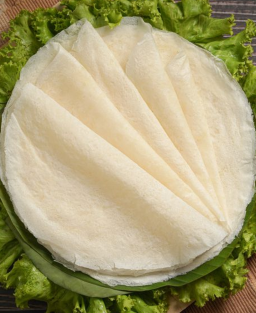
Traditional serving: carved at the table, skin served separately, accompanied by thin pancakes (春饼), spring onions, and hoisin sauce.
Certification:
Preserved by historic houses Quanjude (founded in 1864) and Bianyifang (founded in 1416), recognized as guardians of the authentic imperial suspended roasting and lacquering process.
Peking-Style Roast Duck (北京烤鸭) is one of the most iconic dishes in Chinese gastronomy, and likely one of the oldest imperial dishes still prepared according to a ritual close to the original. Its earliest traces date back to the Yuan Dynasty (1271–1368), when Mongol chefs settled in Beijing and adopted roasting techniques from northern China. At that time, duck was already considered a festive dish, though it was cooked in closed clay ovens.
In the 14th century, imperial chefs perfected the suspended roasting method: the bird, inflated with air between the skin and the meat, was hung over the fire to make the skin crisp while keeping the meat tender. This technique, combined with the use of honey and soy sauce for lacquering, created the caramelized flavor and characteristic shine of the dish.
During the Ming Dynasty (1368–1644), Peking Duck reached its golden age. Beijing became the imperial capital, and the dish emerged as a symbol of court refinement. The Peking duck, a breed selected for tender meat, abundant fat, and fine skin, was raised specifically for this recipe. It was then that the two historic houses, Bianyifang and later Quanjude, established the official techniques: choice of fruitwood for roasting, air inflation under the skin, air drying, and suspended roasting in an open cylindrical oven.
Under the Qing Dynasties (1644–1912), Peking Duck became a national symbol. Served at imperial banquets, it was part of the “four honor dishes” alongside steamed shrimp, braised shark, and caramelized pork. Official banquets at the Summer Palace (Yíhéyuán) routinely included Peking roast duck, served on white porcelain plates, with the skin cut into 108 even slices—a symbolic number representing perfection.
In the 19th century, the recipe left the imperial kitchens and conquered the capital’s restaurants. Chef Yang Quanren, founder of Quanjude in 1864, popularized the dish by adapting it to open wood-fired ovens. This method produced a more golden skin and slightly smoky flavor, appealing to Western travelers. Peking Duck thus became a culinary ambassador of China to European and American diplomats.
During the 20th century, despite political and economic upheavals, the recipe was preserved as a national treasure. Chefs trained in Beijing’s great schools continued to pass down the ancestral know-how, including multi-layer lacquering and suspended drying techniques. From the 1980s onwards, the dish experienced a revival with modernized ovens and standardized cooking protocols, recognized by China’s Ministry of Commerce as an “intangible heritage process.”
Today, Peking-Style Roast Duck is more than a dish: it embodies the quintessence of Chinese culinary art. A symbol of abundance and harmony, it is served at major diplomatic receptions, weddings, and Lunar New Year celebrations. Its preparation, always codified, combines the science of fire, mastery of technique, and aesthetic pursuit. Contemporary chefs such as Da Dong and Dong Zhenxiang have offered lighter interpretations while respecting the original spirit: ultra-fine skin, translucent lacquer, and tender meat.
Peking Duck remains a living testament to a millennia-old culinary tradition, symbolizing the union of fire, air, and honey—the three elements that, according to Chinese philosophy, harmonize body and mind.
Iconic Chefs and Contributions
Bianyifang (Beijing) – First historic house (1416), closed-oven roasting.
Quanjude (Beijing) – Modern reinvention of honey glazing and fruit-wood roasting.
Made in China (Beijing Grand Hyatt) – Contemporary gastronomic version.
Da Dong Roast Duck (Beijing) – Lighter, ultra-thin skin, translucent glaze.
Lung King Heen (Hong Kong) – Cantonese–Beijing fusion, citrus seasoning.
Temple Restaurant Beijing – Modern interpretation, served in three sequences (skin, meat, broth).
Dish Presentation
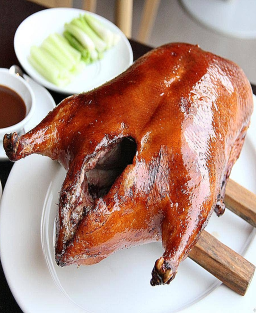
Appearance: Whole duck, shiny mahogany-glazed skin, finely carved at the table.
Texture: Crispy skin, tender and juicy meat.
Dominant Aromas: Honey, soy, five-spice, ginger.
Culinary Particularities: Hanging roasting, successive glazing, air drying.
Required Utensils: Duck hook, pot, glazing brush, oven, long fine-blade knife.
Ingredients (for 6 people)
1 fattened duck (approx. 2.2 kg)
2 medium onions, chopped
10 g fresh ginger
2 garlic cloves
3 tbsp liquid honey
3 tbsp soy sauce
2 tbsp Chinese five-spice powder
2 tbsp hoisin sauce
1 tbsp white rice vinegar
1 pinch carmine
2 tsp salt
1 tsp pepper
1 tbsp cornstarch
1 tsp oil
Preparation and Method — Peking Roast Duck (Professional Codified Version)
Total Time:
Initial preparation: 30–45 min
Drying/rest: 48–72 h
Roasting: 1 h 10–1 h 30
Special Equipment Required:
Manual air pump (or culinary inflation syringe)
Stainless steel hanging hook
Fan or ventilated drying cabinet (10–15 °C)
Vertical rotisserie oven or professional combination oven (200–230 °C)
Blanching basin
Probe thermometer
Detailed Technical Steps
1. Duck Preparation
Choose a 2–2.5 kg Pekin duck, eviscerated and whole.
Rinse thoroughly with cold water and pat dry.
Using an air pump, separate the skin from the meat by injecting air between skin and meat (at the neck).
This step is essential for crispy skin: the air creates an insulating layer that prevents fat from penetrating the skin during roasting.
2. Controlled Blanching
Bring 4 L water to a boil with 30 g rice vinegar and 50 g honey.
Immerse the whole duck for 1–2 minutes, basting the skin with a ladle.
Drain immediately and air-dry for a few minutes.
3. Progressive Glazing
Prepare the imperial glaze:
Honey: 80 g
Light soy sauce: 50 ml
Rice vinegar: 30 ml
Shaoxing wine: 40 ml
Cornstarch: 10 g
Fresh grated ginger: 5 g
Salt: 2 g
Water: 200 ml
Bring to a gentle boil to homogenize.
Brush evenly onto the still-warm duck.
Repeat 3–4 successive layers at 30-minute intervals for a shiny, even coating.
4. Hanging Drying (Crucial Step)
Hang the duck by the neck in a cool, ventilated, dry room (10–15 °C).
Duration: 48–72 h, until skin is tight, dry, and slightly translucent.
In imperial kitchens, drying was done facing a light natural airflow or under gentle ventilation hoods.
5. Hanging Roasting (Traditional Method)
Preheat the oven to 200–230 °C.
Hang the duck in the oven, avoiding contact with trays.
Roast 50–60 min according to weight.
During the final phase, baste regularly with melted fat to enhance gloss.
Finish with a brief high-heat pass (250 °C) or 30-sec immersion in 200 °C oil to maximize crispiness.
Internal temperature should reach 70–72 °C.
6. Plating and Chinese-Style Carving
Slice the skin into thin strips (3–4 cm wide).
Serve with steamed wheat pancakes, cucumber sticks, scallions, and hoisin sauce.
Carving should distinguish skin, meat, and fat, representing the three desired textures.
Technical Notes
Ambient humidity during drying must not exceed 60%.
Rotating the duck during roasting ensures uniform glaze.
Post-roasting rest (10 min) stabilizes skin and juices.
Regional Versions and Variants
Quanjude: fruit-wood fire roasting.
Bianyifang: closed-oven roasting with enveloping heat.
Hong Kong: sweeter glaze, finer skin.
Westernized: served as fillets with hoisin sauce and wheat pancakes.
Tips and Advice
Thoroughly dry the skin before roasting for shine and crispness.
Do not prick the skin before roasting to retain protective fat.
Repeat glazing multiple times for uniform color.
Chef’s Tip:
Add a drop of rice vinegar in the last glaze layer to enhance shine.
Service and Accompaniments
Plating style: Gastronomic or imperial banquet.
Presentation: Finely sliced skin, served with wheat pancakes, spring onions, and hoisin sauce.
Accompaniments: Cucumber sticks, pickled radish, leek julienne.
Recommended Wines and Drinks
Suggested wine: Alsace Gewurztraminer, German Riesling, or Chinese dry Shaoxing white wine.
Non-alcoholic alternatives: Lapsang Souchong smoked tea, ginger-honey infusion.
Nutritional Information (per 100 g roasted duck)
Energy: 240 kcal / 1005 kJ
Fat: 16 g
Carbohydrates: 6 g
Protein: 18 g
Fiber: 0 g
Allergens: Soy, gluten (hoisin sauce), corn (cornstarch)
Possible adaptations: gluten-free version with tamari soy sauce.
Traditional Peking-Style Roast Duck Recipe (Peking Duck Recipe)
Other names: Beijing Kaoya (北京烤鸭)
Discover the traditional Peking-style Roast Duck recipe, a culinary emblem of imperial China. This refined dish, with its golden, crispy skin, symbolizes the art of lacquered roasting and the delicate balance of sweetness, spices, and umami.
“北京烤鸭,香飘四海”
(The roast duck of Beijing fills the four seas with fragrance.)
A Chinese saying celebrating the worldwide fame of this imperial dish.
An ancient legend tells that during the Ming Dynasty, a young imperial palace cook named Li Feng fell in love with Mei Hua, the daughter of a beekeeper in the outskirts of Beijing. Their love was impossible: Li, a palace servant, could not leave the Forbidden City without permission, and Mei Hua belonged to the common people.
To prove his devotion, he decided to create a dish that would unite their two worlds: the palace’s fire and the sweetness of honey. One night, he stole a duck meant for an imperial banquet and brushed it with a secret mixture of flower honey and fermented sauce. He then suspended the bird over a pearwood fire, carefully watching its roasting by moonlight.
The next day, the emperor tasted the dish and was amazed by its golden shine and aroma. He asked for the creator’s name. Li, trembling, explained that it was a tribute to Mei Hua, whose name meant “plum blossom,” a symbol of fidelity in Chinese tradition. Moved by the story, the emperor granted the young man his freedom and blessed their union.
Since then, Peking Roast Duck has been regarded not only as an imperial delicacy but also as a dish symbolizing sincere love and shared prosperity.
As the elders still say:
“A dish prepared with the heart touches more than a thousand words.”
Thus, Peking Roast Duck is more than a culinary feat; it embodies the boldness of love, the refinement of skill, and the blessing of ancestors. Each bite evokes the flame of a discreet fire, the sweetness of honey offered in secret, and the faith of a heart willing to defy the walls of the Forbidden City.
In the alleys of Beijing, when the scent of wood smoke rises in the evening air, some still whisper:
“To taste the roast duck is to hear the echo of a love that has never died.”
Country: China
Region: Beijing
Official Status: National emblematic dish
Codified Recipe: Yes (lacquering and suspended roasting technique)
The Peking-Style Roast Duck (北京烤鸭) recipe follows a precise protocol, passed down by Beijing’s master roasters:
Peking Duck: a specific breed raised in Beijing and Hebei, fed cereals, slaughtered at about 65 days.
Pre-blanching: immersion in boiling water to tighten the skin and separate subcutaneous fat.
Air inflation between skin and meat: essential for separating the skin from the muscle and ensuring crispiness.
Lacquering: application of successive layers of honey, soy sauce, spices, and rice vinegar.
Suspended drying: 24–72 hours in a cool, ventilated area to allow the skin to tighten.
Roasting: dry-heat roasting, traditionally in an open suspended oven heated with fruitwood (pear, jujube, or peach).
Traditional serving: carved at the table, skin served separately, accompanied by thin pancakes (春饼), spring onions, and hoisin sauce.
Certification:
Preserved by historic houses Quanjude (founded in 1864) and Bianyifang (founded in 1416), recognized as guardians of the authentic imperial suspended roasting and lacquering process.
Peking-Style Roast Duck (北京烤鸭) is one of the most iconic dishes in Chinese gastronomy, and likely one of the oldest imperial dishes still prepared according to a ritual close to the original. Its earliest traces date back to the Yuan Dynasty (1271–1368), when Mongol chefs settled in Beijing and adopted roasting techniques from northern China. At that time, duck was already considered a festive dish, though it was cooked in closed clay ovens.
In the 14th century, imperial chefs perfected the suspended roasting method: the bird, inflated with air between the skin and the meat, was hung over the fire to make the skin crisp while keeping the meat tender. This technique, combined with the use of honey and soy sauce for lacquering, created the caramelized flavor and characteristic shine of the dish.
During the Ming Dynasty (1368–1644), Peking Duck reached its golden age. Beijing became the imperial capital, and the dish emerged as a symbol of court refinement. The Peking duck, a breed selected for tender meat, abundant fat, and fine skin, was raised specifically for this recipe. It was then that the two historic houses, Bianyifang and later Quanjude, established the official techniques: choice of fruitwood for roasting, air inflation under the skin, air drying, and suspended roasting in an open cylindrical oven.
Under the Qing Dynasties (1644–1912), Peking Duck became a national symbol. Served at imperial banquets, it was part of the “four honor dishes” alongside steamed shrimp, braised shark, and caramelized pork. Official banquets at the Summer Palace (Yíhéyuán) routinely included Peking roast duck, served on white porcelain plates, with the skin cut into 108 even slices—a symbolic number representing perfection.
In the 19th century, the recipe left the imperial kitchens and conquered the capital’s restaurants. Chef Yang Quanren, founder of Quanjude in 1864, popularized the dish by adapting it to open wood-fired ovens. This method produced a more golden skin and slightly smoky flavor, appealing to Western travelers. Peking Duck thus became a culinary ambassador of China to European and American diplomats.
During the 20th century, despite political and economic upheavals, the recipe was preserved as a national treasure. Chefs trained in Beijing’s great schools continued to pass down the ancestral know-how, including multi-layer lacquering and suspended drying techniques. From the 1980s onwards, the dish experienced a revival with modernized ovens and standardized cooking protocols, recognized by China’s Ministry of Commerce as an “intangible heritage process.”
Today, Peking-Style Roast Duck is more than a dish: it embodies the quintessence of Chinese culinary art. A symbol of abundance and harmony, it is served at major diplomatic receptions, weddings, and Lunar New Year celebrations. Its preparation, always codified, combines the science of fire, mastery of technique, and aesthetic pursuit. Contemporary chefs such as Da Dong and Dong Zhenxiang have offered lighter interpretations while respecting the original spirit: ultra-fine skin, translucent lacquer, and tender meat.
Peking Duck remains a living testament to a millennia-old culinary tradition, symbolizing the union of fire, air, and honey—the three elements that, according to Chinese philosophy, harmonize body and mind.