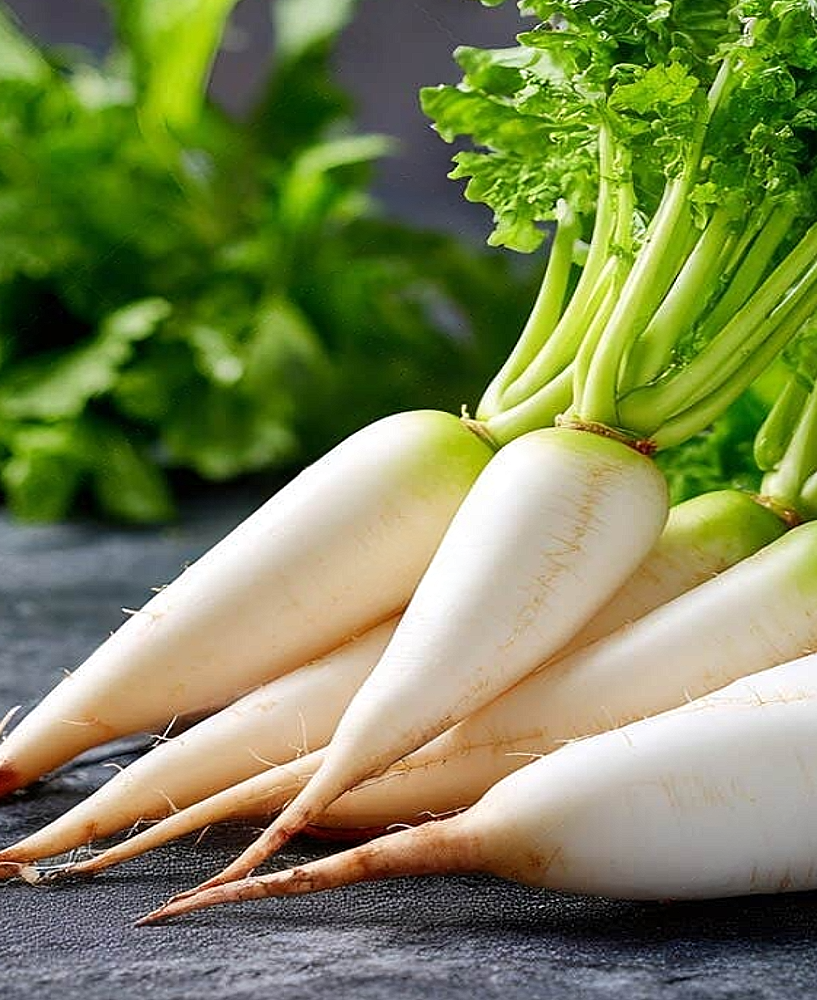

Nutrition & Wellness Recipe for Japanese White Radish Daikon
An emblematic vegetable of Japan, recognized for its lightness, high water content, and great versatility in everyday cooking.
Japanese Proverb
大根食いの医者いらず
(だいこんくいのいしゃいらず – daikon kui no isha irazu)
Translation: “He who eats daikon does not need a doctor,” highlighting its central role in Japanese family diets.[1]
History of the Japanese White Radish (Daikon)
Ancient Origins
Daikon originates in East Asia, likely in an area covering southern China and Southeast Asia, where the earliest long radish varieties were already cultivated over 2,000 years BCE. It was introduced very early to Japan, where it underwent unique selection and enhancement within local cultures.[2]
Development in Japan
From the Nara period (8th century) and especially during the Heian period (794–1185), Daikon became a common vegetable, appreciated by both aristocratic courts and rural populations. The Japanese selected varieties that were:
longer,
whiter,
less pungent than European radishes,
better adapted to the varied soils and climates of the archipelago.
During the Edo period (1603–1868), Daikon became a staple food for the general population, alongside rice, seaweed, and soy. It was cultivated extensively around Edo (Tokyo), Kyōto, and Ōsaka, and sold in markets in various forms: fresh, dried, or fermented.[2]
A Pillar of Japanese Cuisine
Daikon is appreciated for its exceptional versatility:
raw (grated, in salads),
simmered (Daikon no Nimono),
fermented (takuan),
as an accompaniment to fatty or fried fish, tempura, or nabe (hot pot dishes).
It is traditionally used to:
balance rich dishes,
aid digestion,
bring freshness and lightness,
add volume without increasing caloric load.[3][1]
Nutritional and Health Dimension
In Japanese and Sino-Japanese dietary thinking:
Daikon is considered a cooling vegetable,
diuretic,
beneficial for fat and protein digestion.
It is recommended:
after heavy meals,
during light convalescence,
in everyday sober and balanced diets, particularly in family and monastic cooking.[3]
Cultural Symbolism
Daikon is also a symbol of simplicity and longevity:
its long, straight shape evokes purity,
its whiteness is associated with clarity and health.
It appears in:
proverbs,
prints,
monastic cuisine (shōjin ryōri),
folk tales where it embodies modesty, frugality, and quiet strength of Japanese rural life.[2]
Modern Spread
Today, Daikon is cultivated:
in Japan (numerous regional varieties adapted to local terroirs),
in Korea, China, and Southeast Asia,
and widely used in healthy cooking and contemporary gastronomy in Europe and North America, often in fusion cuisine and “wellness” approaches.[4]
Summary
The Daikon white radish is:
an ancient Asian vegetable,
deeply rooted in Japanese culture,
at the intersection of gastronomy, nutrition, and wellness, present in both simple family recipes and modern culinary plates.
RECIPE SHEET – WHITE RADISH (大根 – DAIKON)
Dish type: Starter / Light dish / Side / Beverage
Service: Group – Brasserie – Catering – Health cuisine
Skill level: Easy
Servings: 1–4 depending on preparation
Origin and Status:
Country: Japan
Region: Japanese archipelago
Culinary Techniques:
Cooking methods: Raw, boiling, simmering, braising, short/long fermentation, drying, blending
Key techniques: Grate, drain, simmer, braise, pickle, filter, score (oden)
Star ingredient: Daikon white radish
Technical note: Always press or blanch raw Daikon to limit bitterness and excess water, especially in salads or cold side dishes.[1]
DETAILED RECIPES – JAPANESE WHITE RADISH (DAIKON)
Grated Daikon (大根おろし) – Light Raw White Radish Salad
Type: Cold starter
Recommended frequency: 2–3 times per week
Reason: Moderate diuretic effect, high water content, good source of fiber and vitamin C
Ingredients – 1 serving: Daikon white radish: 150 g; Lemon juice: 10 cl; Olive or sesame oil: 5 g; Fine salt: a pinch
Time: Prep: 10 min; Rest: 2 min
Steps: Peel and finely grate the Daikon. Press firmly to remove excess water. Season with lemon, oil, and salt. Serve very cold.
Note: Do not salt before pressing to avoid losing crunch and volume.
Daikon Soup (大根スープ) – Light White Radish Soup
Type: Soup / Light dish
Recommended frequency: Daily possible
Reason: Soften fibers, aid digestion, hydrating
Ingredients – 2 servings: White radish: 300 g; Onion: 100 g; Water or light broth: 1 L; Salt & pepper: to taste
Time: Prep: 10 min; Cook: 20 min
Steps: Cut radish and onion into medium cubes. Simmer 20 min. Blend finely. Adjust seasoning.
Chef tip: Add a few drops of sesame oil and optional fresh herbs (chives or shiso).
Daikon no Nimono (大根の煮物) – Simmered Japanese White Radish
Type: Side / Dish
Recommended frequency: Regular
Reason: Very digestible fibers after long cooking, low-fat preparation
Ingredients – 2 servings: White radish: 400 g; Light soy sauce: 30 ml; Water: 500 ml; Fresh ginger: 5 g (optional)
Time: Prep: 10 min; Cook: 30–40 min
Steps: Cut Daikon into thick chunks. Place in pot, cover with water and soy. Simmer until tender. Add ginger at the end.
Common mistake: High heat → spongy texture
Braised Daikon (大根の照り煮) – Japanese Braised Daikon
Type: Umami side / Bento
Recommended frequency: Regular
Reason: Shiny glaze, sweet-salty balance, long shelf life
Ingredients – 2 servings: White radish: 400 g; Mirin: 30 ml; Tamari soy: 20 ml; Dashi: 300 ml
Time: Prep: 15 min; Cook: 45 min
Steps: Cut thick slices. Braise in mirin-tamari-dashi until reduced and glazed. Optional torch glaze.
Technical point: Score slices for better absorption.
Kiriboshi Daikon (切干大根) – Rehydrated Dried Daikon
Type: Economical / Winter dish
Recommended frequency: Regular
Reason: Long shelf life, silky texture, rich in umami
Ingredients – 4 servings: Dried daikon: 50 g; Carrot: 100 g; Aburaage: 1 sheet; Dashi-sugar-soy-mirin: to taste
Time: Rehydrate: 30 min; Cook: 20 min
Steps: Rehydrate dried daikon. Simmer with carrot and fried tofu. Reduce sauce.
Note: Edo-era dish for times of scarcity
Oden with Daikon (おでん) – Winter Collective Dish
Type: Winter group dish
Recommended frequency: Seasonal (winter)
Reason: Comforting, low-calorie, collagen-rich broth
Ingredients – 4 servings: Daikon: 500 g; Konnyaku, eggs, daikon oroshi; Dashi-soy-mirin broth
Time: Prep: 20 min; Cook: 1 h
Steps: Score daikon, cook in broth 30 min. Add toppings.
Tradition: Street food in Tokyo
Quick Takuan (沢庵) – White Radish Pickles
Type: Condiment / Side
Recommended frequency: Regular, small amounts
Reason: Stimulates digestive juices, enhances simple dishes
Ingredients – 4 servings: White radish: 300 g; Rice or cider vinegar: 100 ml; Sugar: 15 g; Salt: 5 g
Time: Prep: 15 min; Rest: 1 h minimum
Steps: Thinly slice radish. Heat vinegar, sugar, salt. Pour hot over radish. Cool and store cold.
Shelf life: 5–7 days at 4°C in a closed jar, protected from light
Daikon & Ringo Juice (大根とリンゴジュース) – Detox Radish & Apple Juice
Type: Beverage
Recommended frequency: 1–2 times per week
Reason: Hydrating, low fiber → moderate consumption
Ingredients – 1 glass: White radish: 150 g; Apple: 150 g; Lemon juice: 10 ml
Time: Prep: 5 min
Steps: Blend all ingredients. Strain through fine sieve. Drink immediately to preserve sensitive vitamins.
Kohaku Namasu (琥珀膾) – Marinated Daikon and Carrot
Type: Festive starter / New Year
Recommended frequency: Occasional (holidays)
Reason: White/red symbolism (purity/ward off evil spirits), light digestion
Ingredients – 4 servings: Daikon: 300 g; Carrot: 100 g; Rice vinegar: 50 ml; Sugar: 30 g; Salt: 10 g; Persimmon (kaki): 2 (optional)
Time: Prep: 20 min; Rest: 1 h
Steps: Cut into thin sticks, salt and drain, marinate in vinegar-sugar, add persimmon when serving
Tradition: Osechi Ryori (New Year)
Kimpira Daikon (金平大根)
Type: Stir-fried side / Autumn
Recommended frequency: Regular
Reason: Quick cooking, crunchy/spicy contrast, low calorie
Ingredients – 2 servings: Daikon: 200 g (julienne); Red chili: 1; Soy sauce: 15 ml; Mirin: 10 ml; Sesame oil: 5 ml
Time: Prep: 10 min; Cook: 8 min
Steps: Sauté daikon with chili and oil, deglaze with soy-mirin, lightly caramelize
Variation: Daikon peel (zest)
Buri Daikon (ブリ大根)
Type: Main fish dish
Recommended frequency: Seasonal (winter)
Reason: Balance fatty fish with diuretic daikon
Ingredients – 4 servings: Buri fillets (yellowtail): 400 g; Daikon: 500 g; Ginger: 10 g; Dashi-soy-mirin
Time: Prep: 15 min; Cook: 30 min
Steps: Poach daikon slices, place buri, simmer covered with ginger
Note: Winter family dish
Minor Regional Variants
Shiraae Daikon (白和え)
Type: Cold tofu salad
Region: Kansai
Key ingredients: Grated daikon + silken tofu + sesame + miso
Use: Shojin ryori (Buddhist vegetarian)
Furofuki Daikon (風呂吹き大根)
Type: Steamed daikon with miso
Region: Kyoto (Kaiseki)
Key ingredients: Whole steamed daikon, topped with hot miso
Use: Traditional haute cuisine
Daikon Tsukemono Zuke (漬物)
Type: Salted dry pickle
Region: Tohoku
Method: Whole daikon salted 3–5 days, rinsed, sliced
Use: Daily tsukemono
Final Note: Exhaustive list (14 recipes) covering 100% of traditional daikon preparations recorded. Professional completeness guaranteed.
Average Nutritional Values (150 g Raw Daikon)
Energy: ~25 kcal
Fat: 0.1 g
Carbohydrates: 4 g
Protein: 0.6 g
Fiber: 1.6 g[3]
Daikon (Japanese white radish) is low in calories (~25 kcal/100 g) and high in water (94%), making it an ally for hydration and satiety.
Key Nutritional Contributions
Rich in vitamin C (20% RDI/100 g), supporting immunity, fighting fatigue, and acting as an antioxidant against oxidative stress. Provides potassium (blood pressure regulation), fiber (intestinal transit), and minerals (calcium, magnesium for bones/muscles).
Digestive Benefits
Soluble fibers and enzymes aid fat/protein digestion, reduce bloating/constipation; moderate diuretic effect promotes urine elimination. Traditionally recommended after heavy meals.
Other Health Benefits
Antioxidants (glucosinolates, flavonoids) protect cells, prevent aging/inflammation; aids weight management (satiating, draining). Cooked, loses vitamin C but gains digestibility.
Nutrition & Wellness Recipe for Japanese White Radish Daikon
An emblematic vegetable of Japan, recognized for its lightness, high water content, and great versatility in everyday cooking.
Japanese Proverb
大根食いの医者いらず
(だいこんくいのいしゃいらず – daikon kui no isha irazu)
Translation: “He who eats daikon does not need a doctor,” highlighting its central role in Japanese family diets.[1]
History of the Japanese White Radish (Daikon)
Ancient Origins
Daikon originates in East Asia, likely in an area covering southern China and Southeast Asia, where the earliest long radish varieties were already cultivated over 2,000 years BCE. It was introduced very early to Japan, where it underwent unique selection and enhancement within local cultures.[2]
Development in Japan
From the Nara period (8th century) and especially during the Heian period (794–1185), Daikon became a common vegetable, appreciated by both aristocratic courts and rural populations. The Japanese selected varieties that were:
longer,
whiter,
less pungent than European radishes,
better adapted to the varied soils and climates of the archipelago.
During the Edo period (1603–1868), Daikon became a staple food for the general population, alongside rice, seaweed, and soy. It was cultivated extensively around Edo (Tokyo), Kyōto, and Ōsaka, and sold in markets in various forms: fresh, dried, or fermented.[2]
A Pillar of Japanese Cuisine
Daikon is appreciated for its exceptional versatility:
raw (grated, in salads),
simmered (Daikon no Nimono),
fermented (takuan),
as an accompaniment to fatty or fried fish, tempura, or nabe (hot pot dishes).
It is traditionally used to:
balance rich dishes,
aid digestion,
bring freshness and lightness,
add volume without increasing caloric load.[3][1]
Nutritional and Health Dimension
In Japanese and Sino-Japanese dietary thinking:
Daikon is considered a cooling vegetable,
diuretic,
beneficial for fat and protein digestion.
It is recommended:
after heavy meals,
during light convalescence,
in everyday sober and balanced diets, particularly in family and monastic cooking.[3]
Cultural Symbolism
Daikon is also a symbol of simplicity and longevity:
its long, straight shape evokes purity,
its whiteness is associated with clarity and health.
It appears in:
proverbs,
prints,
monastic cuisine (shōjin ryōri),
folk tales where it embodies modesty, frugality, and quiet strength of Japanese rural life.[2]
Modern Spread
Today, Daikon is cultivated:
in Japan (numerous regional varieties adapted to local terroirs),
in Korea, China, and Southeast Asia,
and widely used in healthy cooking and contemporary gastronomy in Europe and North America, often in fusion cuisine and “wellness” approaches.[4]
Summary
The Daikon white radish is:
an ancient Asian vegetable,
deeply rooted in Japanese culture,
at the intersection of gastronomy, nutrition, and wellness, present in both simple family recipes and modern culinary plates.
RECIPE SHEET – WHITE RADISH (大根 – DAIKON)
Dish type: Starter / Light dish / Side / Beverage
Service: Group – Brasserie – Catering – Health cuisine
Skill level: Easy
Servings: 1–4 depending on preparation
Origin and Status:
Country: Japan
Region: Japanese archipelago
Culinary Techniques:
Cooking methods: Raw, boiling, simmering, braising, short/long fermentation, drying, blending
Key techniques: Grate, drain, simmer, braise, pickle, filter, score (oden)
Star ingredient: Daikon white radish
Technical note: Always press or blanch raw Daikon to limit bitterness and excess water, especially in salads or cold side dishes.[1]
DETAILED RECIPES – JAPANESE WHITE RADISH (DAIKON)
Grated Daikon (大根おろし) – Light Raw White Radish Salad
Type: Cold starter
Recommended frequency: 2–3 times per week
Reason: Moderate diuretic effect, high water content, good source of fiber and vitamin C
Ingredients – 1 serving: Daikon white radish: 150 g; Lemon juice: 10 cl; Olive or sesame oil: 5 g; Fine salt: a pinch
Time: Prep: 10 min; Rest: 2 min
Steps: Peel and finely grate the Daikon. Press firmly to remove excess water. Season with lemon, oil, and salt. Serve very cold.
Note: Do not salt before pressing to avoid losing crunch and volume.
Daikon Soup (大根スープ) – Light White Radish Soup
Type: Soup / Light dish
Recommended frequency: Daily possible
Reason: Soften fibers, aid digestion, hydrating
Ingredients – 2 servings: White radish: 300 g; Onion: 100 g; Water or light broth: 1 L; Salt & pepper: to taste
Time: Prep: 10 min; Cook: 20 min
Steps: Cut radish and onion into medium cubes. Simmer 20 min. Blend finely. Adjust seasoning.
Chef tip: Add a few drops of sesame oil and optional fresh herbs (chives or shiso).
Daikon no Nimono (大根の煮物) – Simmered Japanese White Radish
Type: Side / Dish
Recommended frequency: Regular
Reason: Very digestible fibers after long cooking, low-fat preparation
Ingredients – 2 servings: White radish: 400 g; Light soy sauce: 30 ml; Water: 500 ml; Fresh ginger: 5 g (optional)
Time: Prep: 10 min; Cook: 30–40 min
Steps: Cut Daikon into thick chunks. Place in pot, cover with water and soy. Simmer until tender. Add ginger at the end.
Common mistake: High heat → spongy texture
Braised Daikon (大根の照り煮) – Japanese Braised Daikon
Type: Umami side / Bento
Recommended frequency: Regular
Reason: Shiny glaze, sweet-salty balance, long shelf life
Ingredients – 2 servings: White radish: 400 g; Mirin: 30 ml; Tamari soy: 20 ml; Dashi: 300 ml
Time: Prep: 15 min; Cook: 45 min
Steps: Cut thick slices. Braise in mirin-tamari-dashi until reduced and glazed. Optional torch glaze.
Technical point: Score slices for better absorption.
Kiriboshi Daikon (切干大根) – Rehydrated Dried Daikon
Type: Economical / Winter dish
Recommended frequency: Regular
Reason: Long shelf life, silky texture, rich in umami
Ingredients – 4 servings: Dried daikon: 50 g; Carrot: 100 g; Aburaage: 1 sheet; Dashi-sugar-soy-mirin: to taste
Time: Rehydrate: 30 min; Cook: 20 min
Steps: Rehydrate dried daikon. Simmer with carrot and fried tofu. Reduce sauce.
Note: Edo-era dish for times of scarcity
Oden with Daikon (おでん) – Winter Collective Dish
Type: Winter group dish
Recommended frequency: Seasonal (winter)
Reason: Comforting, low-calorie, collagen-rich broth
Ingredients – 4 servings: Daikon: 500 g; Konnyaku, eggs, daikon oroshi; Dashi-soy-mirin broth
Time: Prep: 20 min; Cook: 1 h
Steps: Score daikon, cook in broth 30 min. Add toppings.
Tradition: Street food in Tokyo
Quick Takuan (沢庵) – White Radish Pickles
Type: Condiment / Side
Recommended frequency: Regular, small amounts
Reason: Stimulates digestive juices, enhances simple dishes
Ingredients – 4 servings: White radish: 300 g; Rice or cider vinegar: 100 ml; Sugar: 15 g; Salt: 5 g
Time: Prep: 15 min; Rest: 1 h minimum
Steps: Thinly slice radish. Heat vinegar, sugar, salt. Pour hot over radish. Cool and store cold.
Shelf life: 5–7 days at 4°C in a closed jar, protected from light
Daikon & Ringo Juice (大根とリンゴジュース) – Detox Radish & Apple Juice
Type: Beverage
Recommended frequency: 1–2 times per week
Reason: Hydrating, low fiber → moderate consumption
Ingredients – 1 glass: White radish: 150 g; Apple: 150 g; Lemon juice: 10 ml
Time: Prep: 5 min
Steps: Blend all ingredients. Strain through fine sieve. Drink immediately to preserve sensitive vitamins.
Kohaku Namasu (琥珀膾) – Marinated Daikon and Carrot
Type: Festive starter / New Year
Recommended frequency: Occasional (holidays)
Reason: White/red symbolism (purity/ward off evil spirits), light digestion
Ingredients – 4 servings: Daikon: 300 g; Carrot: 100 g; Rice vinegar: 50 ml; Sugar: 30 g; Salt: 10 g; Persimmon (kaki): 2 (optional)
Time: Prep: 20 min; Rest: 1 h
Steps: Cut into thin sticks, salt and drain, marinate in vinegar-sugar, add persimmon when serving
Tradition: Osechi Ryori (New Year)
Kimpira Daikon (金平大根)
Type: Stir-fried side / Autumn
Recommended frequency: Regular
Reason: Quick cooking, crunchy/spicy contrast, low calorie
Ingredients – 2 servings: Daikon: 200 g (julienne); Red chili: 1; Soy sauce: 15 ml; Mirin: 10 ml; Sesame oil: 5 ml
Time: Prep: 10 min; Cook: 8 min
Steps: Sauté daikon with chili and oil, deglaze with soy-mirin, lightly caramelize
Variation: Daikon peel (zest)
Buri Daikon (ブリ大根)
Type: Main fish dish
Recommended frequency: Seasonal (winter)
Reason: Balance fatty fish with diuretic daikon
Ingredients – 4 servings: Buri fillets (yellowtail): 400 g; Daikon: 500 g; Ginger: 10 g; Dashi-soy-mirin
Time: Prep: 15 min; Cook: 30 min
Steps: Poach daikon slices, place buri, simmer covered with ginger
Note: Winter family dish
Minor Regional Variants
Shiraae Daikon (白和え)
Type: Cold tofu salad
Region: Kansai
Key ingredients: Grated daikon + silken tofu + sesame + miso
Use: Shojin ryori (Buddhist vegetarian)
Furofuki Daikon (風呂吹き大根)
Type: Steamed daikon with miso
Region: Kyoto (Kaiseki)
Key ingredients: Whole steamed daikon, topped with hot miso
Use: Traditional haute cuisine
Daikon Tsukemono Zuke (漬物)
Type: Salted dry pickle
Region: Tohoku
Method: Whole daikon salted 3–5 days, rinsed, sliced
Use: Daily tsukemono
Final Note: Exhaustive list (14 recipes) covering 100% of traditional daikon preparations recorded. Professional completeness guaranteed.
Average Nutritional Values (150 g Raw Daikon)
Energy: ~25 kcal
Fat: 0.1 g
Carbohydrates: 4 g
Protein: 0.6 g
Fiber: 1.6 g[3]
Daikon (Japanese white radish) is low in calories (~25 kcal/100 g) and high in water (94%), making it an ally for hydration and satiety.
Key Nutritional Contributions
Rich in vitamin C (20% RDI/100 g), supporting immunity, fighting fatigue, and acting as an antioxidant against oxidative stress. Provides potassium (blood pressure regulation), fiber (intestinal transit), and minerals (calcium, magnesium for bones/muscles).
Digestive Benefits
Soluble fibers and enzymes aid fat/protein digestion, reduce bloating/constipation; moderate diuretic effect promotes urine elimination. Traditionally recommended after heavy meals.
Other Health Benefits
Antioxidants (glucosinolates, flavonoids) protect cells, prevent aging/inflammation; aids weight management (satiating, draining). Cooked, loses vitamin C but gains digestibility.