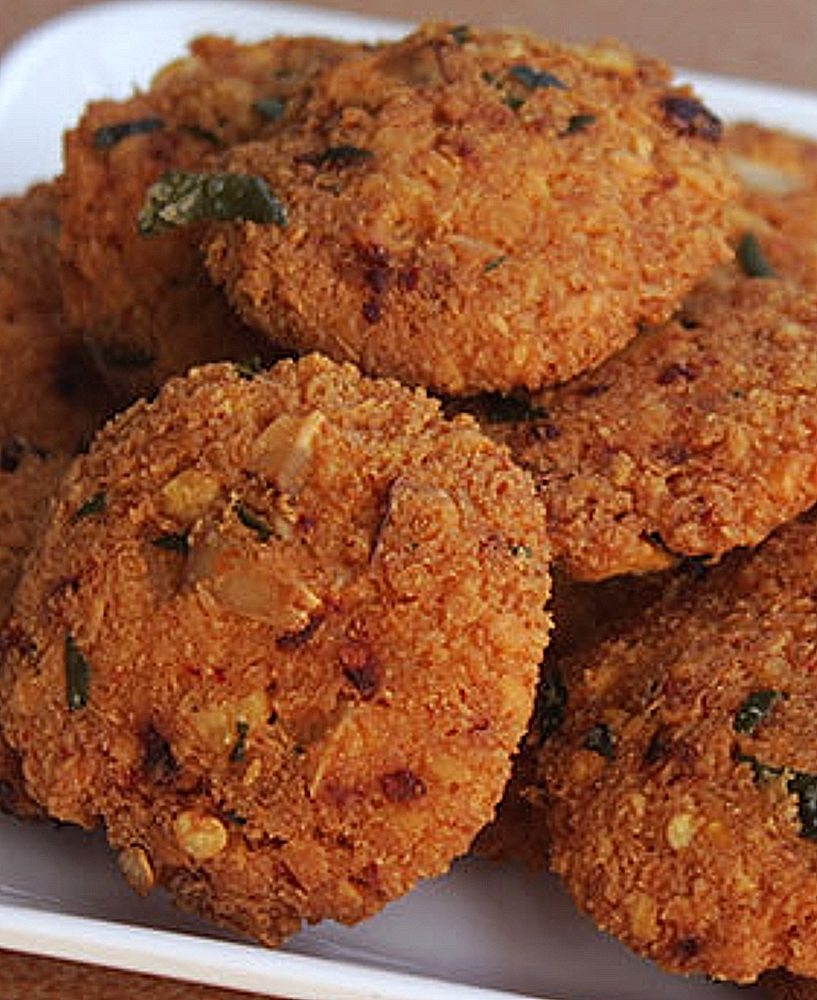


மசால வடை — Masala Vaḍai
Etymology: from Tamil — "masala" (மசால, spice blend) + "vaḍai" (வடை, fried legume fritter). Also called "Paruppu Vadai" (பருப்பு வடை) in its simplest version.
Fried fritter of chana dal and split peas with Tamil spices, street speciality and Hindu ritual offering — stone mortar grinding technique and high-temperature frying.
"Discover the traditional recipe for Masala Vada, an emblematic speciality of Tamil Nadu and Kerala (South India), recognised for its authenticity, its unique crispy texture and its heritage in Dravidian cuisine over centuries."
Tamil name: மசால வடை (Masala Vaḍai) Kannada name: ಮಸಾಲ ವಡೆ (Masala Vade) Telugu name: మసాల వడ (Masala Vada) Malayalam name: മസാല വട (Masala Vada) Hindi name: मसाला वड़ा (Masala Vaṛā)
Attested dialectal variants:
Classic Tamil version (reference): chana dal lentils and yellow split peas, green chilli, ginger, curry leaves, onion, cumin, fresh coriander. Slightly domed patty shape, characteristic jagged edges. Frying at 160–170 °C.
Kerala version (Uzhunnu Vada): base of peeled black lentils (urad dal) — lighter and airier texture, characteristic ring-shaped fritter.
Karnataka version (Ambode): chickpeas (chana dal) only, added grated coconut, generous curry leaves, coarser and more rustic texture.
Maharashtra version: addition of white sesame, denser texture, sometimes consumed as a sandwich with green chutney.
Festive version / prasad: prepared without onion or garlic for temple offerings — sattvic version in accordance with Hindu dietary rules.
Contemporary gastronomic version: mini-vada as canapés, sandwich version (vada pav), incorporation into yoghurt curry (dahi vada).
Estimated period of appearance: Dravidian antiquity — the first written references to vadai appear in Tamil Sangam literature (3rd century BC – 3rd century AD).
Ingredients added over time: chilli (introduced by the Portuguese in the 16th century), onion (progressive Mughal influence).
Modern adaptations: oven or air fryer version for lighter home use; onion-free versions for temple use; fusion versions with Western cheeses.
« Vadai illatha vizha, vizha alla » — "A celebration without vadai is no celebration." (popular Tamil proverb)
According to Hindu tradition, the vadai is one of the offerings most cherished by Ganesh, god of wisdom and beginnings. It is said that during the great Ganesh Chaturthi festivals, devotees who offer vadai at the temple receive in return the blessing of mental clarity and success in their endeavours. In some Tamil Nadu temples, a garland of vadai is hung around the necks of Ganesh statues during abhishekam ceremonies — a practice that continues to this day.
1. Origin of the dish
The vadai is one of the oldest dishes of Dravidian cuisine. The first literary references appear in Tamil Sangam poetry (3rd century BC – 3rd century AD), where the legume fritter is mentioned as food offered to the gods and to honoured guests. At that time, it was prepared exclusively from black lentils (urad dal) ground in a stone mortar — a technique that remains the reference method for purists.
In the temple kitchen system (maduvilai) of Tamil Nadu, the vadai occupied a central place among prasadam — consecrated foods offered to deities and then redistributed to worshippers. Each great temple had its own codified recipes, jealously guarded by hereditary brahmin cook families.
2. Cultural influences and exchanges
The introduction of chilli in the 16th century by the Portuguese through Goa profoundly transformed the aromatic profile of the vadai — before that, heat was provided by long pepper (pippali) and black pepper. The expansion of trade between Tamil Nadu, Kerala and Sri Lanka created distinct regional variants — the Sri Lankan version with coconut and pandan, the Keralite urad dal ring version.
British colonisation and the emigration of Tamil workers to Mauritius, Fiji, Malaysia and South Africa exported the vadai worldwide, where it adapted to local ingredients — giving birth to the Mauritian gato pima, the Fijian dhal puri and South African lentil fritters.
3. Technical and culinary evolution
The shift from the stone mortar to the electric blender, in the second half of the 20th century, significantly modified the texture of the vadai — the blender produces a smoother, more homogeneous paste, while the mortar generates a slightly fibrous, airy texture that encourages rising during frying. Purists in Tamil Nadu and Kerala continue to insist on using the mortar for ritual preparations.
The emergence of tiffin centers — those popular morning cafés ubiquitous in South Indian cities — standardised the recipe and made it an indispensable breakfast staple alongside idli and dosa, served with coconut chutney and sambar.
The technical hallmark of masala vada lies in the partial grinding of the lentils — the paste must not be completely smooth: a portion of the lentils is coarsely crushed to create the characteristic jagged edges and slightly granular interior texture. This controlled textural heterogeneity is what fundamentally differentiates masala vada from a simple smooth legume fritter.
Chana dal lentils (yellow split chickpeas), fresh curry leaves, fresh green chilli, fresh ginger — these four elements define the aromatic identity of authentic masala vada.
(Target yield: 18 to 22 pieces — 6 to 8 aperitif portions)
| Ingredient | Tamil name | Transliteration | Quantity | Approx. weight |
|---|---|---|---|---|
| Chana dal lentils (split chickpeas) | கடலை பருப்பு | Kadalai paruppu | 200 g | 200 g |
| Yellow split peas | துவரம் பருப்பு | Thuvaram paruppu | 50 g | 50 g |
| Red onion | வெங்காயம் | Vengayam | 1 medium | ~100 g |
| Fresh green chilli | பச்சை மிளகாய் | Pachai milagai | 3–4 pieces | ~25 g |
| Fresh ginger | இஞ்சி | Inji | 2 cm | ~10 g |
| Fresh curry leaves | கறிவேப்பிலை | Karuveppilai | 2 sprigs | ~5 g |
| Fresh coriander | கொத்தமல்லி | Kothamalli | 3 tbsp chopped | ~15 g |
| Fennel (seeds) | சோம்பு | Sombu | 1 tsp | ~3 g |
| Cumin (seeds) | சீரகம் | Seeragam | ½ tsp | ~2 g |
| Cracked black pepper (optional) | மிளகு | Milagu | ½ tsp | ~2 g |
| Salt | உப்பு | Uppu | To taste | ~5 g |
| Frying oil | எண்ணெய் | Ennai | As needed | ~500 ml |
Accepted variants:
Variants not in keeping with tradition:
1. Mise en place and soaking
Wash chana dal and split peas separately in cold water until the water runs clear. Soak in a large volume of cold water: chana dal minimum 2 hours, split peas minimum 1 hour. Do not soak too long (beyond 4 hours) — the lentils absorb too much water and the paste becomes too wet.
⚠️ Critical point: reserve a small handful of whole soaked chana dal before grinding — they will be incorporated at the end to create the characteristic jagged edges and heterogeneous interior texture of authentic masala vada.
2. Draining
Carefully drain the soaked lentils. Leave to rest in a colander for 10 minutes to eliminate excess water. Do not rinse after soaking. Excess moisture is the main enemy of crispy texture.
3. Partial grinding — critical technical step
In blender: place the drained lentils in the bowl without adding any water. Blend in short successive pulses until obtaining a coarse paste — neither too smooth nor too chunky. The paste should hold together but with visible pieces of lentil.
⚠️ Never add water during grinding. If the blender struggles, scrape the sides and continue in pulses.
In mortar: pound the lentils in small quantities with circular movements, preserving a slightly coarse texture.
4. Seasoning and mixing
Transfer the coarse paste to a bowl. Add: finely sliced onion, finely chopped green chilli, grated ginger, roughly torn curry leaves, chopped coriander, fennel seeds, cumin, cracked pepper (if used) and salt. Incorporate the whole lentils reserved in step 1. Mix by hand until evenly distributed.
5. Fry test
Before shaping the full batch, fry a small piece of test dough. If it rises quickly, holds its shape and browns evenly → perfect paste. If it falls apart → too wet. If it hardens immediately without browning → oil too hot.
6. Shaping
Lightly oil the hands. Take approximately 2 tablespoons of dough. Form a ball then flatten it between the palms into a patty 6–7 cm in diameter and 1.5 cm thick. The edges should be slightly irregular and jagged. Do not over-smooth.
7. Frying
Heat oil to 160–170 °C in the kadai or deep fryer. Slide the patties in gently in batches of maximum 4–5 pieces. Fry for 2–3 minutes without touching until the crust forms, then turn. Fry for a further 2–3 minutes. Target colour is deep golden brown. Drain on absorbent paper. Serve immediately.
8. Service
Serve very hot with fresh coconut chutney and sambar. The hot/cool thermal contrast is fundamental to traditional South Indian service.
| Criterion | Traditional frying | Oven 200 °C | Air fryer 180 °C |
|---|---|---|---|
| Duration | 5 min | 20–25 min | 12–15 min |
| Outside texture | Very crispy | Lightly crispy | Good crunch |
| Inside texture | Soft | Slightly dry | Soft |
| Fidelity to original | Reference | Acceptable | Good compromise |
| Fat content | Higher | Very low | Very low |
| Observed defect | Probable cause | Correction |
|---|---|---|
| Fritters falling apart | Dough too wet | Drain more carefully; add coarsely powdered chana dal |
| Too smooth, no jagged edges | Excessive grinding | Blend less, preserve visible pieces |
| Too hard and dense | Dough too dry or over-worked | Less blending; lightly moisten hands when shaping |
| Too pale | Oil too cold | Bring to 165–170 °C |
| Too dark, bitter | Oil too hot | Reduce to 160 °C |
| Curry leaf flavour too faint | Dry leaves or insufficient quantity | Always use fresh leaves in generous quantity |
Fresh coconut chutney (Thengai chutney) — the absolute reference condiment: Fresh grated coconut (100 g), green chilli (1–2), ginger (1 cm), salt, water. Blend finely. Temper with mustard seeds, curry leaves, dried red chilli in hot oil. Profile: fresh, creamy, lightly spicy.
Sambar — spiced lentil broth with vegetables: Toor dal lentils, tomatoes, tamarind, seasonal vegetables, sambar powder. Time-consuming to prepare, indispensable in traditional service. Profile: sour, spicy, deep vegetable umami.
Coriander and mint chutney: fresh coriander, mint, green chilli, lemon, salt. Refreshing, vivid green.
Tamarind chutney: tamarind, jaggery (palm sugar), cumin, chilli. Sweet-sour-spicy profile.
Fried masala vada:
Raw dough:
Frying
Cold chain
Allergens
| Mistake | Consequence | Correction |
|---|---|---|
| Adding water during grinding | Dough too wet, fritters fall apart | Never add water — use only natural moisture of lentils |
| Grinding too finely | Smooth paste, edges without jagging, homogeneous texture | Work in short pulses, preserve pieces |
| Soaking too long (> 4 h) | Saturated lentils, unworkable dough | Observe 2 h for chana dal, 1 h for split peas |
| Omitting fresh curry leaves | Loss of signature aroma | Always use fresh leaves — never dried for this recipe |
| Over-smoothing when shaping | Plastic appearance, without character | Leave edges irregular, don't over-work the shape |
| Batch too large | Temperature drop, greasy fritters | Maximum 4–5 pieces at a time |
| Serving cold or lukewarm | Loss of crunch, rubbery texture | Serve immediately straight from the fryer |
Texture: The secret of masala vada's exceptional crunch lies in two elements: perfect draining of the lentils and constant oil temperature. Use a thermometer — 165 °C is the ideal temperature.
Aromas: Fresh curry leaves are absolutely irreplaceable in this recipe — dried leaves do not have the same aromatic profile. If you cannot find them, omit them rather than substitute with dried.
Chef's tip: Dry-toast fennel and cumin seeds in a hot pan for 2 minutes before incorporating them — this simple gesture releases the essential oils and gives incomparable aromatic depth to masala vada.
Equipment:
Traditional South Indian service Masala vada must be served very hot, straight from the fryer, on a banana leaf in traditional service or on a plate with coconut chutney and sambar in tiffin centers.
Traditional South Indian breakfast menu Masala vada fits into the morning menu alongside: idli (steamed rice cakes), dosa (fermented rice and lentil crepe), pongal (spiced rice and lentil porridge). The ensemble is called tiffin.
Drink pairings
Heritage and regional pairings
Estimated values — to be refined according to precise recipe and laboratory analysis
மசால வடை — Masala Vaḍai
Etymology: from Tamil — "masala" (மசால, spice blend) + "vaḍai" (வடை, fried legume fritter). Also called "Paruppu Vadai" (பருப்பு வடை) in its simplest version.
Fried fritter of chana dal and split peas with Tamil spices, street speciality and Hindu ritual offering — stone mortar grinding technique and high-temperature frying.
"Discover the traditional recipe for Masala Vada, an emblematic speciality of Tamil Nadu and Kerala (South India), recognised for its authenticity, its unique crispy texture and its heritage in Dravidian cuisine over centuries."
Tamil name: மசால வடை (Masala Vaḍai) Kannada name: ಮಸಾಲ ವಡೆ (Masala Vade) Telugu name: మసాల వడ (Masala Vada) Malayalam name: മസാല വട (Masala Vada) Hindi name: मसाला वड़ा (Masala Vaṛā)
Attested dialectal variants:
Classic Tamil version (reference): chana dal lentils and yellow split peas, green chilli, ginger, curry leaves, onion, cumin, fresh coriander. Slightly domed patty shape, characteristic jagged edges. Frying at 160–170 °C.
Kerala version (Uzhunnu Vada): base of peeled black lentils (urad dal) — lighter and airier texture, characteristic ring-shaped fritter.
Karnataka version (Ambode): chickpeas (chana dal) only, added grated coconut, generous curry leaves, coarser and more rustic texture.
Maharashtra version: addition of white sesame, denser texture, sometimes consumed as a sandwich with green chutney.
Festive version / prasad: prepared without onion or garlic for temple offerings — sattvic version in accordance with Hindu dietary rules.
Contemporary gastronomic version: mini-vada as canapés, sandwich version (vada pav), incorporation into yoghurt curry (dahi vada).
Estimated period of appearance: Dravidian antiquity — the first written references to vadai appear in Tamil Sangam literature (3rd century BC – 3rd century AD).
Ingredients added over time: chilli (introduced by the Portuguese in the 16th century), onion (progressive Mughal influence).
Modern adaptations: oven or air fryer version for lighter home use; onion-free versions for temple use; fusion versions with Western cheeses.
« Vadai illatha vizha, vizha alla » — "A celebration without vadai is no celebration." (popular Tamil proverb)
According to Hindu tradition, the vadai is one of the offerings most cherished by Ganesh, god of wisdom and beginnings. It is said that during the great Ganesh Chaturthi festivals, devotees who offer vadai at the temple receive in return the blessing of mental clarity and success in their endeavours. In some Tamil Nadu temples, a garland of vadai is hung around the necks of Ganesh statues during abhishekam ceremonies — a practice that continues to this day.
1. Origin of the dish
The vadai is one of the oldest dishes of Dravidian cuisine. The first literary references appear in Tamil Sangam poetry (3rd century BC – 3rd century AD), where the legume fritter is mentioned as food offered to the gods and to honoured guests. At that time, it was prepared exclusively from black lentils (urad dal) ground in a stone mortar — a technique that remains the reference method for purists.
In the temple kitchen system (maduvilai) of Tamil Nadu, the vadai occupied a central place among prasadam — consecrated foods offered to deities and then redistributed to worshippers. Each great temple had its own codified recipes, jealously guarded by hereditary brahmin cook families.
2. Cultural influences and exchanges
The introduction of chilli in the 16th century by the Portuguese through Goa profoundly transformed the aromatic profile of the vadai — before that, heat was provided by long pepper (pippali) and black pepper. The expansion of trade between Tamil Nadu, Kerala and Sri Lanka created distinct regional variants — the Sri Lankan version with coconut and pandan, the Keralite urad dal ring version.
British colonisation and the emigration of Tamil workers to Mauritius, Fiji, Malaysia and South Africa exported the vadai worldwide, where it adapted to local ingredients — giving birth to the Mauritian gato pima, the Fijian dhal puri and South African lentil fritters.
3. Technical and culinary evolution
The shift from the stone mortar to the electric blender, in the second half of the 20th century, significantly modified the texture of the vadai — the blender produces a smoother, more homogeneous paste, while the mortar generates a slightly fibrous, airy texture that encourages rising during frying. Purists in Tamil Nadu and Kerala continue to insist on using the mortar for ritual preparations.
The emergence of tiffin centers — those popular morning cafés ubiquitous in South Indian cities — standardised the recipe and made it an indispensable breakfast staple alongside idli and dosa, served with coconut chutney and sambar.
The technical hallmark of masala vada lies in the partial grinding of the lentils — the paste must not be completely smooth: a portion of the lentils is coarsely crushed to create the characteristic jagged edges and slightly granular interior texture. This controlled textural heterogeneity is what fundamentally differentiates masala vada from a simple smooth legume fritter.
Chana dal lentils (yellow split chickpeas), fresh curry leaves, fresh green chilli, fresh ginger — these four elements define the aromatic identity of authentic masala vada.
(Target yield: 18 to 22 pieces — 6 to 8 aperitif portions)
| Ingredient | Tamil name | Transliteration | Quantity | Approx. weight |
|---|---|---|---|---|
| Chana dal lentils (split chickpeas) | கடலை பருப்பு | Kadalai paruppu | 200 g | 200 g |
| Yellow split peas | துவரம் பருப்பு | Thuvaram paruppu | 50 g | 50 g |
| Red onion | வெங்காயம் | Vengayam | 1 medium | ~100 g |
| Fresh green chilli | பச்சை மிளகாய் | Pachai milagai | 3–4 pieces | ~25 g |
| Fresh ginger | இஞ்சி | Inji | 2 cm | ~10 g |
| Fresh curry leaves | கறிவேப்பிலை | Karuveppilai | 2 sprigs | ~5 g |
| Fresh coriander | கொத்தமல்லி | Kothamalli | 3 tbsp chopped | ~15 g |
| Fennel (seeds) | சோம்பு | Sombu | 1 tsp | ~3 g |
| Cumin (seeds) | சீரகம் | Seeragam | ½ tsp | ~2 g |
| Cracked black pepper (optional) | மிளகு | Milagu | ½ tsp | ~2 g |
| Salt | உப்பு | Uppu | To taste | ~5 g |
| Frying oil | எண்ணெய் | Ennai | As needed | ~500 ml |
Accepted variants:
Variants not in keeping with tradition:
1. Mise en place and soaking
Wash chana dal and split peas separately in cold water until the water runs clear. Soak in a large volume of cold water: chana dal minimum 2 hours, split peas minimum 1 hour. Do not soak too long (beyond 4 hours) — the lentils absorb too much water and the paste becomes too wet.
⚠️ Critical point: reserve a small handful of whole soaked chana dal before grinding — they will be incorporated at the end to create the characteristic jagged edges and heterogeneous interior texture of authentic masala vada.
2. Draining
Carefully drain the soaked lentils. Leave to rest in a colander for 10 minutes to eliminate excess water. Do not rinse after soaking. Excess moisture is the main enemy of crispy texture.
3. Partial grinding — critical technical step
In blender: place the drained lentils in the bowl without adding any water. Blend in short successive pulses until obtaining a coarse paste — neither too smooth nor too chunky. The paste should hold together but with visible pieces of lentil.
⚠️ Never add water during grinding. If the blender struggles, scrape the sides and continue in pulses.
In mortar: pound the lentils in small quantities with circular movements, preserving a slightly coarse texture.
4. Seasoning and mixing
Transfer the coarse paste to a bowl. Add: finely sliced onion, finely chopped green chilli, grated ginger, roughly torn curry leaves, chopped coriander, fennel seeds, cumin, cracked pepper (if used) and salt. Incorporate the whole lentils reserved in step 1. Mix by hand until evenly distributed.
5. Fry test
Before shaping the full batch, fry a small piece of test dough. If it rises quickly, holds its shape and browns evenly → perfect paste. If it falls apart → too wet. If it hardens immediately without browning → oil too hot.
6. Shaping
Lightly oil the hands. Take approximately 2 tablespoons of dough. Form a ball then flatten it between the palms into a patty 6–7 cm in diameter and 1.5 cm thick. The edges should be slightly irregular and jagged. Do not over-smooth.
7. Frying
Heat oil to 160–170 °C in the kadai or deep fryer. Slide the patties in gently in batches of maximum 4–5 pieces. Fry for 2–3 minutes without touching until the crust forms, then turn. Fry for a further 2–3 minutes. Target colour is deep golden brown. Drain on absorbent paper. Serve immediately.
8. Service
Serve very hot with fresh coconut chutney and sambar. The hot/cool thermal contrast is fundamental to traditional South Indian service.
| Criterion | Traditional frying | Oven 200 °C | Air fryer 180 °C |
|---|---|---|---|
| Duration | 5 min | 20–25 min | 12–15 min |
| Outside texture | Very crispy | Lightly crispy | Good crunch |
| Inside texture | Soft | Slightly dry | Soft |
| Fidelity to original | Reference | Acceptable | Good compromise |
| Fat content | Higher | Very low | Very low |
| Observed defect | Probable cause | Correction |
|---|---|---|
| Fritters falling apart | Dough too wet | Drain more carefully; add coarsely powdered chana dal |
| Too smooth, no jagged edges | Excessive grinding | Blend less, preserve visible pieces |
| Too hard and dense | Dough too dry or over-worked | Less blending; lightly moisten hands when shaping |
| Too pale | Oil too cold | Bring to 165–170 °C |
| Too dark, bitter | Oil too hot | Reduce to 160 °C |
| Curry leaf flavour too faint | Dry leaves or insufficient quantity | Always use fresh leaves in generous quantity |
Fresh coconut chutney (Thengai chutney) — the absolute reference condiment: Fresh grated coconut (100 g), green chilli (1–2), ginger (1 cm), salt, water. Blend finely. Temper with mustard seeds, curry leaves, dried red chilli in hot oil. Profile: fresh, creamy, lightly spicy.
Sambar — spiced lentil broth with vegetables: Toor dal lentils, tomatoes, tamarind, seasonal vegetables, sambar powder. Time-consuming to prepare, indispensable in traditional service. Profile: sour, spicy, deep vegetable umami.
Coriander and mint chutney: fresh coriander, mint, green chilli, lemon, salt. Refreshing, vivid green.
Tamarind chutney: tamarind, jaggery (palm sugar), cumin, chilli. Sweet-sour-spicy profile.
Fried masala vada:
Raw dough:
Frying
Cold chain
Allergens
| Mistake | Consequence | Correction |
|---|---|---|
| Adding water during grinding | Dough too wet, fritters fall apart | Never add water — use only natural moisture of lentils |
| Grinding too finely | Smooth paste, edges without jagging, homogeneous texture | Work in short pulses, preserve pieces |
| Soaking too long (> 4 h) | Saturated lentils, unworkable dough | Observe 2 h for chana dal, 1 h for split peas |
| Omitting fresh curry leaves | Loss of signature aroma | Always use fresh leaves — never dried for this recipe |
| Over-smoothing when shaping | Plastic appearance, without character | Leave edges irregular, don't over-work the shape |
| Batch too large | Temperature drop, greasy fritters | Maximum 4–5 pieces at a time |
| Serving cold or lukewarm | Loss of crunch, rubbery texture | Serve immediately straight from the fryer |
Texture: The secret of masala vada's exceptional crunch lies in two elements: perfect draining of the lentils and constant oil temperature. Use a thermometer — 165 °C is the ideal temperature.
Aromas: Fresh curry leaves are absolutely irreplaceable in this recipe — dried leaves do not have the same aromatic profile. If you cannot find them, omit them rather than substitute with dried.
Chef's tip: Dry-toast fennel and cumin seeds in a hot pan for 2 minutes before incorporating them — this simple gesture releases the essential oils and gives incomparable aromatic depth to masala vada.
Equipment:
Traditional South Indian service Masala vada must be served very hot, straight from the fryer, on a banana leaf in traditional service or on a plate with coconut chutney and sambar in tiffin centers.
Traditional South Indian breakfast menu Masala vada fits into the morning menu alongside: idli (steamed rice cakes), dosa (fermented rice and lentil crepe), pongal (spiced rice and lentil porridge). The ensemble is called tiffin.
Drink pairings
Heritage and regional pairings
Estimated values — to be refined according to precise recipe and laboratory analysis