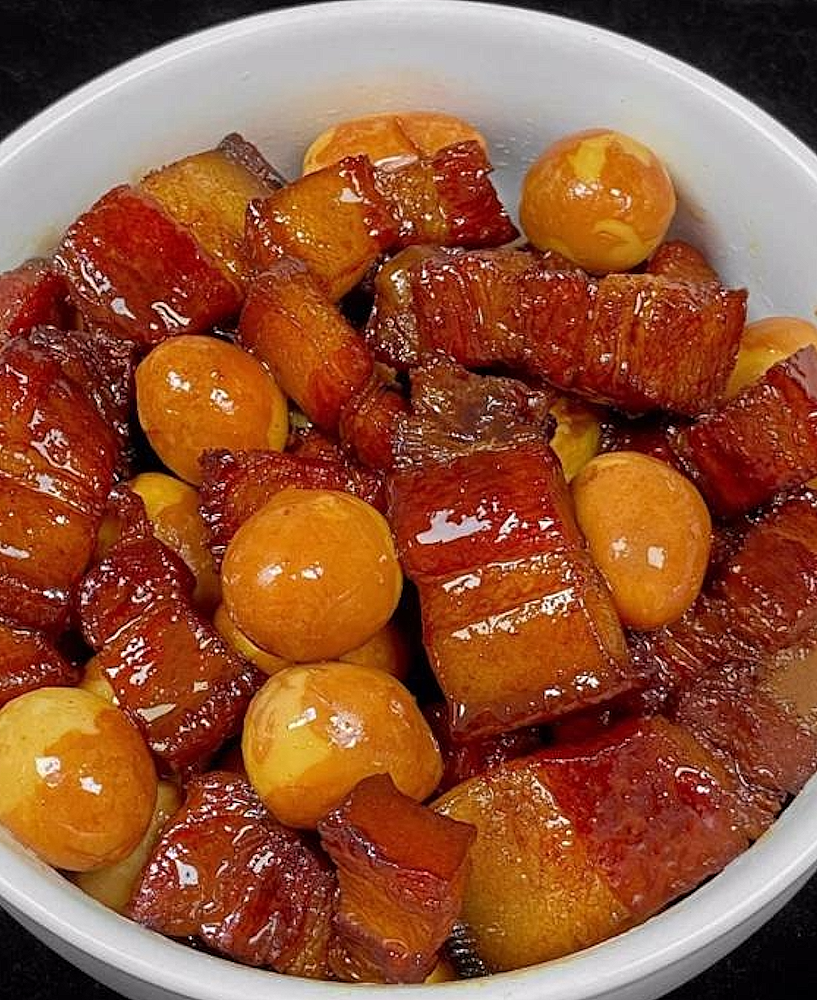

Thịt kho tàu — Caramel-Braised Pork with Hard-Boiled Eggs, Southern Vietnam
Recipe for Thịt kho tàu : caramel-braised pork with hard-boiled eggs, ritual dish of the Vietnamese Tết
Name in its language of origin
Etymology
⚠️ Etymology unconfirmed — no established linguistic consensus.
Speciality of the Mekong Delta, slow-cooked in fresh coconut water, hand-caramelised according to the tradition of the Lunar New Year.
Discover the traditional recipe for Thịt kho tàu, an emblematic speciality of Southern Vietnam, renowned for its ritual authenticity, its Tết symbolism and its culinary heritage from the Mekong Delta.
⚠️ Any other name must be verified against attested oral or linguistic sources.
Essential emblematic products :
Imposed technique :
Traditional prohibitions :
Saying « Thịt kho ngon hơn the next day »
Translation : "The thịt kho tastes better the next day" — the flavours concentrate with rest.
Geographical and social origin
Thịt kho tàu was born in the rural areas of the Mekong Delta, in Southern Vietnam, in a context of river farming marked by the seasonal abundance of the coconut tree. Peasant families used locally available ingredients : farmyard pork, fresh coconut water, artisanal fish sauce, raw cane sugar.
The kho technique — slow reduction cooking — allowed the meat to be preserved for several days without refrigeration, making it an economical, nourishing and practical dish.
Role in the ritual calendar
This dish is deeply rooted in Tết Nguyên Đán (Lunar New Year), the most important festival in the Vietnamese calendar.
It is prepared in the days leading up to the first day of the lunar year, offered on the ancestral altar (bàn thờ) as a sign of respect and family continuity.
Its symbolism is multiple :
Influences and differences from Chinese versions
Similar dishes exist in China — notably hong shao rou (red-braised pork from Hunan) — but their flavour profiles differ :
Thịt kho tàu is distinguished by :
Technical and contemporary developments
The dish has not undergone major changes for several generations.
In the diaspora, progressive adaptations are noted :
Contemporary gastronomic interpretations exist :
but they move away from the heritage dish.
Southern Vietnam version — reference
Systematic use of fresh coconut water.
Very pronounced caramel, abundant black pepper, no spices.
Served with :
Central Vietnam version
Less sweet, less coconut.
Saltier sauce, more discreet pepper.
Different fermented vegetables as accompaniment.
Diaspora version
Some families add a little soy sauce (progressive denaturing).
Pork belly sometimes replaced by less fatty loin.
Contemporary gastronomic version
⚠️ These contemporary versions fall outside the traditional heritage framework.
Evolution of the recipe
Presentation
Texture
Dominant aromas
Essential identity ingredients
Necessary utensils
| Ingredient | Quantity | Notes |
|---|---|---|
| Pork belly (rind and fat retained) | 1.2 kg | 4–5 cm cubes |
| Fresh eggs | 5 pieces | Added at mid-cooking |
| Raw cane sugar | 100 g | Homemade caramel — never refined white sugar |
| Fresh coconut water | 500 ml | Fresh coconut ; unsweetened carton for everyday use |
| First-press nuoc mam | 4 tbsp | Quality is essential |
| Garlic | 2 cloves | Finely chopped |
| Shallots | 2 pieces | Finely diced |
| Freshly ground black pepper | 1 tsp | Abundant — aromatic signature |
| Fine salt | 1 pinch | Adjust according to nuoc mam |
| Neutral vegetable oil | 2 tbsp | Initial searing |
| Hot water | 50 ml | To deglaze the caramel |
⚠️ Never use :
Technical objectives
Step 1 — Mise en place
→ Blanching — often omitted in simplified recipes — removes impurities and ensures a clear sauce.
Step 2 — Homemade caramel (nước màu) — CCP
⚠️ This slightly bitter caramel is the irreplaceable signature of the dish. Any substitution (honey, syrup, sweet soy sauce, industrial caramel) denatures the thịt kho tàu.
Step 3 — Searing the pork
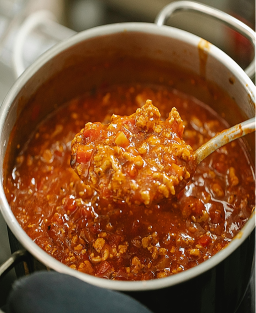
Step 4 — Long cooking in coconut water
Step 5 — Adding the eggs (mid-cooking)
⚠️ Do not add the eggs from the start : the whites would become excessively firm (rubbery texture). This is one of the most frequent mistakes.
Step 6 — Finishing and serving
Critical controls
Tolerances and corrections
Associated condiments
Cold chain
Core cooking temperature
Cooling
Declared allergens
⚠️ Always check the composition of the nuoc mam used (some industrial products contain traces of soy or wheat).
Applicable regulations
Frequent mistakes and corrections
| Mistake | Consequence | Correction |
|---|---|---|
| Caramel replaced by soy sauce or syrup | Flavour profile denatured | Always make the nước màu dry |
| Fat and rind removed | Thin sauce, dry meat | Retain throughout the entire cooking |
| Eggs added from the start | Rubbery whites | Add at mid-cooking, after 1 h |
| Sustained boiling | Tough meat, cloudy sauce | Very low heat, barely visible simmer |
| Sweetened tinned coconut water | Excess sugar, artificial flavour | Fresh coconut water or unsweetened carton |
Texture tips
Aromatic tips
Chef's advice
The true signature of thịt kho tàu lies neither in the ingredients (simple) nor in the technique (accessible) — it lies in patience. A rushed cooking produces an ordinary braised pork. A slow, monitored cooking, with a courageous homemade caramel (approaching 200 °C without fear), produces a dish of unexpected depth. Tradition says to prepare it on the eve of Tết. It is also the best culinary tip in the recipe.
Service
Traditional accompaniments
Wine pairings
Appellation : AOC Alsace Riesling / Alsace Grand Cru Grape variety : Riesling 100 % Sought aromatic profile : Mineral, ripe citrus (lemon, grapefruit), lime blossom, slight petrol note on mature wines Why this pairing : The sharp acidity and minerality of the dry Riesling cuts through the fat of the rind, balances the caramel and refreshes the palate between mouthfuls. The absence of residual sugar (dry version) avoids sweetness overload with the sauce. Serving temperature : 8–10 °C Glass type : Tall tulip glass
| Vintage | Profile | Reason for pairing | Status |
|---|---|---|---|
| 2022 ⭐ | Lively, fruity, mineral, fine acidity | Immediate freshness, perfect pairing with caramelised sauce | Drink now — ideal vintage |
| 2021 | Elegant, fresh, slightly taut | Fine balance, respects the sauce without dominating | Accessible — good value for money |
| 2018 | Rich, ripe, candied citrus notes | Aromatic depth echoing the caramel, fine body | Drink now or keep 2–3 more years |
| 2017 | Straight, mineral, fruity | Classic, versatile, very reliable | Immediate pleasure |
| 2010 | Fresh, fruity, great ageing | Ageing excellence — relatively light in alcohol | Ageing vintage if available |
Reference producers : Trimbach (Clos Sainte-Hune), Zind-Humbrecht, Weinbach, Marcel Deiss, Hugel & Fils
Appellation : AOC Alsace Gewurztraminer / Alsace Grand Cru Grape variety : Gewurztraminer 100 % Sought aromatic profile : Rose, lychee, tropical fruits, soft spices, slight smoky note Why this pairing : The natural sweetness and floral-exotic aromas of the Gewurztraminer resonate directly with the sweetness of the coconut water and caramel. Its slightly luscious character wraps around the pork fat without fighting it. Prefer a dry or off-dry version rather than late harvest to avoid overwhelming the palate. Serving temperature : 10–12 °C Glass type : Tulip glass or wide INAO glass
| Vintage | Profile | Reason for pairing | Status |
|---|---|---|---|
| 2022 ⭐ | Expressive, intense floral, well-balanced | Rose and lychee aromas in perfect harmony with the coconut | Ideal vintage — drink now |
| 2021 | Floral, fruity, slightly more discreet | Subtle pairing, does not overwhelm the sauce | Accessible and reliable |
| 2018 | Rich, opulent, fine persistence | Remarkable synergy with the sweetness of the caramel | Great vintage — drink before 2028 |
| 2017 | Balanced, aromatic, dry | Drier version, precise pairing | Available and recommended |
| 2023 | Fresh, floral, clean | Invigorating aromatic youth | Latest release — to discover |
Reference producers : Zind-Humbrecht, Weinbach, Hugel & Fils, Lorentz, Marcel Deiss
Appellation : AOC Bourgogne / Villages / 1er Cru depending on budget Grape variety : Pinot Noir 100 % Sought aromatic profile : Red fruits (cherry, raspberry), light undergrowth, silky tannins, fresh finish Why this pairing : Burgundy Pinot Noir, served slightly cool (14 °C), offers fine tannins that do not clash with the sweet-savoury sauce. Its relative lightness in alcohol and fruity vivacity counterbalance the fat of the dish without overwhelming it. Avoid Grands Crus that are too tannic or too oaky and would dominate the sauce. Serving temperature : 14 °C Glass type : Burgundy glass (wide, flared)
| Vintage | Profile | Reason for pairing | Status |
|---|---|---|---|
| 2020 ⭐ | Precise, elegant, balanced, classic | Finesse and freshness — ideal pairing without dominating the sauce | Reference vintage — drink now |
| 2021 | Supple, fruity, drink young | Welcome lightness with the coating sauce | Accessible — excellent value for money |
| 2019 | Generous fruit, round, expressive | Fruity generosity echoing the caramel | Very good vintage — available |
| 2022 | Rich, balanced, promising | Ample but fresh style — decant lightly | Ageing vintage or already enjoyable |
| 2015 | Powerful, concentrated, meaty | For lovers of more structured wines — with the fattiest pieces | Great vintage — serve at 14 °C without fail |
Recommended appellations for this pairing : Generic Bourgogne, Côte de Beaune Villages, Savigny-lès-Beaune, Mercurey — avoid Grands Crus (too powerful for the sauce)
Reference producers : Jadot, Drouhin, Olivier Leflaive, Domaine de Montille, Chandon de Briailles
Beers
Non-alcoholic
⚠️ Estimated values (CIQUAL/USDA bases). To be verified by approved software before regulatory publication (EU 1169/2011).
Mandatory regulatory block
| Nutrient | Value |
|---|---|
| Energy | ~520 kcal / ~2175 kJ |
| Fat | ~35 g |
| of which saturated fatty acids | ~13 g |
| of which monounsaturated | ~15 g |
| of which polyunsaturated | ~4 g |
| Carbohydrates | ~18 g |
| of which sugars | ~14 g |
| Protein | ~32 g |
| Dietary fibre | < 1 g |
| Sodium | ~900 mg |
| Salt equivalent NaCl | ~2.3 g |
| Energy distribution | Fat 60 % / Carbohydrates 14 % / Protein 25 % |
Extended block
| Nutrient | Value |
|---|---|
| Cholesterol | ~180 mg |
| Iron | ~2.5 mg |
| Zinc | ~4 mg |
| Vitamin B12 | ~1.5 µg |
| Glycaemic index (GI) | ~45 (moderate) |
⚠️ Always check the composition of the nuoc mam used — some industrial products contain traces of soy or wheat.
Gluten-free The traditional recipe is naturally gluten-free. Only verify the composition of the nuoc mam (supplier labelling).
Low in salt Reduce the nuoc mam by half, partially compensate with lime juice. Notable loss of umami complexity.
Vegetarian / vegan Not applicable without denaturing the dish. A vegan version can substitute the pork with firm tofu or jackfruit, and the nuoc mam with a plant-based fish sauce made from seaweed. The result is a different dish, not a heritage one.
Lighter version Replace the pork belly with trimmed loin. Result : less silky sauce, less aromatic depth. Not recommended for a reference version.
Kho (越: kho) Vietnamese cooking technique by long reduction over very low heat, in a sweet-savoury sauce. The meat, fish or tofu simmer until near-complete absorption of the liquid, concentrating the flavours. Distinct from Western braising which retains more sauce. Kho can last from 1 hour to several hours depending on the ingredient.
Blanching (trần/chần) Brief immersion of raw meat in unsalted boiling water (2–3 min), followed by a rinse in cold water. Removes impurities, residual blood and coagulated proteins that would cloud the broth. A step frequently omitted in simplified recipes, but decisive for the clarity and cleanliness of the sauce.
Searing (áp chảo) Quick cooking in hot fat to trigger the Maillard reaction — brown colouring on the surface, aromatic development. Precedes the long cooking in this dish.
Reduction Progressive evaporation of the cooking liquid under the effect of heat, concentrating the flavours and naturally thickening the sauce. In thịt kho tàu, the final reduction (uncovered) allows a coating sauce to be obtained without adding starch.
Nước màu (homemade caramel) Artisanal preparation essential to Southern Vietnamese cuisine. The raw sugar is melted dry until a dark amber-brown shade (190–200 °C), then deglazed with hot water. Serves both as a natural colourant and flavouring — its slight bitterness is the signature of the dish. Irreplaceable by any industrial product, honey or sweet sauce.
Caramelisation Chemical (non-enzymatic) reaction occurring when sugar is heated above 160 °C, producing hundreds of complex aromatic compounds — notes of butter, vanilla, hazelnut, then controlled bitterness. Different from the Maillard reaction (which involves proteins).
Maillard reaction Reaction between amino acids and reducing sugars under the effect of heat (> 140 °C), creating the aromas and brown colouring of the seared meat. Contributes to the aromatic depth of the dish.
Nước mắm / Nuoc mam Fermented fish sauce, the backbone of Vietnamese cuisine. Produced by macerating fish (mainly anchovies) and sea salt in wooden vats for 12 to 18 months. The first press (nước mắm nhĩ) is the most qualitative : concentrated, amber, rich in umami. Subsequent pressings are progressively more diluted. Its role in thịt kho tàu is threefold : to salt, to colour, to provide umami.
Nước dừa (fresh coconut water) Natural liquid contained in the young coconut, slightly sweet and slightly mineral. Distinct from coconut milk (extracted from grated flesh). In thịt kho tàu, it replaces ordinary water as the cooking liquid, providing sweetness, aromatic depth and a slight vegetal note. The fresh version is preferable to carton for ceremonial preparations.
Raw cane sugar (đường thô / đường mía) Unrefined sugar retaining part of the molasses, with notes of caramel, rum and liquorice. Preferred to refined white sugar for the nước màu because it caramelises with more nuance and aromatic complexity. Historically sometimes substituted by palm sugar (đường thốt nốt), which is rarer.
Palm sugar (đường thốt nốt) Sugar extracted from the sap of the sugar palm (Borassus flabellifer), grown mainly in the provinces of An Giang and Kiên Giang (Mekong Delta). Softer and more floral caramel notes than cane sugar. An older and more noble version of the dish, today less common due to supply reasons.
Pork belly (ba chỉ) Interleaved cut comprising the lard, intercostal muscles and rind. The fat/lean/rind ratio is essential. The collagen in the rind dissolves slowly during cooking to give the broth its characteristic silky, gelatinous texture. Never trim before cooking.
Rind (bì heo) Pork skin, rich in collagen. During long, low-heat cooking, the collagen transforms into gelatine, naturally thickening the sauce and giving it a velvety texture. A fundamental element of the dish — its removal irremediably impoverishes the sauce.
Black pepper (tiêu đen) In Southern Vietnamese thịt kho tàu, pepper is not a simple seasoning but a dominant aroma. It is used freshly ground, in generous quantity. The regions of Phú Quốc and Bà Rịa-Vũng Tàu produce the reference Vietnamese peppers — woody, spicy and slightly citrusy notes.
Umami (vị umami) Fifth fundamental taste (alongside sweet, salty, sour, bitter), identified by Japanese chemist Kikunae Ikeda in 1908. Described as a sensation of depth, roundness and persistence in the mouth. In thịt kho tàu, umami comes from the combination of nuoc mam (natural glutamate) + long reduction + caramel. No spice is needed to achieve it.
Tết Nguyên Đán (節元旦) Vietnamese Lunar New Year — the most important festival in the cultural and religious calendar. Celebrated between January and February according to the lunar cycle. A period of family reunion, respect for ancestors, renewal and prosperity. Thịt kho tàu is one of the essential ritual dishes, prepared in the days leading up to the first day of the year.
Bàn thờ (ancestral altar) Sacred piece of furniture present in almost all Vietnamese homes, regardless of religion practised. Houses : photographs of the deceased, fruit, incense, food, water. Thịt kho tàu is placed there as an offering : symbolically feeding the ancestors perpetuates the bond between the living and the dead.
Symbolism of the ingredients
Kho cuisine (văn hóa kho) A collection of Vietnamese dishes prepared using the kho technique : cá kho tộ (catfish braised in fish sauce in a clay pot), thịt kho tàu, tôm kho (braised shrimp). These dishes share a common philosophy : transforming simple ingredients into rich, deep preparations through the sole patience of the fire.
Dưa cải Vietnamese green mustard (cải bẹ xanh) lacto-fermented in lightly salted and sweetened water. Crunchy texture, sour and slightly spicy flavour. An essential gustatory role as an accompaniment to thịt kho tàu : its acidity cuts through the fat and refreshes the palate between bites.
Dưa giá Pickles of bean sprouts (giá đỗ) and spring onion (hành lá), fermented in salted water. Fine and crunchy texture, lighter acidic flavour than dưa cải. Very common in Mekong Delta households as an accompaniment to kho dishes.
Nước chấm Universal dipping sauce of Vietnamese cuisine. Base of nuoc mam diluted in water, balanced with sugar, lime (or vinegar), minced garlic and chilli. Its sweet-salty-sour-spicy balance makes it the ideal counterpoint to rich dishes. Every family has its own proportions.
Cơm trắng (plain white rice) Jasmine rice or ordinary rice cooked in water, without salt or fat. Obligatory accompaniment to kho dishes — it absorbs the sauce and balances the aromatic concentration of the dish. Served in large quantities : the sauce/rice ratio is at the heart of the gustatory experience.
CCP — Critical Control Point Critical Control Point in the HACCP system (Hazard Analysis and Critical Control Points). A step in the process where a control measure can be applied to prevent, eliminate or reduce a food hazard to an acceptable level. In this dish : the core temperature of the meat (≥ 75 °C) and the caramel colouring.
HACCP (Hazard Analysis and Critical Control Points) Preventive method of risk analysis and critical control points in food safety. Mandatory in professional catering (EC Regulation 852/2004). Based on 7 principles, from hazard analysis to documentation.
Use-by date (UBD) The date beyond which a microbiologically perishable product can no longer be consumed safely. Distinct from the Best Before Date (BBD) which applies to stable products whose organoleptic quality may decrease without danger.
EC Regulation 852/2004 European regulation on the hygiene of foodstuffs. Requires professionals to implement a food safety management plan based on HACCP principles.
EU Regulation 1169/2011 European regulation on the provision of food information to consumers. Requires the declaration of the 14 major allergens (including fish and eggs, both present in this dish).
PGI (Protected Geographical Indication) European label protecting the name of a product whose quality, reputation or other characteristics are linked to its geographical origin. Thịt kho tàu benefits from no such label — it is an officially uncodified intangible culinary heritage.
Hygiene package A set of European regulations (852, 853, 854/2004 and 882/2004) governing the food safety of foodstuffs from production to distribution. The regulatory foundation of all professional catering activity in Europe.
Culinary and oral sources
Linguistic sources
Nutritional sources
Regulations
Professional Heritage Recipe File — March 2026
Thịt kho tàu — Caramel-Braised Pork with Hard-Boiled Eggs, Southern Vietnam
Recipe for Thịt kho tàu : caramel-braised pork with hard-boiled eggs, ritual dish of the Vietnamese Tết
Name in its language of origin
Etymology
⚠️ Etymology unconfirmed — no established linguistic consensus.
Speciality of the Mekong Delta, slow-cooked in fresh coconut water, hand-caramelised according to the tradition of the Lunar New Year.
Discover the traditional recipe for Thịt kho tàu, an emblematic speciality of Southern Vietnam, renowned for its ritual authenticity, its Tết symbolism and its culinary heritage from the Mekong Delta.
⚠️ Any other name must be verified against attested oral or linguistic sources.
Essential emblematic products :
Imposed technique :
Traditional prohibitions :
Saying « Thịt kho ngon hơn the next day »
Translation : "The thịt kho tastes better the next day" — the flavours concentrate with rest.
Geographical and social origin
Thịt kho tàu was born in the rural areas of the Mekong Delta, in Southern Vietnam, in a context of river farming marked by the seasonal abundance of the coconut tree. Peasant families used locally available ingredients : farmyard pork, fresh coconut water, artisanal fish sauce, raw cane sugar.
The kho technique — slow reduction cooking — allowed the meat to be preserved for several days without refrigeration, making it an economical, nourishing and practical dish.
Role in the ritual calendar
This dish is deeply rooted in Tết Nguyên Đán (Lunar New Year), the most important festival in the Vietnamese calendar.
It is prepared in the days leading up to the first day of the lunar year, offered on the ancestral altar (bàn thờ) as a sign of respect and family continuity.
Its symbolism is multiple :
Influences and differences from Chinese versions
Similar dishes exist in China — notably hong shao rou (red-braised pork from Hunan) — but their flavour profiles differ :
Thịt kho tàu is distinguished by :
Technical and contemporary developments
The dish has not undergone major changes for several generations.
In the diaspora, progressive adaptations are noted :
Contemporary gastronomic interpretations exist :
but they move away from the heritage dish.
Southern Vietnam version — reference
Systematic use of fresh coconut water.
Very pronounced caramel, abundant black pepper, no spices.
Served with :
Central Vietnam version
Less sweet, less coconut.
Saltier sauce, more discreet pepper.
Different fermented vegetables as accompaniment.
Diaspora version
Some families add a little soy sauce (progressive denaturing).
Pork belly sometimes replaced by less fatty loin.
Contemporary gastronomic version
⚠️ These contemporary versions fall outside the traditional heritage framework.
Evolution of the recipe
Presentation
Texture
Dominant aromas
Essential identity ingredients
Necessary utensils
| Ingredient | Quantity | Notes |
|---|---|---|
| Pork belly (rind and fat retained) | 1.2 kg | 4–5 cm cubes |
| Fresh eggs | 5 pieces | Added at mid-cooking |
| Raw cane sugar | 100 g | Homemade caramel — never refined white sugar |
| Fresh coconut water | 500 ml | Fresh coconut ; unsweetened carton for everyday use |
| First-press nuoc mam | 4 tbsp | Quality is essential |
| Garlic | 2 cloves | Finely chopped |
| Shallots | 2 pieces | Finely diced |
| Freshly ground black pepper | 1 tsp | Abundant — aromatic signature |
| Fine salt | 1 pinch | Adjust according to nuoc mam |
| Neutral vegetable oil | 2 tbsp | Initial searing |
| Hot water | 50 ml | To deglaze the caramel |
⚠️ Never use :
Technical objectives
Step 1 — Mise en place
→ Blanching — often omitted in simplified recipes — removes impurities and ensures a clear sauce.
Step 2 — Homemade caramel (nước màu) — CCP
⚠️ This slightly bitter caramel is the irreplaceable signature of the dish. Any substitution (honey, syrup, sweet soy sauce, industrial caramel) denatures the thịt kho tàu.
Step 3 — Searing the pork
Step 4 — Long cooking in coconut water
Step 5 — Adding the eggs (mid-cooking)
⚠️ Do not add the eggs from the start : the whites would become excessively firm (rubbery texture). This is one of the most frequent mistakes.
Step 6 — Finishing and serving
Critical controls
Tolerances and corrections
Associated condiments
Cold chain
Core cooking temperature
Cooling
Declared allergens
⚠️ Always check the composition of the nuoc mam used (some industrial products contain traces of soy or wheat).
Applicable regulations
Frequent mistakes and corrections
| Mistake | Consequence | Correction |
|---|---|---|
| Caramel replaced by soy sauce or syrup | Flavour profile denatured | Always make the nước màu dry |
| Fat and rind removed | Thin sauce, dry meat | Retain throughout the entire cooking |
| Eggs added from the start | Rubbery whites | Add at mid-cooking, after 1 h |
| Sustained boiling | Tough meat, cloudy sauce | Very low heat, barely visible simmer |
| Sweetened tinned coconut water | Excess sugar, artificial flavour | Fresh coconut water or unsweetened carton |
Texture tips
Aromatic tips
Chef's advice
The true signature of thịt kho tàu lies neither in the ingredients (simple) nor in the technique (accessible) — it lies in patience. A rushed cooking produces an ordinary braised pork. A slow, monitored cooking, with a courageous homemade caramel (approaching 200 °C without fear), produces a dish of unexpected depth. Tradition says to prepare it on the eve of Tết. It is also the best culinary tip in the recipe.
Service
Traditional accompaniments
Wine pairings
Appellation : AOC Alsace Riesling / Alsace Grand Cru Grape variety : Riesling 100 % Sought aromatic profile : Mineral, ripe citrus (lemon, grapefruit), lime blossom, slight petrol note on mature wines Why this pairing : The sharp acidity and minerality of the dry Riesling cuts through the fat of the rind, balances the caramel and refreshes the palate between mouthfuls. The absence of residual sugar (dry version) avoids sweetness overload with the sauce. Serving temperature : 8–10 °C Glass type : Tall tulip glass
| Vintage | Profile | Reason for pairing | Status |
|---|---|---|---|
| 2022 ⭐ | Lively, fruity, mineral, fine acidity | Immediate freshness, perfect pairing with caramelised sauce | Drink now — ideal vintage |
| 2021 | Elegant, fresh, slightly taut | Fine balance, respects the sauce without dominating | Accessible — good value for money |
| 2018 | Rich, ripe, candied citrus notes | Aromatic depth echoing the caramel, fine body | Drink now or keep 2–3 more years |
| 2017 | Straight, mineral, fruity | Classic, versatile, very reliable | Immediate pleasure |
| 2010 | Fresh, fruity, great ageing | Ageing excellence — relatively light in alcohol | Ageing vintage if available |
Reference producers : Trimbach (Clos Sainte-Hune), Zind-Humbrecht, Weinbach, Marcel Deiss, Hugel & Fils
Appellation : AOC Alsace Gewurztraminer / Alsace Grand Cru Grape variety : Gewurztraminer 100 % Sought aromatic profile : Rose, lychee, tropical fruits, soft spices, slight smoky note Why this pairing : The natural sweetness and floral-exotic aromas of the Gewurztraminer resonate directly with the sweetness of the coconut water and caramel. Its slightly luscious character wraps around the pork fat without fighting it. Prefer a dry or off-dry version rather than late harvest to avoid overwhelming the palate. Serving temperature : 10–12 °C Glass type : Tulip glass or wide INAO glass
| Vintage | Profile | Reason for pairing | Status |
|---|---|---|---|
| 2022 ⭐ | Expressive, intense floral, well-balanced | Rose and lychee aromas in perfect harmony with the coconut | Ideal vintage — drink now |
| 2021 | Floral, fruity, slightly more discreet | Subtle pairing, does not overwhelm the sauce | Accessible and reliable |
| 2018 | Rich, opulent, fine persistence | Remarkable synergy with the sweetness of the caramel | Great vintage — drink before 2028 |
| 2017 | Balanced, aromatic, dry | Drier version, precise pairing | Available and recommended |
| 2023 | Fresh, floral, clean | Invigorating aromatic youth | Latest release — to discover |
Reference producers : Zind-Humbrecht, Weinbach, Hugel & Fils, Lorentz, Marcel Deiss
Appellation : AOC Bourgogne / Villages / 1er Cru depending on budget Grape variety : Pinot Noir 100 % Sought aromatic profile : Red fruits (cherry, raspberry), light undergrowth, silky tannins, fresh finish Why this pairing : Burgundy Pinot Noir, served slightly cool (14 °C), offers fine tannins that do not clash with the sweet-savoury sauce. Its relative lightness in alcohol and fruity vivacity counterbalance the fat of the dish without overwhelming it. Avoid Grands Crus that are too tannic or too oaky and would dominate the sauce. Serving temperature : 14 °C Glass type : Burgundy glass (wide, flared)
| Vintage | Profile | Reason for pairing | Status |
|---|---|---|---|
| 2020 ⭐ | Precise, elegant, balanced, classic | Finesse and freshness — ideal pairing without dominating the sauce | Reference vintage — drink now |
| 2021 | Supple, fruity, drink young | Welcome lightness with the coating sauce | Accessible — excellent value for money |
| 2019 | Generous fruit, round, expressive | Fruity generosity echoing the caramel | Very good vintage — available |
| 2022 | Rich, balanced, promising | Ample but fresh style — decant lightly | Ageing vintage or already enjoyable |
| 2015 | Powerful, concentrated, meaty | For lovers of more structured wines — with the fattiest pieces | Great vintage — serve at 14 °C without fail |
Recommended appellations for this pairing : Generic Bourgogne, Côte de Beaune Villages, Savigny-lès-Beaune, Mercurey — avoid Grands Crus (too powerful for the sauce)
Reference producers : Jadot, Drouhin, Olivier Leflaive, Domaine de Montille, Chandon de Briailles
Beers
Non-alcoholic
⚠️ Estimated values (CIQUAL/USDA bases). To be verified by approved software before regulatory publication (EU 1169/2011).
Mandatory regulatory block
| Nutrient | Value |
|---|---|
| Energy | ~520 kcal / ~2175 kJ |
| Fat | ~35 g |
| of which saturated fatty acids | ~13 g |
| of which monounsaturated | ~15 g |
| of which polyunsaturated | ~4 g |
| Carbohydrates | ~18 g |
| of which sugars | ~14 g |
| Protein | ~32 g |
| Dietary fibre | < 1 g |
| Sodium | ~900 mg |
| Salt equivalent NaCl | ~2.3 g |
| Energy distribution | Fat 60 % / Carbohydrates 14 % / Protein 25 % |
Extended block
| Nutrient | Value |
|---|---|
| Cholesterol | ~180 mg |
| Iron | ~2.5 mg |
| Zinc | ~4 mg |
| Vitamin B12 | ~1.5 µg |
| Glycaemic index (GI) | ~45 (moderate) |
⚠️ Always check the composition of the nuoc mam used — some industrial products contain traces of soy or wheat.
Gluten-free The traditional recipe is naturally gluten-free. Only verify the composition of the nuoc mam (supplier labelling).
Low in salt Reduce the nuoc mam by half, partially compensate with lime juice. Notable loss of umami complexity.
Vegetarian / vegan Not applicable without denaturing the dish. A vegan version can substitute the pork with firm tofu or jackfruit, and the nuoc mam with a plant-based fish sauce made from seaweed. The result is a different dish, not a heritage one.
Lighter version Replace the pork belly with trimmed loin. Result : less silky sauce, less aromatic depth. Not recommended for a reference version.
Kho (越: kho) Vietnamese cooking technique by long reduction over very low heat, in a sweet-savoury sauce. The meat, fish or tofu simmer until near-complete absorption of the liquid, concentrating the flavours. Distinct from Western braising which retains more sauce. Kho can last from 1 hour to several hours depending on the ingredient.
Blanching (trần/chần) Brief immersion of raw meat in unsalted boiling water (2–3 min), followed by a rinse in cold water. Removes impurities, residual blood and coagulated proteins that would cloud the broth. A step frequently omitted in simplified recipes, but decisive for the clarity and cleanliness of the sauce.
Searing (áp chảo) Quick cooking in hot fat to trigger the Maillard reaction — brown colouring on the surface, aromatic development. Precedes the long cooking in this dish.
Reduction Progressive evaporation of the cooking liquid under the effect of heat, concentrating the flavours and naturally thickening the sauce. In thịt kho tàu, the final reduction (uncovered) allows a coating sauce to be obtained without adding starch.
Nước màu (homemade caramel) Artisanal preparation essential to Southern Vietnamese cuisine. The raw sugar is melted dry until a dark amber-brown shade (190–200 °C), then deglazed with hot water. Serves both as a natural colourant and flavouring — its slight bitterness is the signature of the dish. Irreplaceable by any industrial product, honey or sweet sauce.
Caramelisation Chemical (non-enzymatic) reaction occurring when sugar is heated above 160 °C, producing hundreds of complex aromatic compounds — notes of butter, vanilla, hazelnut, then controlled bitterness. Different from the Maillard reaction (which involves proteins).
Maillard reaction Reaction between amino acids and reducing sugars under the effect of heat (> 140 °C), creating the aromas and brown colouring of the seared meat. Contributes to the aromatic depth of the dish.
Nước mắm / Nuoc mam Fermented fish sauce, the backbone of Vietnamese cuisine. Produced by macerating fish (mainly anchovies) and sea salt in wooden vats for 12 to 18 months. The first press (nước mắm nhĩ) is the most qualitative : concentrated, amber, rich in umami. Subsequent pressings are progressively more diluted. Its role in thịt kho tàu is threefold : to salt, to colour, to provide umami.
Nước dừa (fresh coconut water) Natural liquid contained in the young coconut, slightly sweet and slightly mineral. Distinct from coconut milk (extracted from grated flesh). In thịt kho tàu, it replaces ordinary water as the cooking liquid, providing sweetness, aromatic depth and a slight vegetal note. The fresh version is preferable to carton for ceremonial preparations.
Raw cane sugar (đường thô / đường mía) Unrefined sugar retaining part of the molasses, with notes of caramel, rum and liquorice. Preferred to refined white sugar for the nước màu because it caramelises with more nuance and aromatic complexity. Historically sometimes substituted by palm sugar (đường thốt nốt), which is rarer.
Palm sugar (đường thốt nốt) Sugar extracted from the sap of the sugar palm (Borassus flabellifer), grown mainly in the provinces of An Giang and Kiên Giang (Mekong Delta). Softer and more floral caramel notes than cane sugar. An older and more noble version of the dish, today less common due to supply reasons.
Pork belly (ba chỉ) Interleaved cut comprising the lard, intercostal muscles and rind. The fat/lean/rind ratio is essential. The collagen in the rind dissolves slowly during cooking to give the broth its characteristic silky, gelatinous texture. Never trim before cooking.
Rind (bì heo) Pork skin, rich in collagen. During long, low-heat cooking, the collagen transforms into gelatine, naturally thickening the sauce and giving it a velvety texture. A fundamental element of the dish — its removal irremediably impoverishes the sauce.
Black pepper (tiêu đen) In Southern Vietnamese thịt kho tàu, pepper is not a simple seasoning but a dominant aroma. It is used freshly ground, in generous quantity. The regions of Phú Quốc and Bà Rịa-Vũng Tàu produce the reference Vietnamese peppers — woody, spicy and slightly citrusy notes.
Umami (vị umami) Fifth fundamental taste (alongside sweet, salty, sour, bitter), identified by Japanese chemist Kikunae Ikeda in 1908. Described as a sensation of depth, roundness and persistence in the mouth. In thịt kho tàu, umami comes from the combination of nuoc mam (natural glutamate) + long reduction + caramel. No spice is needed to achieve it.
Tết Nguyên Đán (節元旦) Vietnamese Lunar New Year — the most important festival in the cultural and religious calendar. Celebrated between January and February according to the lunar cycle. A period of family reunion, respect for ancestors, renewal and prosperity. Thịt kho tàu is one of the essential ritual dishes, prepared in the days leading up to the first day of the year.
Bàn thờ (ancestral altar) Sacred piece of furniture present in almost all Vietnamese homes, regardless of religion practised. Houses : photographs of the deceased, fruit, incense, food, water. Thịt kho tàu is placed there as an offering : symbolically feeding the ancestors perpetuates the bond between the living and the dead.
Symbolism of the ingredients
Kho cuisine (văn hóa kho) A collection of Vietnamese dishes prepared using the kho technique : cá kho tộ (catfish braised in fish sauce in a clay pot), thịt kho tàu, tôm kho (braised shrimp). These dishes share a common philosophy : transforming simple ingredients into rich, deep preparations through the sole patience of the fire.
Dưa cải Vietnamese green mustard (cải bẹ xanh) lacto-fermented in lightly salted and sweetened water. Crunchy texture, sour and slightly spicy flavour. An essential gustatory role as an accompaniment to thịt kho tàu : its acidity cuts through the fat and refreshes the palate between bites.
Dưa giá Pickles of bean sprouts (giá đỗ) and spring onion (hành lá), fermented in salted water. Fine and crunchy texture, lighter acidic flavour than dưa cải. Very common in Mekong Delta households as an accompaniment to kho dishes.
Nước chấm Universal dipping sauce of Vietnamese cuisine. Base of nuoc mam diluted in water, balanced with sugar, lime (or vinegar), minced garlic and chilli. Its sweet-salty-sour-spicy balance makes it the ideal counterpoint to rich dishes. Every family has its own proportions.
Cơm trắng (plain white rice) Jasmine rice or ordinary rice cooked in water, without salt or fat. Obligatory accompaniment to kho dishes — it absorbs the sauce and balances the aromatic concentration of the dish. Served in large quantities : the sauce/rice ratio is at the heart of the gustatory experience.
CCP — Critical Control Point Critical Control Point in the HACCP system (Hazard Analysis and Critical Control Points). A step in the process where a control measure can be applied to prevent, eliminate or reduce a food hazard to an acceptable level. In this dish : the core temperature of the meat (≥ 75 °C) and the caramel colouring.
HACCP (Hazard Analysis and Critical Control Points) Preventive method of risk analysis and critical control points in food safety. Mandatory in professional catering (EC Regulation 852/2004). Based on 7 principles, from hazard analysis to documentation.
Use-by date (UBD) The date beyond which a microbiologically perishable product can no longer be consumed safely. Distinct from the Best Before Date (BBD) which applies to stable products whose organoleptic quality may decrease without danger.
EC Regulation 852/2004 European regulation on the hygiene of foodstuffs. Requires professionals to implement a food safety management plan based on HACCP principles.
EU Regulation 1169/2011 European regulation on the provision of food information to consumers. Requires the declaration of the 14 major allergens (including fish and eggs, both present in this dish).
PGI (Protected Geographical Indication) European label protecting the name of a product whose quality, reputation or other characteristics are linked to its geographical origin. Thịt kho tàu benefits from no such label — it is an officially uncodified intangible culinary heritage.
Hygiene package A set of European regulations (852, 853, 854/2004 and 882/2004) governing the food safety of foodstuffs from production to distribution. The regulatory foundation of all professional catering activity in Europe.
Culinary and oral sources
Linguistic sources
Nutritional sources
Regulations
Professional Heritage Recipe File — March 2026